Seasonings · Profile
Pumpkin Pie Spice: What’s in It, Where It Came From and How to Use It
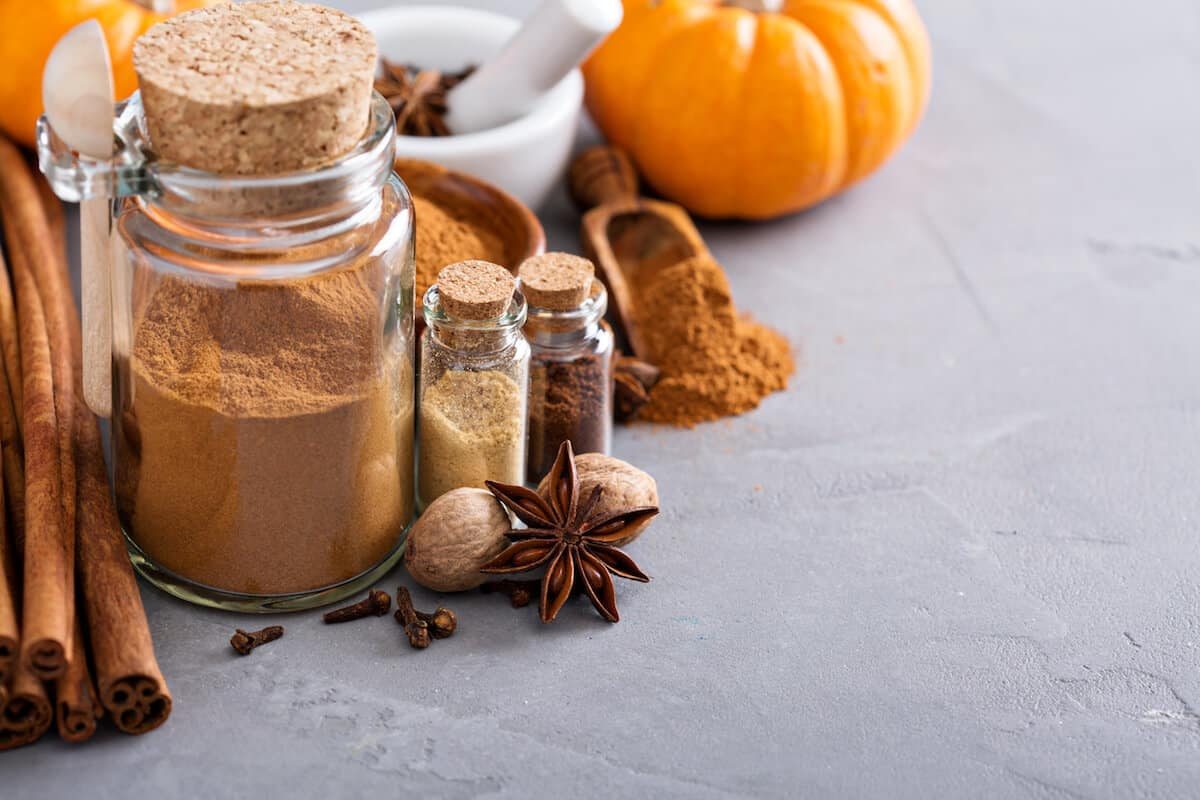
Pumpkin pie spice is a ready-mixed blend of ground baking spices, led by cinnamon, sold for pumpkin pie and now used in everything from muffins to lattes. There is no standard recipe. The best-known commercial version is four spices with no cloves; a widely shared extension recipe uses cloves and no allspice. This page shows what named sources put in it, how far back the combination really goes, how to use and make it, and the one safety point worth knowing.
At a glance
| What it is | A blend of ground sweet baking spices |
| Main ingredient | Cinnamon, listed first by McCormick and used in the largest amount by Oregon State’s recipe12 |
| Common partners | Ginger and nutmeg (in both recipes below), plus allspice or cloves12 |
| Standard recipe | None; no regulator or standards body defines it |
| Commercial since | 1934 for McCormick’s blend, by the company’s own account1 |
| Forms sold | Ground, in jars |
| Safety note | Cinnamon’s coumarin, if the cinnamon is cassia and the amounts are large and daily3 |
What’s in it: named recipes side by side
| Source | Ingredients | Proportions |
|---|---|---|
| McCormick Pumpkin Pie Spice | Cinnamon, ginger, nutmeg, allspice and sulfiting agents (label order) | Not published1 |
| Oregon State University Extension (Food Hero) | Cinnamon, ginger, nutmeg, cloves | 2 tbsp cinnamon, 1 tbsp ginger, 1 1/2 tsp nutmeg, 1 1/2 tsp cloves; makes 4 tbsp2 |
| King Arthur Baking | Described as “a carefully crafted mix of fragrant, warm spices”; no ingredient list on the product page | Not published4 |
US labels list ingredients in descending order of predominance by weight,5 so cinnamon is the largest ingredient in McCormick’s blend and ginger the second. The Oregon State recipe keeps the same order of magnitude: twice as much cinnamon as ginger, and four times as much cinnamon as either nutmeg or cloves.2
The two recipes take their clove-like note from different places: McCormick from allspice, Oregon State from cloves. Allspice is a single spice, which Britannica says is so named because its flavor resembles a combination of cinnamon, nutmeg and cloves.6 Cardamom and orange peel are sometimes said to be usual additions; none of the sources above includes them.
Flavor
Pumpkin pie spice tastes sweet, warm and woody, led by cinnamon, with ginger’s sharper bite, nutmeg’s rounder warmth, and a clove-like edge from cloves or allspice. Blends with cloves read darker and more pungent; blends with more ginger read brighter. That description is ours. In a pie, the spices give a mild, sweet custard of squash most of its character.
History: from 1796 to the latte
The spices are much older than the name. Amelia Simmons’s American Cookery, printed in Hartford in 1796, has two recipes for “pompkin” pie:7
| Recipe (Simmons, 1796) | Filling and spices |
|---|---|
| Pompkin No. 1 | Stewed, strained pumpkin with cream, eggs and sugar; spiced with mace, nutmeg and ginger, baked in a crust |
| Pompkin No. 2 | Milk, pumpkin and eggs, sweetened with molasses; spiced with allspice and ginger, baked in a crust |
Chowhound’s history of the blend calls Simmons’s book the first documented recipe to use the combination.8 Whether it was the very first we could not establish, so this page does not claim it.
The ready-mixed blend came much later. McCormick says its pumpkin pie spice has been “a McCormick original since 1934”,1 and Chowhound gives the same year.8 A widely repeated story says the name “pumpkin spice” first appeared in a 1936 Washington Post recipe and that spice companies began selling the mix in the 1950s; we could not find a source for either, and McCormick’s own date puts commercial blends at least two decades earlier.
Its second life began in coffee. Chowhound reports that pumpkin spice coffee beans appeared in the 1990s and that Starbucks introduced its Pumpkin Spice Latte in the fall of 2003, citing an interview with Starbucks’ Peter Dukes.8
How to use it
McCormick suggests its blend for gingerbread cookies, pumpkin muffins, cobblers and pies; in lattes, smoothies, coffee and hot chocolate; on roasted sweet potatoes, carrots and acorn squash; in sweet potato casserole; and in pancakes, muffins and oatmeal.1 King Arthur suggests it for pies, scones, muffins and cakes.4
For a pie recipe that lists the spices separately, King Arthur’s guidance is to use an equal amount of the blend in place of the total amount of the individual spices.4 That is the maker’s rule for its own blend; it works as a starting point for others.
Making your own
The Oregon State Extension recipe above is a published starting point: 2 tablespoons cinnamon, 1 tablespoon ginger, 1 1/2 teaspoons each nutmeg and cloves, mixed well and kept in a sealed, airtight container.2 Swap some or all of the cloves for allspice for a version closer to McCormick’s.
Buying and storage
The ingredient list is the way to compare blends. McCormick’s label also lists sulfiting agents,1 worth checking if you avoid sulfites. No regulator or standards body publishes a shelf life for ground spice blends. Common practice is to keep the jar sealed, cool and dark, and to replace it when a pinch no longer smells strongly.
Safety
The main point concerns cinnamon. Cassia cinnamon, the most common type sold in North America,9 contains much more coumarin than Ceylon cinnamon; BfR gives about 3,000 mg/kg on average for cassia.3 The European Food Safety Authority’s tolerable daily intake is 0.1 mg of coumarin per kg of body weight,10 which BfR estimates a 60 kg adult reaches with about 2 g a day of average cassia, and a 15 kg child with about 0.5 g.11 The EU limits coumarin in traditional and seasonal bakery ware labeled as containing cinnamon to 50 mg/kg.12 See Ceylon vs. cassia cinnamon.
Nutmeg can cause poisoning in large amounts, but the National Capital Poison Center says nutmeg and similar kitchen spices are not dangerous when used as recommended.13 See too much nutmeg.
Health claims
NCCIH says research does not clearly support using cinnamon for any health condition, and that it is unclear whether cinnamon supplements help with diabetes.9 For ginger, NCCIH reports that it may help with nausea and vomiting in pregnancy, but that most studies of ginger for motion sickness have not shown it to be helpful.14 Those findings concern supplements and doses far above a pinch in a pie; this page makes no health claims for the blend.
Substitutes and related pages
See pumpkin pie spice substitutes for the ranked list. The sister blend is apple pie spice. For savory pumpkin dishes, see pumpkin soup spices and pumpkin seed spices. Individual spices: cinnamon, cassia cinnamon, ginger, nutmeg, allspice, cloves and mace. If a dish has gone over, see too much cinnamon, too much clove or too much ginger.
Footnotes
-
McCormick Pumpkin Pie Spice, product page, McCormick & Company. mccormick.com · Merchant ↩ ↩2 ↩3 ↩4 ↩5 ↩6 ↩7
-
Pumpkin Pie Spice, Food Hero recipe, Oregon State University Extension Service. extension.oregonstate.edu · Reference work ↩ ↩2 ↩3 ↩4 ↩5
-
FAQ on coumarin in cinnamon and other foods, German Federal Institute for Risk Assessment (BfR). bfr.bund.de · Regulator ↩ ↩2
-
Pumpkin Pie Spice, product page, King Arthur Baking Company. shop.kingarthurbaking.com · Merchant ↩ ↩2 ↩3
-
21 CFR 101.4, Food; designation of ingredients, eCFR. ecfr.gov · Regulator ↩
-
“Allspice”, Encyclopaedia Britannica. britannica.com · Reference work ↩
-
Amelia Simmons, American Cookery, Hartford, 1796, Project Gutenberg. gutenberg.org · Reference work ↩
-
Hilary Wheelan Remley, “A Brief History Of Pumpkin Spice”, Chowhound, 2024. chowhound.com · Publication ↩ ↩2 ↩3
-
Cinnamon: Usefulness and Safety, National Center for Complementary and Integrative Health. nccih.nih.gov · Regulator ↩ ↩2
-
Coumarin in flavourings and other food ingredients with flavouring properties, EFSA, 2008. efsa.europa.eu · Regulator ↩
-
“Cassia cinnamon with high coumarin contents to be consumed in moderation”, BfR press release. bfr.bund.de · Regulator ↩
-
Regulation (EC) No 1334/2008, Annex III Part B, EUR-Lex. eur-lex.europa.eu · Regulator ↩
-
Rose Ann Gould Soloway, “Kitchen surprises and cautions”, National Capital Poison Center. poison.org · Reference work ↩
-
Ginger: Usefulness and Safety, National Center for Complementary and Integrative Health. nccih.nih.gov · Regulator ↩