Spice Fixes · Fix
Too Much Sage? How to Fix the Dish, and When It Matters
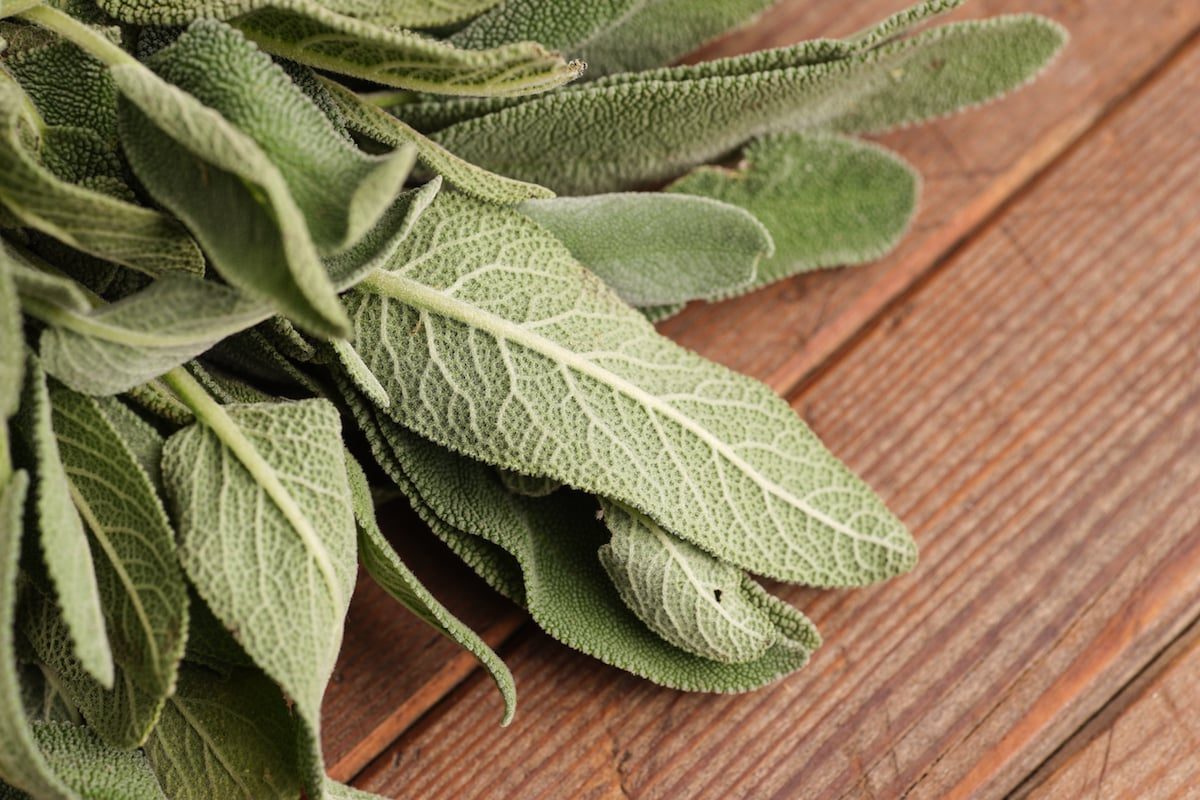
Too much sage makes a dish taste musty, camphor-like and bitter, and in stuffing or a pan sauce it can crowd out everything else. Most of the time it is a flavor problem, with the same fixes as other strong herbs. Sage also contains thujone, a compound regulators watch, so there is a short section on that below. Fastest fixes come first.
Quick answer
| What’s wrong | Fastest fix | If that’s not enough |
|---|---|---|
| Whole fresh leaves in the pot | Pull them out now | Dilute |
| Rubbed or ground sage in a soup, stew or stuffing | Add more of everything else | Make a second, sage-free batch and combine |
| Bitter edge | A pinch of sugar or a little more salt | Sweeter ingredients that suit the dish, such as onions, apple or squash |
| Bitter and acrid (sage fried too hot) | Move the food to a clean pan without scraping | Start the butter or oil over |
| Caked on the outside of meat | Scrape or wipe off the excess | Don’t rinse raw meat or poultry under the tap |
Why sage takes over
The University of Delaware’s extension guide puts sage in its group of strong or dominant flavors, with bay leaf and rosemary, and warns that an herb’s flavor “can be extremely objectionable if too much is used.”1 Dried herbs are stronger than fresh, the same guide notes, because the chemicals behind their flavor are more concentrated,1 which matters with rubbed and ground sage.
Sheer volume: too much sage for the dish
Take out what you can. Whole fresh leaves and sprigs lift out with tongs; do it before trying anything else, since they keep flavoring the pot while they stay in. Rubbed or ground sage can’t be fished out.
Don’t count on cooking it off. It is sometimes said that sage fades with a long braise. America’s Test Kitchen classes sage as a hearty herb to add early in cooking, and notes that hearty herbs’ volatile flavor compounds are more heat-stable than those of delicate herbs.2 We found no test showing that longer cooking reduces a sage overdose.
Dilute. More of everything except sage is the fix that actually lowers the dose in each bite: more bread and stock in a stuffing, more beans or vegetables in a soup, more squash in a risotto. If you can’t add to the dish, the second-batch method Tasting Table describes for too much garlic works the same way: cook a batch with no sage and combine.3 If you used twice the sage you meant to, a second batch of the same size only brings you back to about right, so be ready to make more.
Balance with other aromatics. More garlic, onion, celery or scallion, added near the end, gives the palate other strong flavors to notice. Choose ones the dish already has, and add a little at a time so you don’t trade one excess for another. This is kitchen judgment; no source we found tests aromatics against sage.
Bitter edge
If the dish has turned bitter, try sweetness or salt before acid. In controlled taste tests with pure solutions, sugar and sodium salts both suppressed bitterness, with sugar the strongest suppressor of other tastes; citric acid was the weakest.4 That was a laboratory study, not a test on food. Use just enough sweetness that the bitterness recedes without the dish tasting sweet: caramelized onion, apple in a stuffing, roasted squash, or a pinch of sugar.
Bitter and acrid: the sage scorched
Sage leaves fried in butter, or ground sage in hot fat, can go past crisp to burnt. Ground spices in general turn bitter quickly under intense heat.5 Move the food to a clean pan without scraping the bottom, which only adds burnt flavor,6 then taste. If the butter or oil itself tastes burnt and you haven’t gone far, discard it and redo that step.
Caked on the surface
Scrape or wipe excess sage off a turkey, pork roast or chicken, then re-season with other herbs. Don’t rinse raw meat or poultry under the tap: the USDA does not recommend washing raw poultry, beef, pork, lamb or veal before cooking, because rinsing raises the risk of cross-contamination.7
Is too much sage a safety problem?
Sage contains thujone. The European Medicines Agency’s herbal committee lists sage among the plants that contain it, along with cedar leaf, tansy, wormwood, thyme and rosemary, and notes that it occurs in highly variable amounts.8 α-Thujone acts on the GABA-gated chloride channel, and the main symptom of acute poisoning is convulsions.8 The EMA statement also records that views on how toxic it is have begun to differ.8
Some numbers for scale, all from that statement, which is about herbal medicines rather than cooking. The EMA estimates that average diets already supply 0.3 to 1 mg of thujone a day, proposes 6 mg a day as a limit for daily exposure, and limits thujone from sage leaf medicinal preparations to 5 mg per person a day, for no more than two weeks.8 It also advises that thujone-containing products be avoided or minimized for pregnant women and children.8
What we can’t tell you is how much thujone is in a sage-heavy stuffing: we found no measurement of thujone in cooked dishes or in a teaspoon of culinary sage, and the EMA does not address culinary use. The EMA’s caution for pregnant women and children concerns herbal medicinal products, not cooking. Sage essential oil is a different matter: the same committee concluded that its benefits do not outweigh its risks,8 and in our judgment it has no place in a home kitchen as a flavoring.
Fixes that don’t hold up
A potato to absorb it. The raw-potato trick comes from oversalted soup, and even there a Tasting Table writer who uses it calls it “more of an aid than a final answer.”9 We found no test of a potato absorbing sage or any herb. Extra potato is still dilution, so leave it in if it suits the dish.
Preventing it next time
Start lower than you would with a medium herb. The University of Delaware guide groups sage with the strong flavors and gives an amount (1 to 2 teaspoons for 6 servings) only for its medium herbs; it offers no figure for strong ones.1 So begin below that: half a teaspoon of rubbed sage for a dish serving six is a reasonable first addition, then taste after a few minutes of cooking. That starting point is ours, not a measured figure.
Mind dried versus fresh. The same guide’s rough equivalence is 3/4 to 1 teaspoon dried crumbled herb to 2 to 3 teaspoons fresh.1 More in fresh sage vs. dried sage.
Watch the heat when frying leaves. Crisp sage in butter over moderate heat and pull it as soon as it stops sizzling hard. Common practice.
Related
- Sage substitutes
- Cooking with sage
- Poultry seasoning
- Rosemary vs. sage
- Too much rosemary
- Too much thyme
Footnotes
-
Using Herbs and Spices, University of Delaware Cooperative Extension, 2025. udel.edu · Reference work ↩ ↩2 ↩3 ↩4
-
Our Guide to Fresh Herbs, Liz Bomze, America’s Test Kitchen, 2019. americastestkitchen.com · Publication ↩
-
Simple Ways To Tone Down The Pungency Of Garlic, Harmony Colangelo, Tasting Table, 2023. tastingtable.com · Publication ↩
-
Green BG et al., Taste Mixture Interactions: Suppression, Additivity, and the Predominance of Sweetness, Physiology & Behavior, 2010. pmc.ncbi.nlm.nih.gov · Peer-reviewed ↩
-
How To Improvise Instant Pot Seasoning Without Burning Your Spices, Marco Rossi, Tasting Table, 2023. tastingtable.com · Publication ↩
-
What To Do With Burnt Soup, Karen Greco, Tasting Table, 2022. tastingtable.com · Publication ↩
-
Washing Food: Does it Promote Food Safety?, USDA Food Safety and Inspection Service. fsis.usda.gov · Regulator ↩
-
Public statement on the use of herbal medicinal products containing thujone, European Medicines Agency, HMPC, 2012. ema.europa.eu · Regulator ↩ ↩2 ↩3 ↩4 ↩5 ↩6
-
How To Fix An Oversalted Soup, Alison Spiegel, Tasting Table, 2016. tastingtable.com · Publication ↩