Spice Comparisons · Comparison
Fresh Sage vs. Dried Sage: Flavor, Forms and How Much to Use
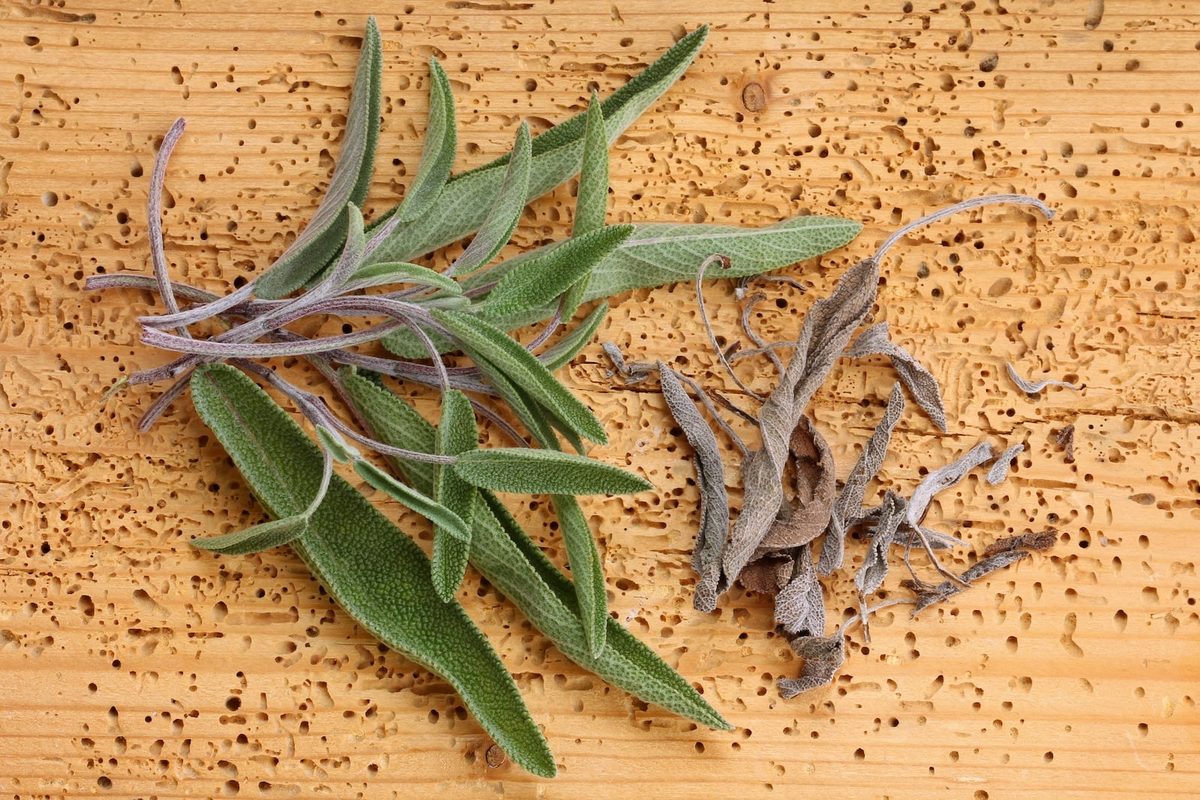
Fresh and dried sage are the same plant, the leaf of Salvia officinalis, a mint-family herb native from southwestern Germany to southern Europe.1 The real differences are strength, texture and timing. Sage is one of the herbs that survives drying reasonably well,2 but drying changes the balance of its aroma compounds,3 and the published fresh-to-dried conversions disagree by a factor of two.
Side by side
| Fresh sage | Dried sage | |
|---|---|---|
| Plant | Salvia officinalis, family Lamiaceae1 | Same plant, dried leaf1 |
| Forms | Whole leaves | Rubbed (leaves rubbed into a coarse, fluffy flake) or ground to a fine powder4 |
| Key aroma compounds | PROSEA credits sage’s strong, characteristic smell to the thujones5 | Same oil, but in one study camphor’s share rose under every drying method and α-thujone’s fell3 |
| Strength | Milder (general herb rule)6 | The University of Delaware says dried herbs are stronger than fresh6 |
| In long cooking | America’s Test Kitchen classes sage as a hearty herb, to add early7 | Fared reasonably well in tests with more than 20 minutes of cooking and plenty of liquid2 |
| Flavor (editorial) | Softer, greener, a little lemony | More concentrated and musky, with a resinous edge |
| Storage | Refrigerate in its packaging or an open zipper-lock bag7 | Airtight, dark, cool; one extension service gives 1 year for ground spices and herbs8 |
| Typical uses | Leaves fried in butter, wrapped around meat, or chopped into sauces (common practice) | Sausages, stuffings and soups,5 and poultry seasoning blends9 |
What drying does to sage
Sage is on America’s Test Kitchen’s short list of herbs worth keeping dried, alongside oregano, thyme, rosemary and marjoram.10 In its side-by-side tests, dried sage, rosemary and thyme fared reasonably well in recipes with fairly long cooking times (more than 20 minutes) and a good amount of liquid, though tasters still preferred fresh herbs in all but one application.2
Two lab studies show what happens to the oil:
- Gentle drying loses little. A 1997 study compared fresh sage and thyme with freeze-dried and oven-dried samples. The amount of extracted volatiles fell significantly only when the herbs were dried at 60°C, mainly through the loss of non-oxygenated monoterpenes.11
- Drying shifts the balance. A 2012 study dried sage six ways, from shade drying at room temperature to oven, infrared and microwave drying. Camphor’s share of the oil rose under every method, from 20.22% in fresh leaves to as much as 46.33%, while α-thujone’s share fell.3 Heat cost the most oil: the authors report oil-yield losses as high as 92.3% when the drying temperature rose by 20°C.3
No study we found measured how those shifts taste. A common claim is that drying makes sage slightly bitter; we found no source that tests it.
Rubbed or ground? Rubbed sage is made by rubbing the dried leaves together, and A Couple Cooks prefers it for flavor.4 Ground sage packs more leaf into a spoon: the Spice House says 1 teaspoon of rubbed sage is about 1/2 teaspoon of ground.12 It is often said that powdered sage fades faster once opened. That fits general extension advice that ground spices keep for a shorter time than whole ones,8 but no sage-specific measurement was found.
Can one stand in for the other?
Yes, as long as you change the amount. The sources disagree on how much.
Fresh to dried (Disputed):
| Source | Fresh | Dried or rubbed | Ground |
|---|---|---|---|
| The Spice House (sage) | 1 tablespoon | 1/2 teaspoon dried12 | not given |
| A Couple Cooks (sage) | 1 tablespoon chopped, or 8 large or 12 medium leaves | 1 teaspoon rubbed4 | not given |
| University of Delaware (all herbs) | 2 to 3 teaspoons | 3/4 to 1 teaspoon crumbled6 | not given |
| LSU AgCenter (all herbs) | 1 tablespoon, finely cut | 1 teaspoon crumbled13 | not given |
| NDSU Extension (all herbs) | 1 tablespoon | 1 teaspoon | 1/2 teaspoon14 |
| Penn State Extension (all herbs) | 1 tablespoon | 1 teaspoon | 1/4 teaspoon15 |
| America’s Test Kitchen (tested, several herbs) | 3 parts | 1 part2 | not given |
America’s Test Kitchen’s 1:3 is the only figure here that came from a tasting; it found that ratio came closest to equal flavor strength.2 The extension figures are general herb rules, and the two sage-specific figures differ from each other. Our Method starting point: 1/2 teaspoon of rubbed sage per tablespoon of chopped fresh, tasted once the dish has cooked a while, working up toward 1 teaspoon. For ground sage, start at 1/4 teaspoon.
A sprig (Attributed): when a recipe calls for a sprig, the Spice House suggests about 1/2 teaspoon of dried sage.12
Timing. America’s Test Kitchen says to add hearty herbs such as sage early in cooking.7 The University of Delaware’s general advice for long-simmered dishes is to add herbs during the last 45 minutes, and to crush dried herbs first to release some of their oils.6
When to use which
- Fresh where the leaf is the point: fried in brown butter for pasta or gnocchi, laid on meat, or chopped into a quick pan sauce. This is common practice and our judgment, not a sourced rule.
- Dried in long-cooked, liquid-rich dishes, which is where it held up in testing,2 and in the jobs sage is best known for: sausages, stuffings and soups.5 Many poultry seasonings already contain it. McCormick Culinary’s lists thyme, sage, marjoram, rosemary, black pepper and nutmeg,9 and US labels list ingredients by weight, largest first,16 so that blend has more thyme than sage.
What isn’t known
- No source we found has measured fresh against dried sage for flavor strength. Every conversion above is a rule of thumb apart from America’s Test Kitchen’s tasting, which covered several herbs rather than sage alone.
- How long fresh sage lasts in the refrigerator: the week often quoted has no traceable source.
- Whether drying makes sage more bitter. The oil chemistry changes;3 the taste has not been tested.
Related
- Sage, sage substitutes and too much sage
- Dried herbs vs. fresh: the general rules for every herb
- How to dry sage, how to store sage, cooking with sage and sage uses
- Fresh thyme vs. dried, dried rosemary vs. fresh and rosemary vs. sage
Footnotes
-
Salvia officinalis L., Plants of the World Online, Royal Botanic Gardens, Kew. powo.science.kew.org · Reference work ↩ ↩2 ↩3
-
“Science: Substituting Dried Herbs for Fresh”, America’s Test Kitchen. americastestkitchen.com · Publication ↩ ↩2 ↩3 ↩4 ↩5 ↩6
-
Hamrouni Sellami et al., “Drying sage (Salvia officinalis L.) plants and its effects on content, chemical composition, and radical scavenging activity of the essential oil”, Food and Bioprocess Technology, 2012. humboldt-reloaded.uni-hohenheim.de · Peer-reviewed ↩ ↩2 ↩3 ↩4 ↩5
-
Sonja Overhiser, “Best Sage Substitute”, A Couple Cooks, 2026. acouplecooks.com · Publication ↩ ↩2 ↩3
-
U.A. Dasuki, Salvia officinalis, Plant Resources of South-East Asia (PROSEA). uses.plantnet-project.org · Reference work ↩ ↩2 ↩3
-
“Using Herbs and Spices”, University of Delaware Cooperative Extension, 2025. udel.edu · Reference work ↩ ↩2 ↩3 ↩4
-
Liz Bomze, “Our Guide to Fresh Herbs”, America’s Test Kitchen, 2019. americastestkitchen.com · Publication ↩ ↩2 ↩3
-
Anna Martin, “Add a Little Spice to Your Life! Part II”, University of California Cooperative Extension, 2002. ucanr.edu · Reference work ↩ ↩2
-
McCormick Culinary Poultry Seasoning, product page, McCormick & Company. mccormick.com · Merchant ↩ ↩2
-
Danielle Lapierre, “When You Should Actually Use Dried Herbs (and Which Ones to Avoid)”, America’s Test Kitchen, 2022. americastestkitchen.com · Publication ↩
-
Venskutonis, “Effect of drying on the volatile constituents of thyme and sage”, Food Chemistry, 1997 (abstract). agris.fao.org · Peer-reviewed ↩
-
“Sage Substitute”, The Spice House, 2017. thespicehouse.com · Merchant ↩ ↩2 ↩3
-
“Flavorful Herbs”, LSU AgCenter. lsuagcenter.com · Reference work ↩
-
Julie Garden-Robinson, Ingredient Substitutions (FN198), NDSU Extension, 2018. ksre.ksu.edu · Reference work ↩
-
Stacy Reed, “Preserving Herbs by Drying”, Penn State Extension, 2024. extension.psu.edu · Reference work ↩
-
21 CFR 101.4, Food; designation of ingredients, US Food and Drug Administration. ecfr.gov · Regulator ↩