Spices · Profile
Poultry Seasoning: What’s in It, Where It Came From and How to Use It
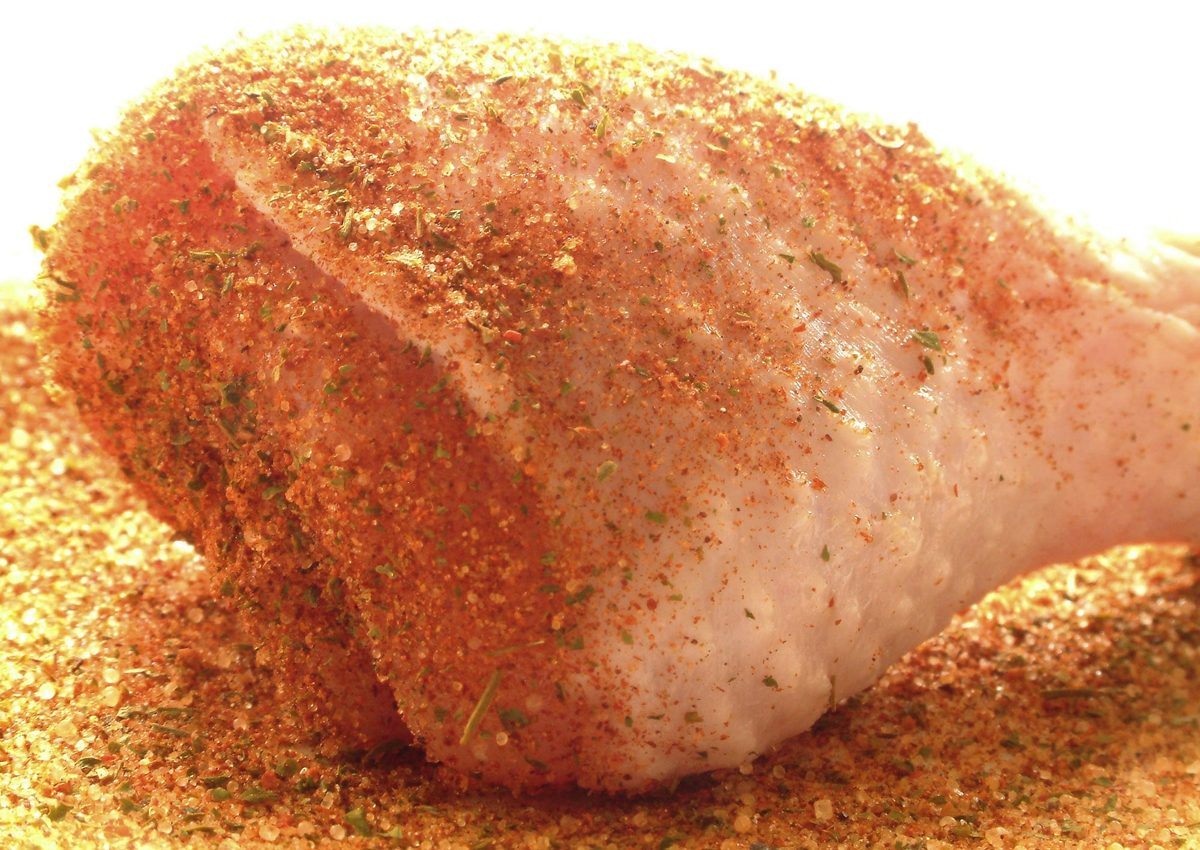
Poultry seasoning is a ready-mixed blend of dried savory herbs, built around sage and thyme, that American cooks reach for when roasting turkey or making stuffing. There is no standard recipe: each maker chooses its own herbs, and the two best-known commercial versions share only three of them. This page shows what named makers put in theirs, where the oldest brand came from, the chemistry behind the flavor, and how to use and make it.
At a glance
| What it is | A blend of dried herbs and a little spice |
| Core herbs | Sage, thyme and marjoram, in both blends checked below12 |
| Salt | None listed in either blend checked12 |
| Standard recipe | None; no regulator or standards body defines it |
| Oldest brand | Bell’s Seasoning, dated to 186723 |
| Forms sold | Dried and ground or rubbed, in jars, tins and boxes |
| Safety note | Sage contains thujone; a concern for concentrated products, not cooking amounts45 |
What’s in it: named blends side by side
| Blend | Ingredients as given | Source |
|---|---|---|
| McCormick Culinary Poultry Seasoning | Thyme, sage, marjoram, rosemary, black pepper, nutmeg (label order) | 1 |
| Bell’s Seasoning | Rosemary, oregano, sage, ginger, marjoram, thyme and pepper; described as salt-free | 2 |
| Food Network Kitchen (homemade, dried) | Sage, thyme, celery seed, marjoram, black pepper, nutmeg, optional cayenne | 6 |
| Saveur (homemade, fresh herbs) | Thyme, rosemary, sage, marjoram, black pepper, celery seed, nutmeg, ginger, smoked paprika | 7 |
US labels list ingredients in descending order of predominance by weight,8 so McCormick’s blend contains more thyme than sage. The Bell’s list comes from a magazine’s description rather than the package, so its order may not reflect proportions. Oregano appears only in Bell’s among these four, and celery seed only in the two homemade versions.
Flavor and the compounds behind it
Poultry seasoning tastes green, woody and resinous, with sage’s slightly bitter, camphor-like edge and thyme’s sharper, savory warmth; pepper and nutmeg sit in the background. That description is ours, and the balance shifts from brand to brand.
Two compounds account for much of it. PROSEA attributes sage’s strong characteristic smell to its thujones,9 and names thymol and carvacrol as the characteristic constituents of thyme oil.10 For more on each herb, see sage, thyme, marjoram and rosemary.
History: Bell’s Seasoning
The earliest poultry seasoning we could document is Bell’s. According to Hagley Museum and Library, William G. Bell (1839 to 1915), a grocer who moved from Lowell, Massachusetts, to Boston, developed his own seasoning blend in 1867 and began selling it in the city.3 Yankee Magazine gives the same year but describes Bell as “of Newton, Massachusetts” and says he made the blend from an old family recipe.2 After Bell’s death, D & L Slade Company bought the rights and distributed the blend into the mid-twentieth century.3
Yankee notes that the blend appeared four years after President Lincoln declared Thanksgiving a federal holiday in 1863.2 Hagley reports that Bell’s claims to be the oldest seasoning blend in the country;3 that is the company’s claim, and we found no independent study of which American poultry blend came first. Bell’s is still sold, and Yankee points readers to the company’s own online store.2
How to use it
PROSEA lists stuffings and sausages among sage’s main uses as a spice,9 and that is where poultry seasoning does its best-known work: in bread stuffing and dressing, rubbed onto turkey and chicken, and in turkey or pork sausage. Beyond the bird, it suits chicken soup, gravy, pot pie, roast pork and roasted root vegetables; that is cooking judgment, not a sourced list.
Because the dried herbs are strong and slightly bitter, add a little, taste, and add more; long cooking in a stuffing softens them. Poultry seasoning contains no animal products in any of the blends above, so it suits vegetarian and vegan cooking despite the name.12
Making your own
Two published recipes give a starting point, quoted as their authors’ and not tested here:
| Source | Recipe | Yield and storage |
|---|---|---|
| Food Network Kitchen | 1/4 cup dried sage, 1/4 cup dried thyme, 2 tbsp celery seed, 2 tbsp dried marjoram, 1 tsp black pepper, 1/4 tsp nutmeg, 1/4 tsp cayenne (optional) | About 3/4 cup; airtight container for up to 6 months6 |
| Saveur | 3 tbsp each chopped fresh thyme, rosemary and sage; 1 tbsp fresh marjoram; 1/2 tbsp black pepper; 1 tsp each celery seed, nutmeg, ground ginger and smoked paprika | About 1/2 cup; refrigerated for about 3 days7 |
Buying and storage
The ingredient list is the way to compare blends: decide whether you want rosemary, oregano or ginger in yours. No regulator or standards body publishes a shelf life for dried herb blends; Food Network Kitchen’s 6-month figure applies to its own homemade mix.6 Common practice is to keep the blend sealed, cool and dark, and to replace it when a rubbed pinch no longer smells strongly of sage.
Safety
Sage contains thujone. NCCIH says sage is likely safe in the amounts used in food, but that high doses or long-term use may be unsafe because of thujone, and that sage may be unsafe during pregnancy for the same reason.4 The European Medicines Agency estimates that ordinary diets already supply about 0.3 to 1 mg of thujone a day and set limits for herbal medicines, not for seasoning food.5 A spoonful of poultry seasoning in a stuffing is a cooking amount.
Health claims
NCCIH notes that only small amounts of research have been done on sage, with limited evidence for any health use.4 We found no study of poultry seasoning itself, and this page makes no health claims for it.
Substitutes and related pages
For stand-ins, see poultry seasoning substitutes. Related pages: spices for turkey, good stuffing spices, turkey gravy spices, good spices for chicken and spices for chicken soup. Similar herb blends: Italian seasoning and herbes de Provence. If a dish has too much sage or thyme, see too much sage and too much thyme.
Footnotes
-
Poultry Seasoning, 12 oz, McCormick Culinary, McCormick & Company. mccormick.com · Merchant ↩ ↩2 ↩3 ↩4
-
Aimee Tucker, “Bell’s Seasoning: A New England Thanksgiving Classic”, Yankee Magazine, 2021. newengland.com · Publication ↩ ↩2 ↩3 ↩4 ↩5 ↩6 ↩7 ↩8
-
Chris Cascio, “A Seasoning for the Holiday Season”, Hagley Museum and Library, 2025. hagley.org · Reference work ↩ ↩2 ↩3 ↩4
-
Sage, National Center for Complementary and Integrative Health. nccih.nih.gov · Regulator ↩ ↩2 ↩3
-
Public statement on the use of herbal medicinal products containing thujone, European Medicines Agency, 2012. ema.europa.eu · Regulator ↩ ↩2
-
Homemade Poultry Seasoning, Food Network Kitchen, Food Network. foodnetwork.com · Publication ↩ ↩2 ↩3
-
Homemade Fresh Poultry Seasoning, Saveur, 2014. saveur.com · Publication ↩ ↩2
-
21 CFR 101.4, Food; designation of ingredients, eCFR. ecfr.gov · Regulator ↩
-
U.A. Dasuki, Salvia officinalis (PROSEA), via Pl@ntUse. uses.plantnet-project.org · Reference work ↩ ↩2
-
S.H. Widodo, Thymus vulgaris (PROSEA), via Pl@ntUse. uses.plantnet-project.org · Reference work ↩