Cooking · Cooking with
Cooking With Sage: Timing, Amounts, Brown Butter, Stuffing and Safety
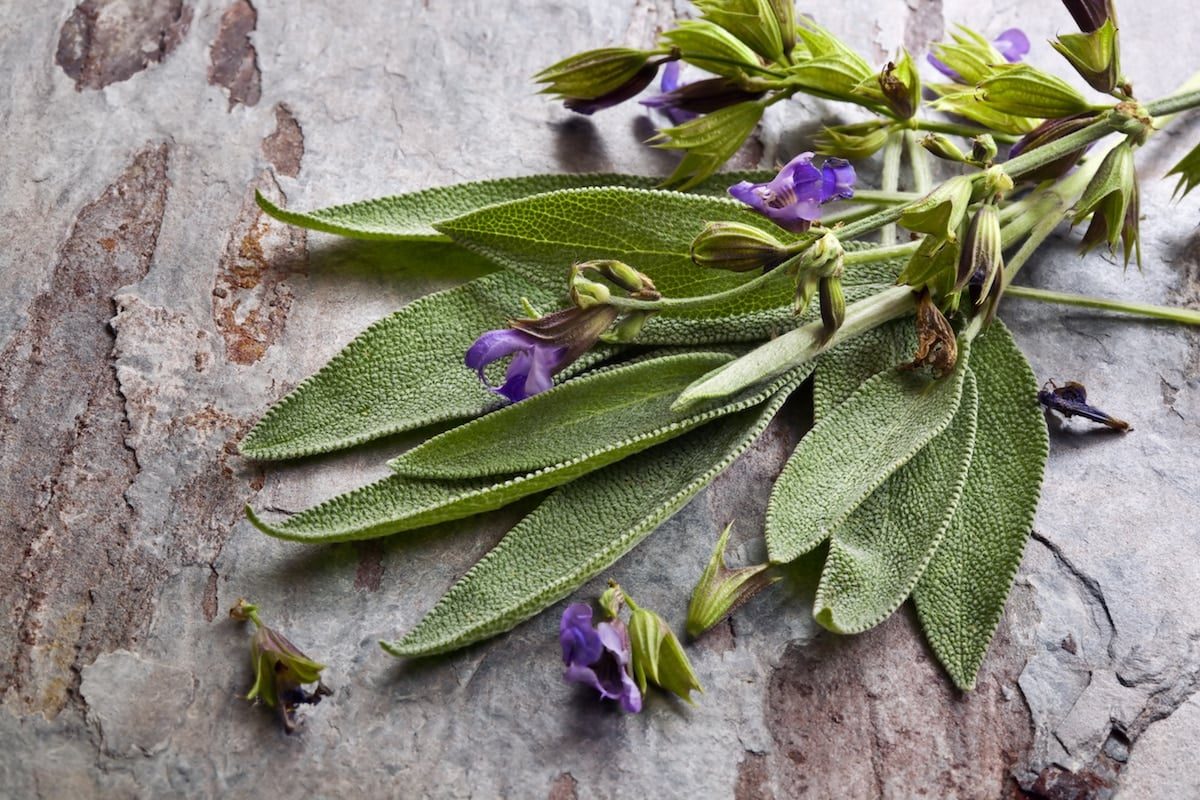
Sage is a strong, slightly bitter herb of the mint family, best known as a seasoning for stuffing and sausage.123 It rewards a light hand: the University of Delaware’s extension guide ranks it with rosemary and bay leaf among the strongest herbs and warns that too much is “extremely objectionable.”4 This page covers when to add it, how much to use, the techniques and dishes that suit it from named recipes, how to keep it, and the one safety point that matters. For the plant and its chemistry, see sage.
At a glance
| Question | Short answer |
|---|---|
| Hearty or delicate? | Hearty: America’s Test Kitchen adds it early in cooking5 |
| Fresh or dried? | Both; dried sage did reasonably well in ATK’s tests of dishes cooked over 20 minutes in liquid6 |
| Fresh-to-dried ratio | 3 parts fresh to 1 part dried, by volume6 |
| Strength | Among the strongest herbs, per the University of Delaware4 |
| Classic uses | Stuffing, sausage, saltimbocca, brown butter sauce2783 |
| Safety | Likely safe in food amounts; may be unsafe in pregnancy in larger amounts because of thujone9 |
How much to use
PROSEA describes sage as combining a nice aroma with a unique bitter and pungent taste.2 The University of Delaware puts it in its strong or dominant group, alongside bay leaf, rosemary and others, and warns that the flavor can be extremely objectionable if too much is used.4 Start small, especially with dried or ground sage, and add more after tasting. Named recipes give a sense of scale (Attributed):
| Dish | Sage | Source |
|---|---|---|
| Saltimbocca alla romana | 16 to 24 fresh sage leaves for the recipe | Saveur7 |
| Brown butter sage sauce | 14 sage leaves to 1/2 cup (112 g) butter | Alida Ryder, Simply Delicious8 |
| Bread stuffing | Lightly seasoned, with sage and thyme the dominant herbs (no amount quoted here) | Yankee Magazine3 |
If a dish has gone over, see too much sage.
When to add it
Sources differ, and none tested sage on its own:
| Source | Advice |
|---|---|
| America’s Test Kitchen | Sage is a hearty herb to add early; hearty herbs’ volatile flavor compounds are somewhat more heat-stable5 |
| University of Delaware | For long simmering, add herbs during the last 45 minutes4 |
| LSU AgCenter | As a general rule, add fresh herbs near the end of cooking or just before serving10 |
A common rule says to add dried sage at the start and fresh sage near the end. That is one way to reconcile the sources above, not a tested finding. In practice, sage in a stuffing, braise or sausage mixture goes in early and cooks through; sage used as a garnish or in a quick butter sauce goes in at the end.
Fresh vs. dried
The University of Delaware notes that dried herbs are stronger than fresh.4 America’s Test Kitchen found 1 part dried herb to 3 parts fresh gave the closest match.6 Sage was one of the herbs that held up reasonably well dried in dishes cooked more than 20 minutes with plenty of liquid.6 Another ATK guide lists sage among herbs that work just fine dried in moist preparations.11 For more, see fresh sage vs. dried sage.
Fresh sage is the better choice where the leaf is seen or fried. Raw sage is rarely eaten on its own; many cooks find raw leaves fuzzy and harsh in a salad, which is a matter of taste rather than a sourced finding.
Techniques and dishes
Brown butter and fried sage
Alida Ryder’s brown butter sage sauce cooks 1/2 cup of butter over medium heat until it smells nutty and toasty, then adds the leaves in a single layer, where they sizzle and crisp in about 30 to 60 seconds.8 The leaves are done when the edges curl slightly and they turn crisp and translucent.8 Ryder’s reasons for the details: dry the leaves, because any moisture makes the hot butter splutter, and don’t crowd the pan, because overcrowded leaves steam rather than crisp.8 The sauce goes over pasta, gnocchi or squash; fried leaves also make a garnish (our judgment).
Saltimbocca
Saveur calls saltimbocca alla romana a mainstay at trattorias throughout Rome, built on just three main ingredients.7 Its recipe uses 16 to 24 fresh sage leaves.7 Fresh leaves are the form to use here (our judgment).
Stuffing and poultry
Yankee Magazine’s bread stuffing is quite lightly seasoned, with sage and thyme the dominant herbs.3 McCormick’s poultry seasoning blends thyme, sage, marjoram, rosemary, black pepper and nutmeg.12 If stuffing cooks inside a bird, the USDA says it must reach a safe minimum internal temperature of 165°F, and for optimal safety and uniform doneness recommends cooking stuffing separately.13 See good stuffing spices and poultry seasoning.
Sausages and pork
PROSEA lists sausages, stuffings, soups and canned vegetables among the uses of dried sage.2 A widely repeated claim ties sage specifically to German pork sausages; we found no source for that. Sage’s fit with pork and other fatty meats is long-standing cooking practice, but the idea that it aids digestion or “cuts” fat is not supported by any source we found, and this page makes no such claim.
Dairy and cheese
PROSEA records fresh sage leaves in herb butters, cheeses, liqueurs, pickles, salads and vinegars.2 The best-known cheese is Sage Derby. Belton Farm, which makes it, describes a smooth, creamy Derby cheese marbled with a delicate sage infusion, and says production is believed to have started in the 17th century, when sage was added for its supposed medicinal properties.14 That history is the maker’s own account. Sage butter, a compound butter of softened butter and chopped fresh sage, fits PROSEA’s herb-butter use.
Pairings
Thyme, rosemary, marjoram and black pepper are sage’s partners in poultry seasoning,12 and thyme in stuffing.3 Garlic, onion, bay leaf, browned butter and squash are other classic partners; beyond the blends and recipes above, that is cooking judgment. See rosemary vs. sage and sage vs. lavender.
Buying and preparing fresh sage
Choose sprigs with firm, evenly colored leaves and no dark or slimy patches (our judgment). The Government of Canada advises storing fresh herbs unwashed and rinsing them under cool running water before use.15 America’s Test Kitchen notes that hearty herbs don’t harbor much grit and need only a quick rinse if dusty.5 Pat the leaves dry, especially before frying (see Ryder above).8 Pull the leaves off the stems, then slice them into thin ribbons or chop them.
Keeping sage
Fresh. ATK stores hearty herbs dry, in their original packaging or an open zipper-lock bag, in the refrigerator.5 See how to store sage.
Frozen. Penn State Extension’s ice-cube method uses about a tablespoon of chopped herbs per section of a half-filled tray, and frozen herbs can be used in the same proportion as fresh.16
Dried. For mint, sage or bay leaf, NCHFP describes drying the leaves separately as an especially nice method.17 See how to dry sage.
Sage vinegar. Colorado State University Extension lists sage among the fresh herbs for flavored vinegar, at 3 to 4 sprigs per pint with vinegar heated to just below boiling.18 It keeps up to three months in a cool, dark place or six to eight months refrigerated.18
Sage honey. Infusing honey with sage is often suggested. We found no tested method or storage guidance, so this page gives none.
Safety
The National Center for Complementary and Integrative Health says sage is likely safe in the amounts commonly found in foods.9 It also says sage may be unsafe during pregnancy because of its thujone content.9 A widely repeated claim says sage causes uterine contractions; NCCIH’s stated concern is thujone, and we found no source for the contraction claim. The European Medicines Agency advises that thujone exposure be avoided or minimized for groups such as pregnant women and children, and concluded that the benefits of sage essential oil do not outweigh its risks.19 The practical line for cooks is between ordinary seasoning amounts of the leaf and concentrated products such as sage oil. More detail is on the sage profile.
If you have none
Poultry seasoning, thyme and marjoram can cover parts of sage’s role. See sage substitutes and sage uses.
Footnotes
-
Salvia officinalis L., Plants of the World Online, Royal Botanic Gardens, Kew. powo.science.kew.org · Reference work ↩
-
U.A. Dasuki, “Salvia officinalis”, PROSEA, via Pl@ntUse. uses.plantnet-project.org · Reference work ↩ ↩2 ↩3 ↩4 ↩5
-
“Bread Stuffing”, Yankee Magazine, 2007. newengland.com · Publication ↩ ↩2 ↩3 ↩4 ↩5
-
“Using Herbs and Spices”, University of Delaware Cooperative Extension, 2025. udel.edu · Reference work ↩ ↩2 ↩3 ↩4 ↩5
-
Liz Bomze, “Our Guide to Fresh Herbs”, America’s Test Kitchen, 2019. americastestkitchen.com · Publication ↩ ↩2 ↩3 ↩4
-
“Science: Substituting Dried Herbs for Fresh”, America’s Test Kitchen. americastestkitchen.com · Publication ↩ ↩2 ↩3 ↩4
-
“Veal Saltimbocca (Saltimbocca alla Romana)”, Saveur, 2019. saveur.com · Publication ↩ ↩2 ↩3 ↩4
-
Alida Ryder, “Brown Butter Sage Sauce”, Simply Delicious, 2026. simply-delicious-food.com · Publication ↩ ↩2 ↩3 ↩4 ↩5 ↩6
-
“Sage”, National Center for Complementary and Integrative Health, 2025. nccih.nih.gov · Regulator ↩ ↩2 ↩3
-
“Flavorful Herbs”, LSU AgCenter. lsuagcenter.com · Reference work ↩
-
“Using Dried Herbs”, America’s Test Kitchen. americastestkitchen.com · Publication ↩
-
Poultry Seasoning, McCormick Culinary. mccormick.com · Merchant ↩ ↩2
-
“Stuffing and Food Safety”, USDA Food Safety and Inspection Service. fsis.usda.gov · Regulator ↩
-
“Under the Spotlight: Sage Derby”, Belton Farm, 2018. beltonfarm.co.uk · Merchant ↩
-
“Food safety tips for fresh herbs”, Government of Canada, 2013. oc4h.ucanr.edu · Regulator ↩
-
Martha Zepp, “Freezing Herbs”, Penn State Extension, 2025. extension.psu.edu · Reference work ↩
-
“Drying Herbs”, National Center for Home Food Preservation. nchfp.uga.edu · Reference work ↩
-
“Making Flavored Vinegar”, Fact Sheet 9.340, Colorado State University Extension, 2021. foodsmartcolorado.colostate.edu · Reference work ↩ ↩2
-
“Public statement on the use of herbal medicinal products containing thujone”, European Medicines Agency. ema.europa.eu · Regulator ↩