Herbs · Profile
Sage (Salvia officinalis): Flavor, Thujone, Uses and What the Evidence Says
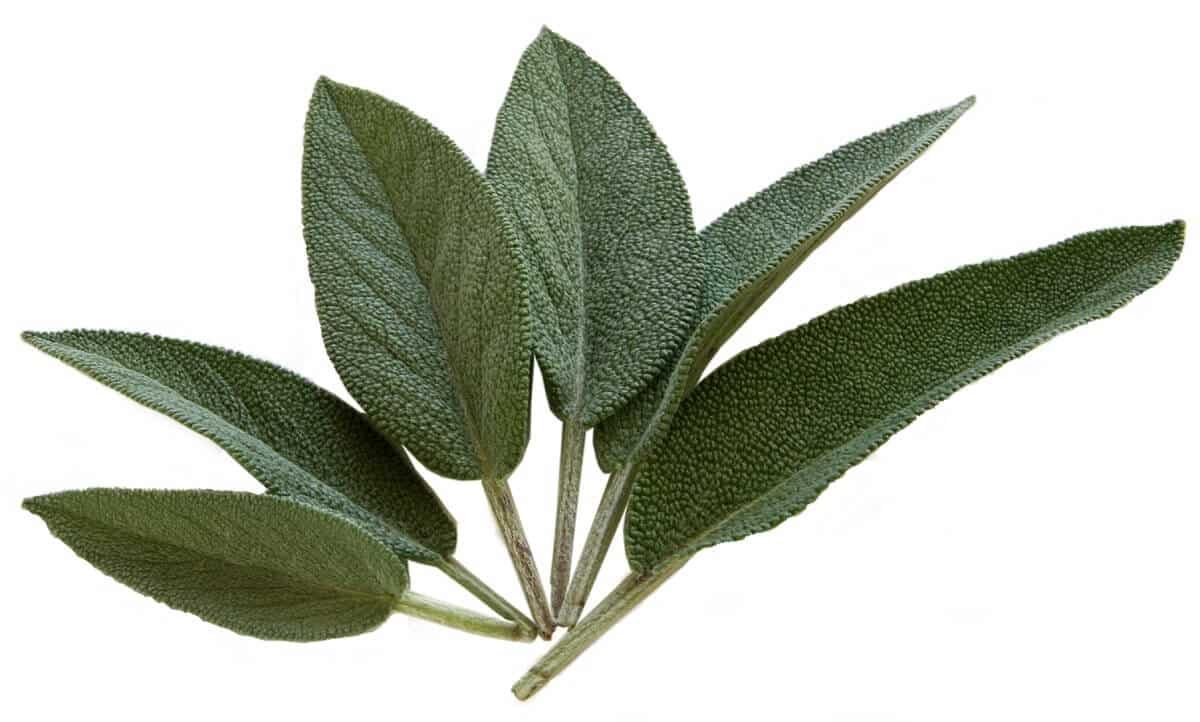
Sage is the leaf of Salvia officinalis, a gray-leaved subshrub from southern Europe, and the herb behind the flavor of many sausages and stuffings.12 It is strong, bitter and camphor-scented, and its essential oil is led by thujones, compounds the European Medicines Agency limits in herbal medicines.23 This page covers what sage is, the chemistry of its flavor, where it comes from, how it is used, and what the health evidence and safety advice actually say.
At a glance
| Botanical name | Salvia officinalis L. (common sage)14 |
| Plant family | Lamiaceae (mint family)1 |
| Part used | Leaves, fresh or dried2 |
| Native range | Southwestern Germany to southern Europe per Kew; the Adriatic Balkans per PROSEA (see Origin)12 |
| Main producers | The Balkan region along the Adriatic, per PROSEA (trade figures from the late 1980s)2 |
| Key aroma compounds | α-thujone, β-thujone, 1,8-cineole, camphor2 |
| Essential oil in dried leaf | Up to 2.5%, depending on origin and harvest2 |
| Forms sold | Fresh leaves, dried whole or rubbed, ground; also essential oil and oleoresin2 |
Measured values
10 figures, sourced| Measure | Value | Scope | Source |
|---|---|---|---|
| Essential oil | up to 2.5 % of dried leaf | Dried leaves, depending on origin, growing conditions and harvest (PROSEA) | uses.plantnet-project.org |
| α-Thujone | 22.8 % of essential oil | One Spanish sage oil, as reported by PROSEA | uses.plantnet-project.org |
| β-Thujone | 4.3 % of essential oil | One Spanish sage oil, as reported by PROSEA | uses.plantnet-project.org |
| 1,8-Cineole | 15.7 % of essential oil | One Spanish sage oil, as reported by PROSEA | uses.plantnet-project.org |
| Camphor | 5.0 % of essential oil | One Spanish sage oil, as reported by PROSEA | uses.plantnet-project.org |
| α-Thujone | 23.0 % of essential oil | One Italian sage oil, as reported by PROSEA | uses.plantnet-project.org |
| β-Thujone | 26.9 % of essential oil | One Italian sage oil, as reported by PROSEA | uses.plantnet-project.org |
| 1,8-Cineole | 11.8 % of essential oil | One Italian sage oil, as reported by PROSEA | uses.plantnet-project.org |
| Stems (adulterant), maximum Limit | 10 % | Traded dried sage, per PROSEA | uses.plantnet-project.org |
| Pyrrolizidine alkaloids, maximum Limit | 400 µg/kg | EU Regulation 2023/915, dried herbs (covers dried sage, not among the named exceptions) | eur-lex.europa.eu |
Each figure is quoted as its source states it, with the samples or standard it applies to. Where sources differ, both are shown; nothing is averaged. All measured values
What sage is
Common sage is a perennial subshrub, erect or sprawling, 40–70 cm tall.2 Its leaves are opposite and oblong to elliptical, and its flowers, borne in tiers along the stem, are violet-blue, pink or white.2
One sage among a thousand
Salvia is a very large genus: Kew’s Plants of the World Online counts 1,041 accepted species.5 That total now includes rosemary, which Kew accepts as Salvia rosmarinus.6 Only a few sages are used as culinary herbs. The FDA’s list of spices generally recognized as safe includes common sage and has a separate entry for Greek sage.7 Its list of GRAS essential oils adds Spanish sage, Salvia lavandulaefolia.8 NCCIH treats common sage and Spanish sage as two different species, both Mediterranean shrubs.4 For a sweet, fruity relative grown mostly in gardens, see pineapple sage.
Flavor and aroma
Sage tastes savory, bitter and astringent, with a strong camphor and pine-resin smell; that description is ours. PROSEA attributes sage’s strong characteristic smell to the thujones.2
The compounds
Dried sage leaves yield up to 2.5% essential oil, with the amount depending on where and how the plant was grown and when it was harvested.2 The main components are α-thujone, β-thujone, 1,8-cineole and camphor, but their balance shifts from source to source:2
| Scope | α-thujone | β-thujone | 1,8-cineole | Camphor | Source |
|---|---|---|---|---|---|
| One Spanish sage oil, as reported by PROSEA | 22.8% | 4.3% | 15.7% | 5.0% | 2 |
| One Italian sage oil, as reported by PROSEA | 23.0% | 26.9% | 11.8% | not given | 2 |
These are two oils from two places, not a range for all sage. The figures should not be averaged or applied to a jar of dried leaf.
Fresh vs. dried
The University of Delaware’s extension guide notes that dried herbs are stronger than fresh, and equates 3/4 to 1 teaspoon of crumbled dried herb with 2 to 3 teaspoons of fresh.9 That is a general herb rule. See fresh sage vs. dried sage.
Origin and production
The references disagree on where sage is native. Kew gives southwestern Germany to southern Europe, listing Albania, France, Germany, Greece, Italy, the northwestern Balkans, Spain and Switzerland.1 PROSEA places it in the Adriatic belt of the Balkan peninsula: Greece, Albania and the former Yugoslavia.2 NCCIH describes common sage as native to the Mediterranean region and the Middle East.4 Kew is the botanical authority, but the three do not draw the same map. Sage has since been introduced far more widely; Kew’s introduced range includes many US states, Ontario, Québec and Korea.1
PROSEA names the Balkan region bordering the Adriatic Sea as the major producing and exporting area, and the United States as the biggest user, at about 4,000 tonnes a year.2 Those figures date from the late 1980s, when western European imports ran at about 1,750 tonnes a year.2 We found no current statistical source for world sage production. A widely repeated claim that Croatia, Albania and Montenegro supply more than half of the world’s sage could not be traced.
How sage is used
PROSEA lists dried sage as a spice for sausages, stuffings, soups and canned vegetables, and fresh leaves in herb butters, cheeses, salads and vinegars.2 In American kitchens, sage is best known as a poultry herb:
- Poultry seasoning. McCormick’s culinary poultry seasoning lists thyme first, then sage, marjoram, rosemary, black pepper and nutmeg.10 Because US labels list ingredients in descending order by weight, that blend contains more thyme than sage.11 See poultry seasoning.
- Sausage and stuffing. These are sage’s classic jobs, in line with PROSEA’s list above.2
- Pork, poultry, butter sauces and squash. Cooking judgment: sage stands up to fat and long roasting, and whole leaves crisp well when fried briefly in butter or oil.
Technique and amounts
America’s Test Kitchen classes sage as a “hearty” herb that goes in early in cooking.12 The University of Delaware’s guide puts sage among the strong herbs and warns that the flavor can be “extremely objectionable” if too much is used.9 Start small; if a dish has gone over, see too much sage. More ideas: sage uses and cooking with sage.
Pairings
Common partners are thyme, rosemary, marjoram, garlic, black pepper and onion; apart from the blend above, that list is cooking judgment. Comparisons: rosemary vs. sage and sage vs. lavender.
Buying and quality
PROSEA identifies two common problems in traded sage. Stems are the most frequent adulterant and should not exceed 10%, and leaves are often mixed with other Salvia species, especially S. fruticosa.2 Sage oil has been adulterated with cheaper thujone.2 As kitchen judgment: good dried sage is gray-green, soft and strongly scented when rubbed; “rubbed” sage is lightly crumbled leaf, fluffier than ground sage.
Storage
We found no published shelf-life figure for fresh or dried sage from a regulator or standards body. Smell is the practical test. For methods, see how to store sage and how to dry sage.
Health claims and safety
What the evidence says
NCCIH says only small amounts of research have been done on sage for health conditions.4 On that limited evidence:
- Memory and thinking. Sage may improve scores on memory or other cognitive tests in healthy people; whether it affects cognition in people with Alzheimer’s disease is uncertain.4
- Hot flashes. A few small studies suggest common sage might reduce the frequency of menopausal hot flashes.4
- Blood lipids and glucose. A few studies suggest effects on blood lipids; there is not enough evidence on blood glucose.4
These are findings about sage extracts and preparations in studies, not about seasoning food. This page makes no claim that sage treats or prevents any condition.
Thujone
Thujone is the safety issue with sage, and it is a matter of concentrated products more than of cooking.
- NCCIH says sage is likely safe in food amounts, but that common sage contains thujone, which can be toxic in large amounts, so high doses or long-term use may be unsafe.4 It also says sage may be unsafe during pregnancy because of thujone.4
- The European Medicines Agency notes that thujone occurs in sage, thyme, rosemary, wormwood and other plants in highly variable amounts, and estimates that average diets already supply 0.3 to 1 mg a day.3
- For herbal medicines, the EMA proposed 6 mg as a limit of daily exposure, and 5 mg per person a day for sage leaf preparations taken for no more than two weeks.3 It advises avoiding or minimizing thujone for groups such as pregnant women and children.3
- The most prominent sign of acute thujone poisoning is epileptiform convulsions.3 The EMA concluded that the benefits of sage essential oil do not outweigh its risks.3
None of these documents measures the thujone in a teaspoon of culinary sage, and we found no source that does. The clear practical line is between the leaf, which NCCIH considers likely safe in food amounts, and sage essential oil, which the EMA advises against.
Food status and contaminants
The FDA lists sage as a spice generally recognized as safe, and sage oil as a GRAS essential oil.78 EU law caps pyrrolizidine alkaloids in dried herbs at 400 µg/kg, a limit that covers dried sage since it is not among the named exceptions.13
Substitutes
Marjoram, thyme and poultry seasoning can cover parts of sage’s role, though none matches its camphor note. No source we found gives a tested swap ratio. See sage substitutes.
Footnotes
-
Salvia officinalis L., Plants of the World Online, Royal Botanic Gardens, Kew. powo.science.kew.org · Reference work ↩ ↩2 ↩3 ↩4 ↩5 ↩6
-
U.A. Dasuki, Salvia officinalis, Plant Resources of South-East Asia (PROSEA). uses.plantnet-project.org · Reference work ↩ ↩2 ↩3 ↩4 ↩5 ↩6 ↩7 ↩8 ↩9 ↩10 ↩11 ↩12 ↩13 ↩14 ↩15 ↩16 ↩17 ↩18 ↩19 ↩20 ↩21 ↩22
-
Public statement on herbal medicinal products containing thujone, European Medicines Agency, 2012. ema.europa.eu · Regulator ↩ ↩2 ↩3 ↩4 ↩5 ↩6
-
“Sage”, National Center for Complementary and Integrative Health, 2025. nccih.nih.gov · Regulator ↩ ↩2 ↩3 ↩4 ↩5 ↩6 ↩7 ↩8 ↩9
-
Salvia L., Plants of the World Online, Royal Botanic Gardens, Kew. powo.science.kew.org · Reference work ↩
-
Salvia rosmarinus Spenn., Plants of the World Online, Royal Botanic Gardens, Kew. powo.science.kew.org · Reference work ↩
-
21 CFR 182.10, US Food and Drug Administration. ecfr.gov · Regulator ↩ ↩2
-
21 CFR 182.20, US Food and Drug Administration. ecfr.gov · Regulator ↩ ↩2
-
“Using Herbs and Spices”, University of Delaware Cooperative Extension, 2025. udel.edu · Reference work ↩ ↩2
-
McCormick Culinary Poultry Seasoning, product page, McCormick & Company. mccormick.com · Merchant ↩
-
21 CFR 101.4, US Food and Drug Administration. ecfr.gov · Regulator ↩
-
Liz Bomze, “Our Guide to Fresh Herbs”, America’s Test Kitchen, 2019. americastestkitchen.com · Publication ↩
-
Commission Regulation (EU) 2023/915, Annex I, section 2.4. eur-lex.europa.eu · Regulator ↩