Spice Substitutes · Substitutes
Vanilla Powder Substitutes, and What US Rules Say About Their Strength
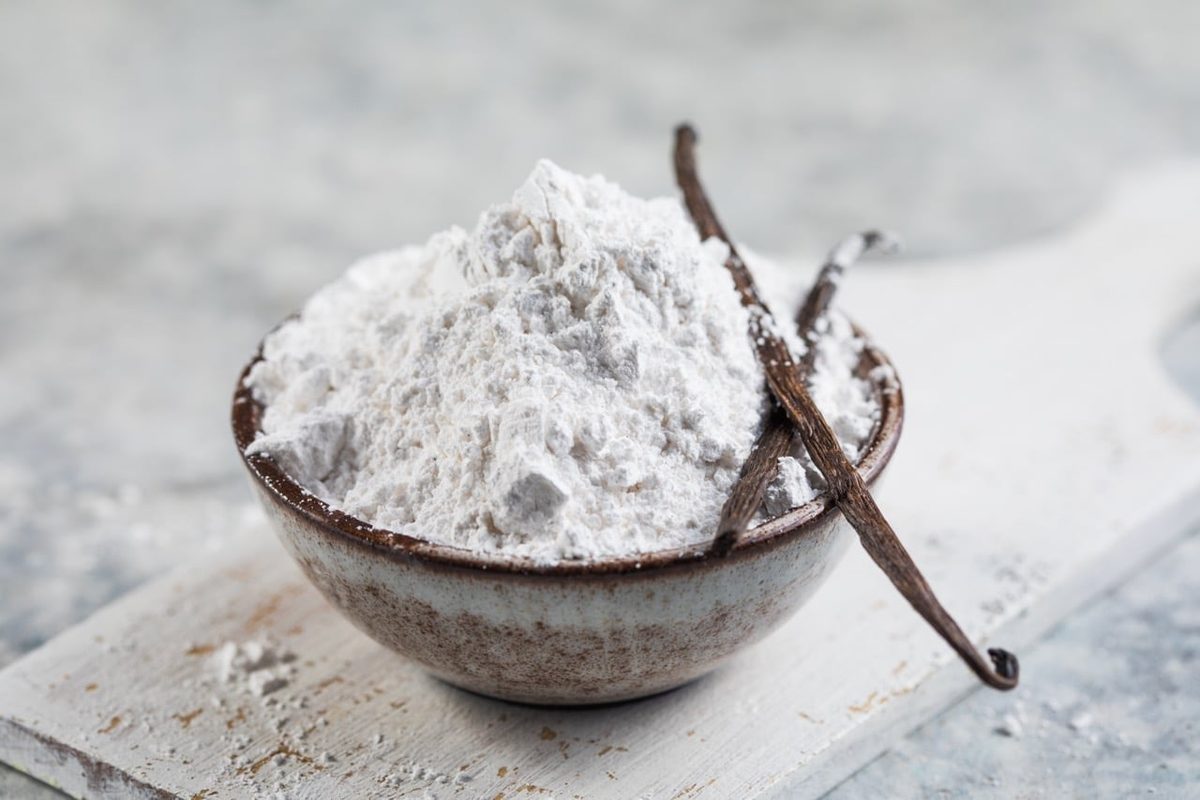
In the US, vanilla powder is a legal term: ground vanilla beans or vanilla oleoresin, or both, blended with a carrier, with at least one “unit” of vanilla in every 8 pounds.1 Not every powder is simply ground pods. Nielsen-Massey’s, for example, lists maltodextrin and vanilla bean extractives.2 Cooks reach for powder because it adds vanilla without liquid or alcohol. The best substitute depends on whether that dryness matters in your recipe.
Quick answer
| What the powder is doing | Best substitute | Starting amount, per 1 Tbsp powder | Treatment |
|---|---|---|---|
| Dry vanilla flavor in a sweet mix, rub or topping | Vanilla sugar (bean-based) | Same weight | Computed |
| Dry vanilla flavor, no added sugar | Seeds of a whole vanilla bean | 1 bean | Attributed |
| Flavor in a moist batter or frosting | Vanilla bean paste | 1 Tbsp | Attributed |
| Flavor where a little liquid is fine | Vanilla extract | 1 Tbsp to start (sources give 1 to 2); about 1 mL per gram of powder | Disputed |
How the ratios on this page are labeled
Every ratio carries one of four labels.
- Computed: based on a measurable physical relationship, with the source named.
- Attributed: a named source publishes this ratio. We quote it as theirs.
- Disputed: named sources give different answers to the same swap. We show each one and do not average them.
- Method: we found no published ratio. We give a direction and a cautious starting point, and say so.
US rules set the minimum vanilla content of extract and powder, which lets us compute some comparisons. They are minimums, and products can be stronger. No published study compares how strong these forms taste.
The arithmetic behind the swaps
A US “unit of vanilla constituent” is everything extractable from one unit weight of vanilla beans: 13.35 ounces of beans at no more than 25 percent moisture.3 Vanilla extract must contain at least one unit per gallon,4 and vanilla powder at least one unit per 8 pounds.1 Converted to metric (13.35 oz is 378.5 g, a gallon is 3,785 mL, 8 pounds is 3,629 g),5 that comes to:
| Product at the federal minimum | Beans extracted, per unit of product |
|---|---|
| Vanilla extract | About 0.100 g per mL |
| Vanilla powder (or vanilla sugar) | About 0.104 g per g |
So, at minimum strength, 1 gram of vanilla powder carries about as much vanilla as 1 milliliter of extract, and 1 teaspoon of extract matches about 4.7 g of powder. This is our arithmetic from the standards. It measures the weight of beans extracted, not flavor, and says nothing about a product made above the minimum or outside the US.
If the powder is adding dry vanilla flavor
This is powder’s real advantage: in a dry spice rub for desserts, a cocoa or drink mix, a sugar topping or a recipe where extra liquid would upset the balance.
1. Vanilla sugar
Under the same US rule, when sugar is the carrier, vanilla powder may be called “vanilla sugar.”1 In other words, a US vanilla sugar made to the standard is vanilla powder.
Ratio (Computed): Products made to the same standard and strength can be swapped by weight. Because the carrier is sugar, you are adding a little sweetness, which rarely matters in a sweet recipe (our judgment).
Read the label first. Some products sold as vanilla sugar are flavored with something other than vanilla bean. The Dr. Oetker vanilla sugar sold at Wegmans, for example, lists sugar and artificial flavor.6 A vanillin-based sugar will give the main vanilla note but not the rest: vanillin is vanilla’s main aroma compound, while natural vanilla flavor is a mix of more than 200 components.7 For more, see vanilla sugar.
2. Seeds from a whole vanilla bean
Scraped seeds add vanilla with almost no extra liquid. Beans are not dry, though: Cook’s Vanilla sells even its “extract grade” beans at 22 to 27 percent moisture.8
Ratio (Attributed): Nielsen-Massey equates 1 whole vanilla bean with 1 tablespoon of its vanilla powder.92 A tablespoon is three teaspoons (14.79 mL against 4.93 mL),5 so that is about a third of a bean per teaspoon of powder.
3. Your own ground vanilla
Ratio (Method): If you have spare beans, or pods already scraped for another recipe, you can dry them until brittle and grind them in a spice grinder, alone or with sugar. That is common practice. We found no tested drying method or published strength for homemade powder, so use it as you would bought powder and taste.
If a little moisture is fine
1. Vanilla bean paste
Ratio (Attributed): Nielsen-Massey gives one equivalence for all its forms: 1 tablespoon of extract, 1 whole bean, 1 tablespoon of paste and 1 tablespoon of powder.9 That makes paste a one-for-one swap for powder, by its account. Paste adds sugar, water and a thickener (Nielsen-Massey’s lists gum tragacanth),9 so it suits batters, custards and frostings better than dry mixes.
Paste is not necessarily alcohol-free. Nielsen-Massey’s contains vanilla extract,9 and US extract is at least 35 percent alcohol.4
2. Vanilla extract
In the US, vanilla extract is vanilla flavor dissolved in water and ethyl alcohol, at least 35 percent alcohol by volume.4 Stronger “concentrated” extracts, sold as two-fold and higher, must contain two or more units per gallon.10 Check the fold on the label before measuring.
Ratio (Disputed):
| Source | Extract per 1 Tbsp powder |
|---|---|
| Nielsen-Massey (its own powder) | 1 Tbsp (“the same measurement”)2 |
| Healthline | It gives 1/2 to 1 Tbsp of powder per 1 Tbsp of extract,11 which works out to 1 to 2 Tbsp of extract per Tbsp of powder |
Computed check: At the federal minimums, use about 1 mL of single-strength extract per gram of powder (see the table above).341 If you can weigh your powder, this is the most defensible figure on this page. If you can’t, start with Nielsen-Massey’s one-for-one and taste.
Imitation vanilla powder
Powders that mix vanilla with added vanillin must be sold as “vanilla-vanillin” products and carry the statement “contains vanillin, an artificial flavor (or flavoring).”10 Vanillin can be made synthetically as well as taken from vanilla pods,12 and Katzer notes it can be made cheaply from paper-industry wood waste.13 German consumer advisers also point out that vanilla is a relatively expensive raw material.12 In our judgment, vanillin products work best where vanilla is a supporting note.
What not to use
Tonka beans, or any vanilla product that lists tonka. FDA deems any food with added coumarin, including coumarin added as a constituent of tonka beans or tonka extract, to be adulterated.14 In 2008 FDA warned that so-called Mexican vanilla is often made with tonka extract, and that coumarin may be dangerous for people taking blood thinners.15 Katzer’s note that tonka extract turns up regularly in vanilla extract in Mexico13 refers to that product, not to vanilla grown there, and Mexico is part of vanilla’s native range.16
What isn’t known
- No published measurement compares the flavor strength of powder with beans, paste or extract. The Computed figures compare legal minimum bean content only.
- We found no tested method or published strength for homemade vanilla powder, whether ground from dried beans or made by drying extract onto starch or sugar.
- It is often said that powder is stronger than extract. At the federal minimums the two are nearly equal, gram for milliliter, so any difference is down to the product.
Related
- Vanilla and too much vanilla
- Vanilla powder vs. vanilla extract and vanilla powder vs. vanilla paste
- Vanilla extract substitutes, vanilla paste substitutes and vanilla sugar substitutes
- Vanilla sugar and vanilla sugar uses
Footnotes
-
21 CFR 169.179, Vanilla powder, eCFR. ecfr.gov · Regulator ↩ ↩2 ↩3 ↩4
-
Pure Vanilla Powder, Nielsen-Massey Vanillas. nielsenmassey.com · Merchant ↩ ↩2 ↩3
-
21 CFR 169.175, Vanilla extract, eCFR. ecfr.gov · Regulator ↩ ↩2 ↩3 ↩4
-
NIST Guide to the SI, Appendix B.9, National Institute of Standards and Technology. nist.gov · Standard ↩ ↩2
-
Dr. Oetker Vanilla Sugar, product listing, Wegmans. wegmans.com · Merchant ↩
-
Cai et al., “Metabolite Transformation and Enzyme Activities of Hainan Vanilla Beans During Curing to Improve Flavor Formation”, Molecules, 2019. mdpi.com · Peer-reviewed ↩
-
“How are Madagascar vanilla beans graded?”, Cook’s Vanilla, 2023. cooksvanilla.com · Merchant ↩
-
Pure Vanilla Bean Paste, Nielsen-Massey Vanillas. nielsenmassey.com · Merchant ↩ ↩2 ↩3 ↩4
-
21 CFR Part 169 Subpart B, sections 169.175 to 169.182, eCFR. ecfr.gov · Regulator ↩ ↩2
-
Cecilia Snyder, “Vanilla extract substitutes”, Healthline, 2021. healthline.com · Publication ↩
-
“Vanille, Vanilla und Vanillearoma: Was sind die Unterschiede?”, Verbraucherzentrale, 2026. verbraucherzentrale.de · Publication ↩ ↩2
-
Gernot Katzer, Vanilla (Vanilla planifolia), Gernot Katzer’s Spice Pages. gernot-katzers-spice-pages.com · Reference work ↩ ↩2
-
Robert Preidt, “FDA Warns of Dangers of Mexican Vanilla”, HealthDay, 2008. healthday.com · Publication ↩
-
Vanilla planifolia Andrews, Plants of the World Online, Royal Botanic Gardens, Kew. powo.science.kew.org · Reference work ↩