Spice Comparisons · Comparison
Vanilla Powder vs. Vanilla Extract: What the Labels Mean and How to Swap Them
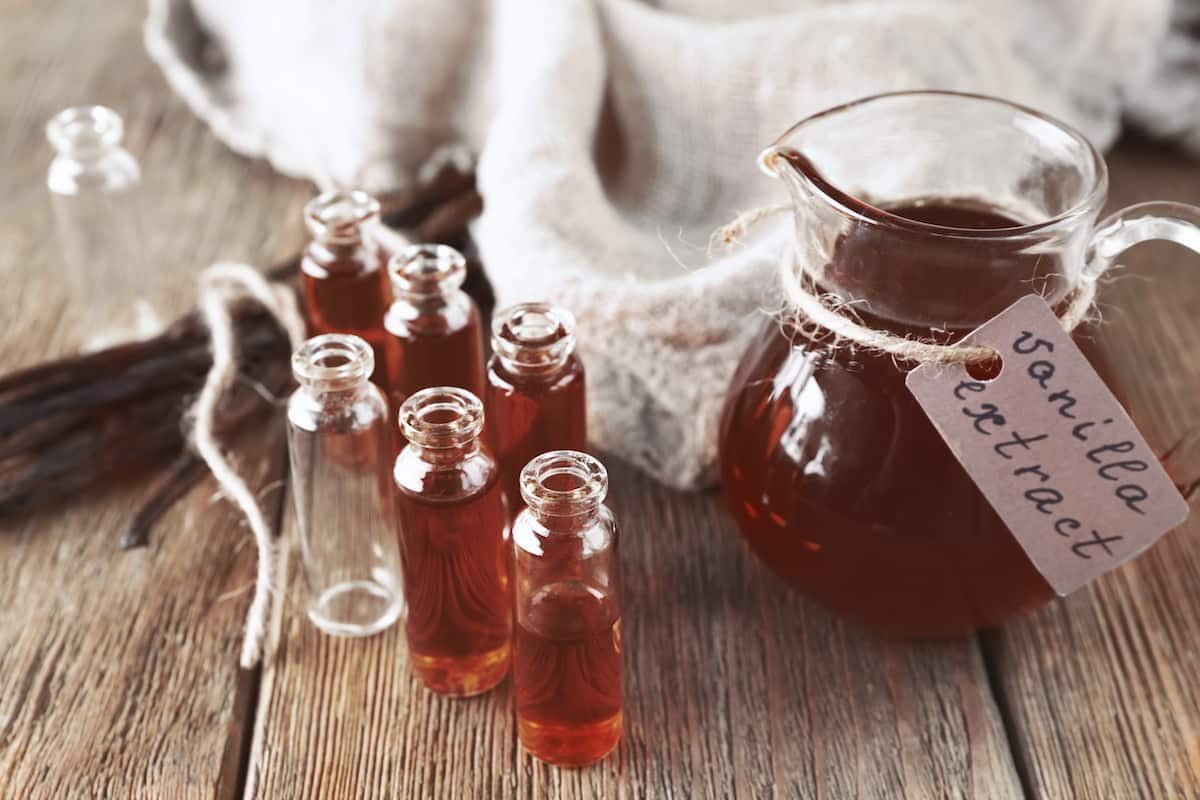
Vanilla extract is vanilla dissolved in alcohol and water. Vanilla powder is vanilla in dry form, either ground beans or vanilla carried on a sugar or starch base. In the US both are defined by law, with a minimum vanilla content for each, and at those minimums a gram of powder carries about as much vanilla as a milliliter of extract.123 The real differences are liquid, alcohol, and which kind of powder you are holding.
Side by side
| Vanilla powder | Vanilla extract | |
|---|---|---|
| US definition | Ground vanilla beans or vanilla oleoresin, or both, which may be blended with sugar, dextrose, lactose, food starch, dried corn syrup or gum acacia3 | A solution of the flavor of vanilla beans in water and ethyl alcohol2 |
| Alcohol | None required by the standard; America’s Test Kitchen calls powder alcohol-free4 | At least 35% by volume2 |
| Minimum vanilla content | One unit of vanilla constituent per 8 pounds3 | One unit per gallon2 |
| Beans behind it, at the minimum (our arithmetic) | About 0.104 g of beans per gram | About 0.100 g of beans per milliliter |
| Related names | “Vanilla sugar” when sugar is the carrier; added vanillin makes it “vanilla-vanillin powder,” declared as an artificial flavor35 | Concentrated (two-fold and up); “vanilla flavoring” if under 35% alcohol; vanilla-vanillin extract5 |
| Look | Pure ground vanilla is dark brown and crumbly; sweetened powders are white or pale brown (ATK)6 | Liquid |
| Best at | Dry mixes and icings (Nielsen-Massey);7 ATK says to use powder only as a dry ingredient in baked goods4 | Batters, custards, sauces |
| Price | Up to $14 an ounce for the sweetened powders, and up to $56 an ounce for the pure ground vanilla, that ATK tested in 20226 | No dated, sourced figure found |
A “unit of vanilla constituent” is everything extractable from 13.35 ounces of vanilla beans at no more than 25 percent moisture.1 The arithmetic behind the bean row is below.
Two kinds of “vanilla powder”
The word covers two different products, and the difference matters more than the powder-versus-extract question.
- Ground vanilla. America’s Test Kitchen describes it as a dark-brown, crumbly powder made strictly from ground vanilla beans.6 ATK notes that ground vanilla adds flecks, as paste does.8
- Sweetened or carrier powder. ATK describes this as a sucrose, dextrose or maltodextrin base flavored with vanilla, white or pale brown and sweet.6 Nielsen-Massey’s, for example, lists maltodextrin and vanilla bean extractives,7 and another ATK article describes vanilla powder as vanilla extract dried onto a cornstarch base.4
The US standard allows both, since it permits ground beans or vanilla oleoresin with a list of carriers.3 Read the ingredient list to know which you have.
How strong each one is
US rules let us compare minimum-strength products directly. Extract must hold at least one unit of vanilla constituent per gallon, and powder at least one unit per 8 pounds.23 Converted to metric (13.35 ounces is 378.5 g, a gallon is 3,785 mL, 8 pounds is 3,629 g):9
| Product at the federal minimum | Beans extracted, per unit of product |
|---|---|
| Vanilla extract | About 0.100 g per mL |
| Vanilla powder | About 0.104 g per g |
So at minimum strength, 1 gram of powder carries about as much vanilla as 1 milliliter of extract, and 1 teaspoon of extract (4.93 mL)9 matches about 4.7 g of powder. This is our arithmetic from the standards. It compares the weight of beans extracted, not flavor, and says nothing about products made above the minimum or outside the US. Concentrated extracts carry two or more units per gallon,5 so check the label.
In the kitchen
Where powder earns its place. Powder adds vanilla without liquid or alcohol. Nielsen-Massey suggests its powder for dry baking mixes and icings and says it dissolves easily in liquids.7 In an America’s Test Kitchen tasting, tasters were nearly unanimous in preferring a yellow cake made with vanilla powder over one made with extract.4 That is one test of particular products, not a general rule.
Melted chocolate. King Arthur Baking names vanilla extract among the liquids that can make melted chocolate seize when only a little is added.10 It adds that, for bittersweet and semisweet chocolate, at least 1 tablespoon of water-type liquid per 2 ounces of chocolate is needed to prevent seizing.10 Powder adds no liquid, which is why cooks reach for it here; no source we found tested powder in melted chocolate.
Baking off. It is often said that extract’s flavor “bakes off” with its alcohol in a long, hot bake while powder’s does not. No source we found measures this.
Where extract is simpler. In custards, sauces, whipped cream and most batters, a teaspoon of liquid makes no difference and extract is the default. That is our judgment.
Can one stand in for the other?
Usually, by weight if you can, and by the label if you can’t. The sources disagree on the volume swap, partly because they are measuring different powders.
Ratio (Disputed): powder per 1 tablespoon of extract
| Source | Powder | What powder |
|---|---|---|
| Nielsen-Massey | 1 Tbsp, “the same measurement”7 | Its own powder (maltodextrin base) |
| America’s Test Kitchen, 2022 tasting | Same amount (“1 to 1”)6 | Sweetened powders |
| America’s Test Kitchen, 2022 tasting | Half the amount6 | Ground vanilla (beans only) |
| Healthline | 1/2 to 1 Tbsp11 | “Vanilla bean powder,” not further defined |
None of the four says how its figure was reached. Computed check: at the federal minimums, use about 1 mL of single-strength extract per gram of powder, or about 4.7 g of powder per teaspoon of extract.1239 If you can weigh, that is the most defensible figure on this page.
Starting point (Method): Without a scale, use a sweetened powder one for one with extract, where Nielsen-Massey and ATK agree, and start pure ground vanilla at half, as ATK advises; then taste. Going the other way, extract works anywhere a little liquid is fine, but not in a dry mix meant to keep. For more options, see vanilla extract substitutes and vanilla powder substitutes.
Making extract at home
Soaking beans in alcohol makes extract. VanillaPura, a bean seller, advises a spirit of at least 40 percent alcohol (80 proof), 1 ounce of beans per 8 ounces of alcohol, and 12 months or more of infusing for full potency.12 For comparison, the federal single-strength minimum works out to about 100 g of beans per liter of finished extract (378.5 g per 3.785 L).19
A safety note on “Mexican vanilla”
FDA deems any food with added coumarin, including coumarin added through tonka beans or tonka extract, to be adulterated.13 Katzer reports that tonka extract shows up regularly in vanilla extract in Mexico,14 and in 2008 FDA warned that coumarin may be dangerous for people taking blood thinners.15 The concern is tonka, not vanilla grown in Mexico. Avoid extracts that list tonka or have a vague ingredient list.
What isn’t known
- No published study compares the flavor strength of vanilla powder and extract. The Computed figures compare legal minimum bean content only.
- No source measures whether extract loses more flavor than powder in baking.
- The ATK and Healthline powder figures do not state how they were reached.
- Vanillin, the main aroma compound, is about 2 percent of a cured pod, and natural vanilla flavor has more than 200 components;1416 no source compares how powder and extract carry those minor components.
Related
- Vanilla and too much vanilla
- Vanilla powder vs. vanilla paste
- Vanilla extract substitutes, vanilla powder substitutes and vanilla paste substitutes
- Vanilla sugar, vanilla sugar uses and vanilla sugar substitutes
Footnotes
-
21 CFR 169.3, Definitions, eCFR. ecfr.gov · Regulator ↩ ↩2 ↩3 ↩4
-
21 CFR 169.175, Vanilla extract, eCFR. ecfr.gov · Regulator ↩ ↩2 ↩3 ↩4 ↩5 ↩6
-
21 CFR 169.179, Vanilla powder, eCFR. ecfr.gov · Regulator ↩ ↩2 ↩3 ↩4 ↩5 ↩6 ↩7
-
“Vanilla Powder and Paste”, America’s Test Kitchen. americastestkitchen.com · Publication ↩ ↩2 ↩3 ↩4
-
21 CFR Part 169 Subpart B, sections 169.175 to 169.182, eCFR. ecfr.gov · Regulator ↩ ↩2 ↩3
-
Carolyn Grillo, “The Best Ground Vanilla and Vanilla Powder”, America’s Test Kitchen, 2022. americastestkitchen.com · Publication ↩ ↩2 ↩3 ↩4 ↩5 ↩6
-
Pure Vanilla Powder, Nielsen-Massey Vanillas. nielsenmassey.com · Merchant ↩ ↩2 ↩3 ↩4
-
Carolyn Grillo, “The Best Vanilla Paste”, America’s Test Kitchen, 2022. americastestkitchen.com · Publication ↩
-
NIST Guide to the SI, Appendix B.9, National Institute of Standards and Technology. nist.gov · Standard ↩ ↩2 ↩3 ↩4
-
Jessica Battilana, “Things bakers know: Yes, you can mix chocolate and water”, King Arthur Baking, 2025. kingarthurbaking.com · Publication ↩ ↩2
-
Cecilia Snyder, “Vanilla extract substitutes”, Healthline, 2021. healthline.com · Publication ↩
-
“How Many Vanilla Beans Do You Need for DIY Vanilla Extract?”, VanillaPura, 2025. vanillapura.com · Merchant ↩
-
Gernot Katzer, Vanilla (Vanilla planifolia), Gernot Katzer’s Spice Pages. gernot-katzers-spice-pages.com · Reference work ↩ ↩2
-
Robert Preidt, “FDA Warns of Dangers of Mexican Vanilla”, HealthDay, 2008. healthday.com · Publication ↩
-
Cai et al., “Metabolite Transformation and Enzyme Activities of Hainan Vanilla Beans During Curing to Improve Flavor Formation”, Molecules, 2019. mdpi.com · Peer-reviewed ↩