Sweeteners · Profile
Vanilla Sugar: What It Is, Vanilla vs. Vanillin, and How to Use It
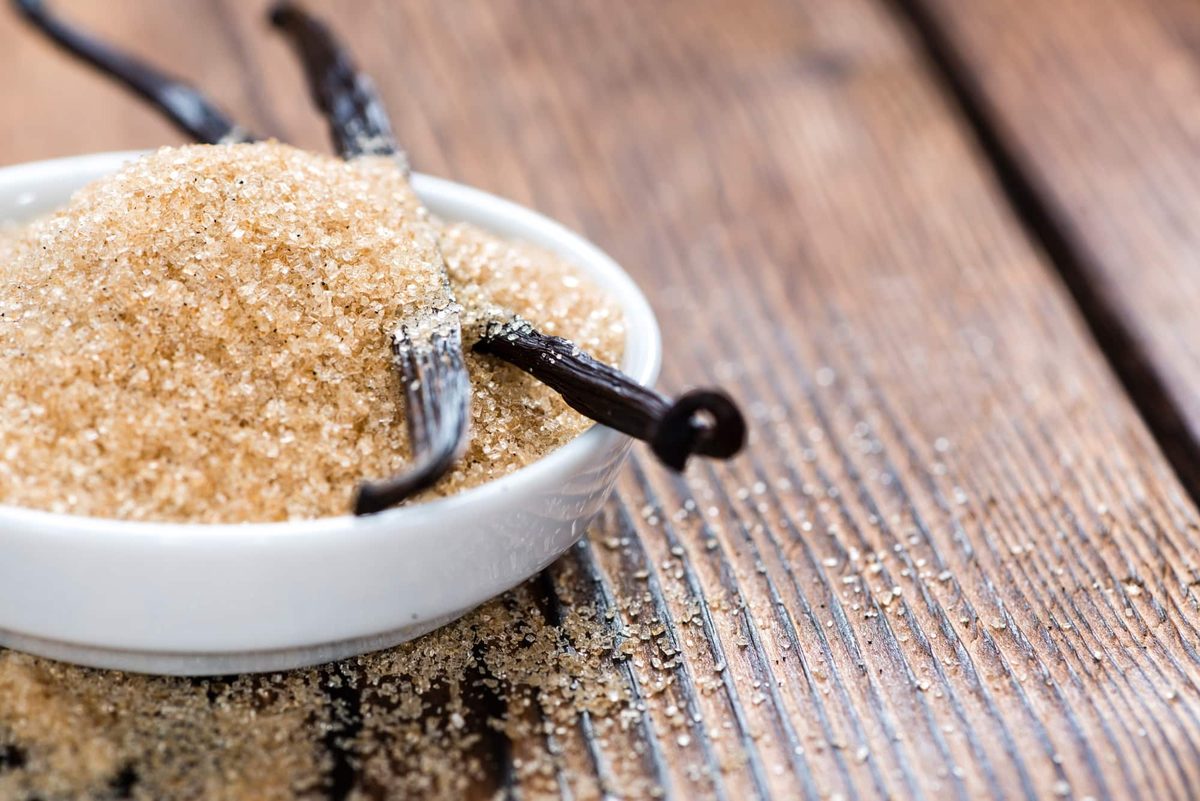
Vanilla sugar is sugar flavored with vanilla, sold in small packets in much of Europe and easy to make at home. The name covers two different products: sugar flavored with real vanilla bean, and sugar flavored with vanillin, a vanilla flavor compound that can also be made synthetically.1 The ingredient list tells you which you have. This page covers both, what US and German labels mean, how it is used, and how to make it.
At a glance
| What it is | Sugar blended with ground vanilla beans, vanilla extract or oleoresin, or vanillin flavoring234 |
| Vanilla plant | Vanilla planifolia, a climbing orchid (Orchidaceae)5 |
| Native range of vanilla | Southern Mexico to northern Brazil (Kew)5 |
| US legal name | “Vanilla powder”; “vanilla sugar” is an allowed alternative name when sugar is the blending ingredient2 |
| German names | Vanillezucker (real vanilla) and Vanillin-Zucker (vanillin flavoring), as sold by Dr. Oetker34 |
| Typical packet | Dr. Oetker sells Bourbon vanilla sugar as 3 packets totaling 24 g3 |
| Forms sold | Packets, jars; homemade |
Measured values
2 figures, sourced| Measure | Value | Scope | Source |
|---|---|---|---|
| Vanilla constituent, minimum Limit | one unit per 8 pounds units of vanilla constituent | US standard of identity for vanilla powder / vanilla sugar, 21 CFR 169.179 | ecfr.gov |
| Unit weight of vanilla beans Limit | 13.35 ounces for beans of no more than 25% moisture ounces (at stated maximum moisture) | US definition, 21 CFR 169.3 | ecfr.gov |
Each figure is quoted as its source states it, with the samples or standard it applies to. Where sources differ, both are shown; nothing is averaged. All measured values
Vanilla sugar vs. vanillin sugar
Two products sit side by side on German shelves, and Dr. Oetker’s own ingredient lists show the difference:
| Product | Ingredients as listed | Source |
|---|---|---|
| Dr. Oetker Bourbon-Vanillezucker | Sugar, ground extracted vanilla pods, Bourbon vanilla extract | 3 |
| Dr. Oetker Vanillin-Zucker | Sugar, vanillin flavoring | 4 |
Germany’s consumer advice centers note that vanillin can be made synthetically as well as taken from vanilla pods, that synthetic and natural vanillin differ in their starting materials and production methods, and that natural vanillin taken directly from vanilla pods falls far short of world demand.1 They also note that vanilla is a relatively expensive raw material.1 In our view, bean-based vanilla sugar has the fuller flavor of the whole spice, and the dark specks to show for it.
What a US label means
In the US, the standard of identity is “vanilla powder”: a mixture of ground vanilla beans or vanilla oleoresin or both, blended with sugar, dextrose, lactose, food starch, dried corn syrup or gum acacia.2 When sugar is the blending ingredient, the product may be called “vanilla sugar” instead.2 It must contain at least one unit of vanilla constituent per 8 pounds.2 A unit of vanilla constituent is defined as everything flavorful that can be extracted from one unit weight of vanilla beans, which for beans of no more than 25% moisture is 13.35 ounces.6 Products under 2-fold strength drop the fold number from the name.2
So a US product sold as vanilla sugar under that standard is made with vanilla beans or oleoresin.
Flavor
Bean-based vanilla sugar tastes of sugar first, then the warm, floral, slightly smoky perfume of vanilla, with no alcohol edge. Vanillin sugar is simpler and sweeter-smelling, closer to the vanilla of commercial cookies. These descriptions are ours.
History
The vanilla orchid is native from southern Mexico to northern Brazil, and Kew lists it as introduced in Madagascar, Réunion, the Comoros and Java, among many other places.5
Vanilla was hard to come by in the early United States. In July 1791, writing from Philadelphia, Thomas Jefferson told William Short that a man named Petit had been all over town in quest of vanilla and that it was unknown there, and asked Short to send 50 pods tucked in a packet of newspapers.7 Jefferson’s own ice cream recipe called for a stick of vanilla in the cream.8 The often-repeated claim that Jefferson was the first to bring vanilla to America goes further than this letter shows.
Other stories about vanilla sugar’s past, including its role in 19th-century American soda fountains and a 1911 dairy trade-journal recipe for grinding vanilla beans with loaf sugar, could not be traced to a source for this review. Dr. Oetker says its vanillin sugar has been made since 1894.4
How vanilla sugar is used
Dr. Oetker suggests its Bourbon vanilla sugar for whipped cream, fine pastries and cream fillings.3 By common practice it is also sprinkled over baked goods, stirred into coffee or tea, used in place of some plain sugar in cakes, cookies, scones and muffins, scattered over oatmeal or fruit, and dissolved into a vanilla simple syrup. A German recipe that calls for “1 Päckchen Vanillezucker” means one of those small packets, about 8 g if Dr. Oetker’s 24 g, three-packet box is divided evenly (our arithmetic).3
For more ideas see vanilla sugar uses.
Making it at home
America’s Test Kitchen publishes a recipe: Jessica Rudolph’s Vanilla Bean Sugar uses 2 vanilla beans for 1 cup of sugar, left to sit for at least 2 days so the flavors meld, and says the sugar keeps for up to 1 month.9 A looser Method starting point for a larger jar: split a vanilla bean, scrape the seeds into a jar of granulated sugar, add the empty pod, close the jar and leave it for a week or two, shaking now and then. Used pods from other recipes can be dried and buried in sugar the same way. Grinding a dried pod with sugar in a spice grinder gives a faster, more speckled result. Taste and add more bean if it is faint.
Storage
No published shelf-life figure was found. Common practice is to keep it airtight and dry, and to smell it before using: if the vanilla is faint, it has faded.
Health
Vanilla sugar is sugar, and counts as added sugar. FDA’s Daily Value for added sugars is 50 grams a day on a 2,000-calorie diet, and the Dietary Guidelines recommend keeping added sugars under 10% of daily calories.10 FDA notes that too much added sugar can make it hard to meet nutrient needs while staying within calorie limits.10 The vanilla in it is used in amounts too small to matter nutritionally (our judgment). This page makes no health claims for vanilla.
Substitutes and related pages
Plain sugar plus a little vanilla extract is the closest swap; see vanilla sugar substitutes. Related: vanilla, vanilla powder vs. vanilla extract, vanilla extract substitutes, vanilla powder substitutes, too much vanilla and too much sugar.
Footnotes
-
“Vanille, Vanilla und Vanillearoma: Was sind die Unterschiede?”, Verbraucherzentrale, 2026. verbraucherzentrale.de · Publication ↩ ↩2 ↩3
-
21 CFR 169.179, Vanilla powder, eCFR. ecfr.gov · Regulator ↩ ↩2 ↩3 ↩4 ↩5 ↩6
-
Dr. Oetker Bourbon-Vanillezucker, product listing, REWE. rewe.de · Merchant ↩ ↩2 ↩3 ↩4 ↩5 ↩6
-
Dr. Oetker Vanillin-Zucker, product listing, REWE. rewe.de · Merchant ↩ ↩2 ↩3 ↩4
-
Vanilla planifolia Andrews, Plants of the World Online, Royal Botanic Gardens, Kew. powo.science.kew.org · Reference work ↩ ↩2 ↩3
-
Thomas Jefferson to William Short, 28 July 1791, Founders Online, National Archives. founders.archives.gov · Reference work ↩
-
Anna Diamond, “Make Thomas Jefferson’s Recipe for Ice Cream”, Smithsonian Magazine, 2020. smithsonianmag.com · Publication ↩
-
Jessica Rudolph, “Vanilla Bean Sugar”, America’s Test Kitchen, 2023. americastestkitchen.com · Publication ↩
-
Added Sugars on the Nutrition Facts Label, U.S. Food and Drug Administration. fda.gov · Regulator ↩ ↩2