Spices · Profile
Allspice: One Berry, Not a Blend. Flavor, Chemistry and Uses
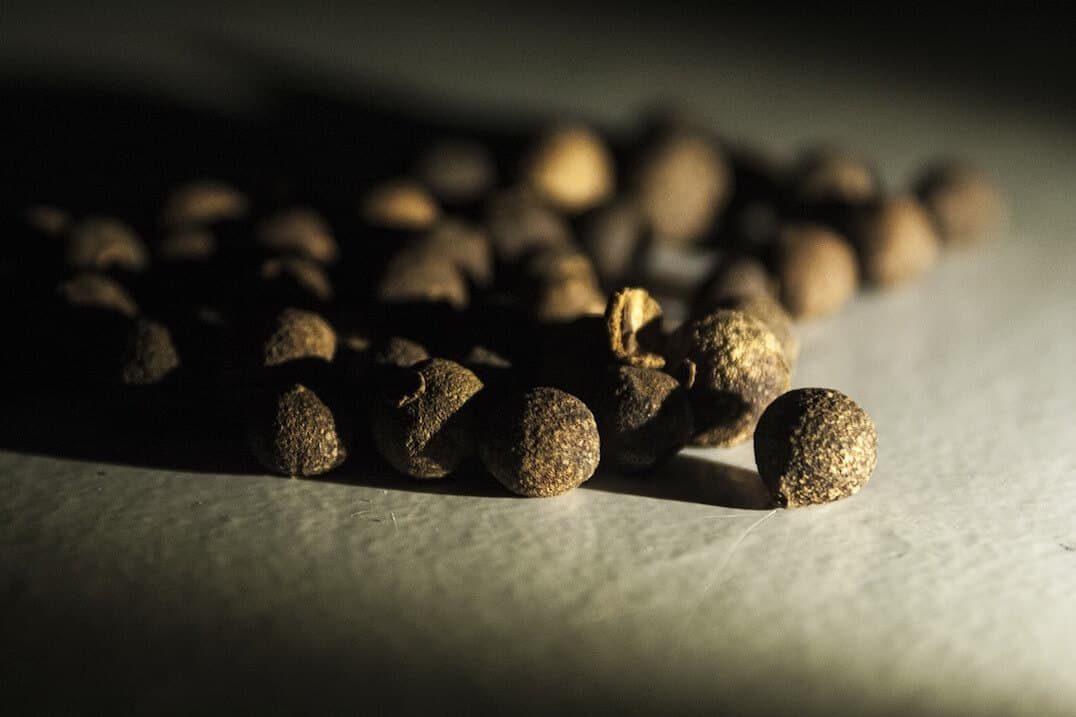
Allspice is a single spice, not a blend: the dried berries of Pimenta dioica, a tree in the myrtle family native to southern Mexico, Central America and the Caribbean.12 Britannica says it got its English name because the dried berry tastes like a combination of cloves, cinnamon and nutmeg.2 This page covers what allspice is, the eugenol behind its clove-like smell, where it comes from, how it is used from jerk to Cincinnati chili, how it is adulterated, and what is known about its safety.
At a glance
| Botanical name | Pimenta dioica (L.) Merr.1 |
| Plant family | Myrtaceae (myrtle family, like cloves)13 |
| Part used | The fruit, picked fully mature but still green and dried42 |
| Other names | Pimento, Jamaican pepper; pimienta gorda in Mexico25 |
| Native range | Southern Mexico to Central America and the Caribbean1 |
| Main exporter | Jamaica, about 70% of world exports per PROSEA (no year given)4 |
| Key aroma compound | Eugenol, with methyl eugenol and myrcene5 |
| Essential oil in the berry | 3.3–4.5% (PROSEA); about 4.5% for Jamaican allspice (Britannica)42 |
| Forms sold | Whole berries, ground, berry oil, oleoresin4 |
| US status | Listed as a generally recognized as safe spice6 |
Measured values
7 figures, sourced| Measure | Value | Scope | Source |
|---|---|---|---|
| Essential oil | 3.3–4.5 % of berry | berries generally (PROSEA)Sources differ | uses.plantnet-project.org |
| Essential oil | about 4.5 % of berry | Jamaican allspice (Britannica)Sources differ | britannica.com |
| Essential oil | 1.5–4.5 % | leaves and berries (2022 review) | intechopen.com |
| Eugenol | 50–80 % of berry oil | berry oil generally (PROSEA) | uses.plantnet-project.org |
| Eugenol | about 8 to about 86 % of berry oil | berry oils in individual studies, from some Mexican samples (about 8%) to a commercial Jamaican oil (about 86%); 2022 review, compiled table | intechopen.com |
| Methyl eugenol | about 65 % of berry oil | one Mexican berry oil; 2022 review, compiled table | intechopen.com |
| Ochratoxin A, maximum Limit | 15 µg/kg | EU general limit for dried spices | eur-lex.europa.eu |
Each figure is quoted as its source states it, with the samples or standard it applies to. Where sources differ, both are shown; nothing is averaged. All measured values
What allspice is
The allspice tree is an evergreen.2 Kew lists it as native from southern Mexico through Belize, Guatemala, Honduras, Nicaragua and Costa Rica to Cuba, Jamaica, the Dominican Republic, the Bahamas and the Cayman Islands, and as introduced in Florida, Hawaii, Puerto Rico, Trinidad and Tobago, Colombia and Venezuela, among other places. It grows mainly in the seasonally dry tropics.1
The fruit is harvested before it is fully ripe. PROSEA says fully mature but still green fruits are picked 3 to 4 months after flowering, and that in Jamaica the harvest normally runs from July to September.4 As they dry in the sun the berries turn from green to a dull reddish brown.2
A widely repeated claim says allspice trees once grew in “rainforests” and are dwindling as those forests are cleared. We found no source for either part; Kew places the species in the seasonally dry tropical biome.1
Flavor and aroma
Britannica calls allspice aromatic and pungent, and gives the clove, cinnamon and nutmeg comparison as the reason for its name.2 A 2022 review describes its flavor the same way.5 In the pot it reads as warm, clove-forward and faintly peppery; that is our description. A “4 on the hotness scale” rating that circulates has no source and no defined scale.
The compounds
The aroma sits in the berry’s essential oil. The main constituents are eugenol, methyl eugenol and myrcene.5 Eugenol is also the dominant compound in clove oil, which is why the two spices smell so alike.3 How much oil there is, and how much of it is eugenol, depends heavily on the source:
| Scope | Figure | Source |
|---|---|---|
| Essential oil, berries generally | 3.3–4.5% | PROSEA4 |
| Essential oil, Jamaican allspice | about 4.5% | Britannica2 |
| Essential oil, leaves and berries | 1.5–4.5% | 2022 review5 |
| Eugenol, share of berry oil | 50–80% | PROSEA4 |
| Eugenol, berry oils in individual studies | about 8% (some Mexican samples) to about 86% (a commercial Jamaican oil) | 2022 review, compiled table5 |
| Methyl eugenol, one Mexican berry oil | about 65% | 2022 review, compiled table5 |
These figures come from different samples and methods and are not merged. The last two rows show why: one Mexican oil in the review was dominated by methyl eugenol rather than eugenol.5 For clove, by comparison, the 2020 review by Batiha and colleagues puts eugenol at about 85 to 92% of the oil.3
Origin and history
PROSEA says Spanish explorers came across allspice’s use as a spice in the Caribbean in the 16th century, mistook the berries for black pepper because of their shape and flavor, and called them pimienta (pepper), which English later turned into “pimento.”4 Britannica likewise says early Spanish explorers called it pimenta.2
The common claim that the English named it “allspice” in the 1600s could not be traced. Britannica gives the reason for the name but not when or by whom it was coined.2
Production and trade
PROSEA names Jamaica as the largest producer and exporter, with about 70% of world exports, and puts annual world trade at 3,000 to 4,000 tonnes worth US$5 to 7 million; it gives no year for either figure.4 A 2022 review says Jamaican berries are of higher quality than those of other islands and are preferred in trade.5 We found no current official production or trade series for allspice.
How allspice is used
- Jamaica. Pimento is central to jerk. Smithsonian Magazine’s history of the dish calls pimento and fresh thyme essential ingredients, alongside Scotch bonnet peppers, and notes that meat for traditional jerk is smoked over pimento wood.7 See jerk seasoning and Jamaican spices.
- Pickling and broths. PROSEA says whole berries go into meat broths, gravies and pickling liquids, while ground allspice is preferred for desserts.4 Britannica says it is widely used in baking and usually present in mincemeat and mixed pickling spice.2
- Meat products. PROSEA and the 2022 review both note that allspice oil and oleoresin are used in the meat industry.45
- Cincinnati chili. Saveur’s recipe uses allspice alongside cinnamon, cloves and nutmeg.8
It is sometimes said that allspice is the sole spice in many Palestinian main dishes, but we found no source for this, nor do several other dish-specific claims that circulate (Jamaican beef patties, Middle Eastern stews, commercial ketchup). They are left out rather than asserted.
Technique
Whole berries suit long-cooked liquids where they can be fished out; ground allspice suits batters, rubs and fillings. Allspice is strong, so add a little, let it cook in and taste before adding more. These are kitchen judgments. If a dish has gone over, see too much allspice.
Buying and quality
PROSEA notes two kinds of adulteration: ground allspice cut with clove stems and starchy products, and allspice berry oil cut with eugenol from cheaper sources.4 Whole berries are harder to adulterate than ground; buy whole and grind as needed if that matters to you (kitchen judgment). We found no international standard for allspice that we could open.
Storage
We found no shelf-life figure for allspice from a regulator, standards body or study. Like other spices whose flavor sits in a volatile oil, it is best kept whole, tightly closed and away from heat and light, and judged by smell; that is common practice rather than a measured result.
Safety
The 2022 review gives no toxicity figures for allspice oil, and we found no regulator or clinical source that sets an amount at which allspice eaten in food becomes a concern.5 In the US, allspice is on the FDA’s list of spices generally recognized as safe for their intended use.6
Methyl eugenol, which can dominate some allspice oils,5 is regulated as an added substance in the EU: it may not be added to food as such, and there are caps for it in some compound foods. Those caps do not apply where the only flavoring ingredients added are fresh, dried or frozen herbs and spices.9 Allspice also falls under the EU’s general ochratoxin A limit for dried spices, 15 µg/kg.10
Health claims
Allspice has been used in traditional medicine for gastrointestinal complaints, cramps, flatulence, indigestion and nausea, according to the 2022 review.5 That is a record of traditional use, not evidence that it works. Lists crediting allspice with treating fever, depression, arthritis and infections, or with supplying meaningful amounts of vitamins and minerals, have no source we could check. This page makes no claim that allspice treats or prevents any condition.
Substitutes and comparisons
Because its flavor is likened to cloves, cinnamon and nutmeg,2 those three, in some combination, are the usual stand-ins, and in our judgment allspice can fill in for them too. No source we found gives a tested ratio. See allspice substitutes, and:
- Allspice vs. cloves
- Allspice vs. nutmeg
- Allspice vs. black pepper
- Allspice berries vs. juniper berries
- Mace vs. allspice
- Garam masala vs. allspice
Footnotes
-
Pimenta dioica (L.) Merr., Plants of the World Online, Royal Botanic Gardens, Kew. powo.science.kew.org · Reference work ↩ ↩2 ↩3 ↩4 ↩5 ↩6
-
“Allspice”, Encyclopaedia Britannica. britannica.com · Reference work ↩ ↩2 ↩3 ↩4 ↩5 ↩6 ↩7 ↩8 ↩9 ↩10 ↩11 ↩12 ↩13
-
Batiha et al., “Syzygium aromaticum L. (Myrtaceae): Traditional Uses, Bioactive Chemical Constituents, Pharmacological and Toxicological Activities”, Biomolecules, 2020. mdpi.com · Peer-reviewed ↩ ↩2 ↩3
-
D. Sulistiarini, Pimenta dioica, Plant Resources of South-East Asia (PROSEA). uses.plantnet-project.org · Reference work ↩ ↩2 ↩3 ↩4 ↩5 ↩6 ↩7 ↩8 ↩9 ↩10 ↩11 ↩12
-
Andrade Avila, Cruz-Olivares and Pérez-Alonso, “Antioxidant Effect and Medicinal Properties of Allspice Essential Oil”, IntechOpen, 2022. intechopen.com · Peer-reviewed ↩ ↩2 ↩3 ↩4 ↩5 ↩6 ↩7 ↩8 ↩9 ↩10 ↩11 ↩12 ↩13
-
21 CFR 182.10, Spices and other natural seasonings and flavorings, FDA. ecfr.gov · Regulator ↩ ↩2
-
Vaughn Stafford Gray, “A Brief History of Jamaican Jerk”, Smithsonian Magazine, 2020. smithsonianmag.com · Publication ↩
-
“Cincinnati Chili”, Saveur. saveur.com · Publication ↩
-
Regulation (EC) No 1334/2008, Annex III, European Union. eur-lex.europa.eu · Regulator ↩
-
Commission Regulation (EU) 2023/915, European Commission. eur-lex.europa.eu · Regulator ↩