Spice Comparisons · Comparison
Allspice vs. Cloves: Two Eugenol Spices, a Berry and a Bud
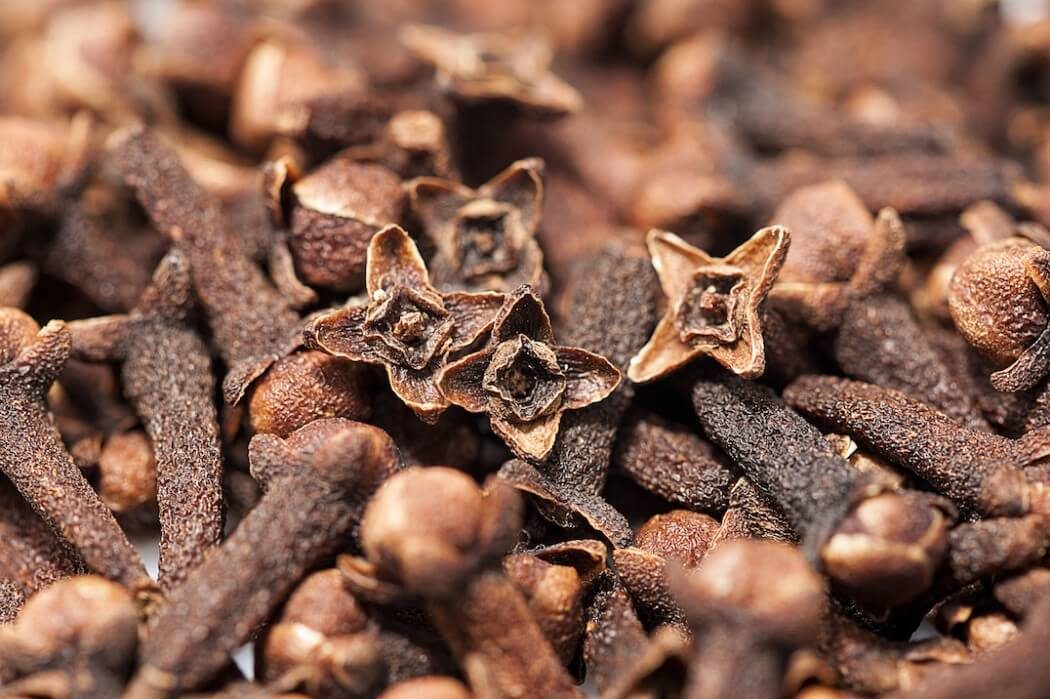
Allspice and cloves are relatives that smell alike for a sound chemical reason. Both come from trees in the myrtle family, and in both the essential oil is led by eugenol.1234 The differences are in what part of the plant you are using and how much oil it holds: a clove is a dried flower bud that can be up to a fifth essential oil, while an allspice berry is a dried fruit with a few percent.56 That makes them each other’s best substitute, with an adjustment for strength.
Side by side
| Allspice | Cloves | |
|---|---|---|
| Species | Pimenta dioica1 | Syzygium aromaticum2 |
| Family | Myrtaceae1 | Myrtaceae27 |
| Native range | Southern Mexico to Central America and the Caribbean1 | Maluku, Indonesia2 |
| Part used | The fruit, picked before fully ripe and dried6 | The flower bud, picked just before it opens and dried4 |
| Essential oil | About 4.5% for Jamaican allspice (Britannica)6 | 14–20% of the bud (Britannica)5 |
| Eugenol, share of the oil | 50–80% (PROSEA)3 | 70–90% (PROSEA); about 85–92% (Batiha et al.)47 |
| Other main compounds | Methyl eugenol and myrcene8 | Eugenyl acetate (up to 17%) and β-caryophyllene47 |
| Flavor (editorial) | Warm and clove-like, rounder; Britannica says it resembles cloves, cinnamon and nutmeg together6 | Britannica: strong in aroma, hot and pungent in taste5 |
| Forms | Whole berries, ground, berry oil3 | Whole buds, ground, oleoresin, bud oil4 |
| Typical uses | Jerk; broths and pickling liquids; desserts, fruit cakes and pies39 | Meats and baked goods; Chinese five-spice510 |
| Safety | No regulator sets a concern level for the spice in food; EU limit for ochratoxin A in dried spices applies to both11 | Same for the spice; clove oil is a separate, far more concentrated product (see below)12 |
| Price | No dated, sourced retail comparison found | No dated, sourced retail comparison found |
The oil and eugenol rows compare like with like: the oil share of the whole spice from Britannica’s two articles, and the eugenol share of the oil from PROSEA’s two entries. They still come from different samples, so read them as orders of magnitude rather than precise ratios.
Why they taste alike
Eugenol is the common thread. PROSEA puts it at 50 to 80 percent of allspice berry oil and 70 to 90 percent of clove bud oil.34 Britannica says allspice was named because the dried berry tastes like a combination of cloves, cinnamon and nutmeg.6 A popular version adds black pepper to that list; the pepper connection actually comes from the Spanish, who took the berries for black pepper and called them pimienta.3
What separates them chemically is the supporting cast. Allspice oil’s other main constituents are methyl eugenol and myrcene,8 while clove oil carries eugenyl acetate and β-caryophyllene.47 Allspice oil also varies a lot by origin: in studies compiled in one 2022 review, one Mexican berry oil was dominated by methyl eugenol rather than eugenol,8 so some lots will taste less clove-like than others.
Which is stronger?
Cloves, as far as the chemistry shows. Britannica gives 14 to 20 percent essential oil for clove buds and about 4.5 percent for Jamaican allspice,56 and eugenol makes up a larger share of clove oil.43 No published taste test compares the two, so how that translates on the tongue is not measured. The common claim that allspice is the more intense of the two has no source we could find and runs against these figures.
In our judgment, cloves read as sharper and more medicinal, with a numbing edge in quantity, and allspice as warmer and rounder. The Spice House describes allspice as having “the same peppery notes as cloves,”13 so the two are closer than that description suggests.
Telling them apart
Whole, they are easy to tell apart. A clove is a flower bud: PROSEA describes the whole flower cluster being picked just before the buds open,4 which leaves the familiar nail shape of a stem with a round head. Allspice is a round berry, close enough in shape to a peppercorn that the Spanish mistook it for one.3
Ground, they are hard to tell apart by eye, in our observation. That matters for one reason: PROSEA notes that ground allspice is sometimes adulterated with clove stems and starchy products.3 Buying whole and grinding as needed avoids the question.
Using them in the kitchen
Britannica says cloves flavor many foods, particularly meats and baked goods,5 and lists them among the five spices of Chinese five-spice powder.10 For allspice, PROSEA says whole berries go into meat broths, gravies and pickling liquids and ground allspice into desserts, fruit cakes and pies,3 and in Jamaica pimento is an essential ingredient of jerk.9 The two often appear together in spice cakes, mulled drinks and glazed ham; that is common practice. See spices for ham and mulling spices.
Can one stand in for the other?
Yes, more closely than almost any other pair of warm spices. The ratios below come from our clove substitutes and allspice substitutes pages and keep their labels: Computed has a measurable basis, Attributed quotes a named source, and Method is our starting point where no published number exists.
| Swap | Starting amount | Treatment |
|---|---|---|
| Ground allspice for ground cloves | 1:1 | Attributed (The Spice House; A Couple Cooks) |
| Ground cloves for ground allspice | Half as much, then taste | Method |
| Whole allspice berries for whole cloves, in a steeped liquid | About the same number, then taste | Method |
| Whole cloves for whole allspice berries, in a steeped liquid | About half as many | Method |
| Whole allspice to ground allspice | 5 berries = 1 teaspoon ground | Computed (McCormick conversion) |
| Whole cloves to ground cloves | 3 whole = 1/4 teaspoon ground (McCormick); 3/4 teaspoon ground per 1 teaspoon whole (The Spice House) | Attributed |
Allspice in place of cloves. The Spice House says to use a 1:1 ratio of allspice to cloves, because allspice shares cloves’ peppery notes,13 and A Couple Cooks gives the same swap: half a teaspoon of allspice for half a teaspoon of cloves.14 Neither says how the ratio was set. Given the oil figures above, expect a slightly softer clove note.
Cloves in place of allspice. No source gives a ratio. Because clove buds hold several times more oil,56 start with half as much ground clove as the allspice called for and build up. If allspice is one of several warm spices, The Spice House’s blend of 2 parts cinnamon, 1 part nutmeg and 1 part cloves, used 1:1, keeps the clove note in proportion.15
Whole spices. McCormick’s conversion puts 5 whole allspice berries at 1 teaspoon of ground allspice,16 and counts 3 whole cloves as 1/4 teaspoon ground.16 The Spice House uses a different unit: 3/4 teaspoon of ground cloves for every teaspoon of whole cloves.13 No source says how many cloves fill a teaspoon, so the two clove rules can’t be reconciled. Where the whole spice is the point, as in a clove-studded ham, A Couple Cooks says ground cloves cannot replace it.14
Safety: the spice versus clove oil
At kitchen amounts neither spice has a regulator-set concern level that we found, and both fall under the EU’s ochratoxin A limit for dried spices.11 Clove oil is different. The European Medicines Agency’s monograph covers it as a traditional herbal medicine for minor mouth and throat inflammation and toothache, and does not recommend it for anyone under 18.12 Do not use clove oil in place of ground cloves or allspice in a recipe.
Claims that allspice is healthier than cloves, or rich in vitamins and minerals, have no source we could find, and this page makes no health claim for either spice.
What isn’t known
- No published taste test compares the strength of allspice and cloves.
- No source gives a ratio for cloves in place of allspice; the half-strength start is ours.
- No source gives the number of whole cloves in a teaspoon.
- No dated price comparison.
Related
- Allspice, allspice substitutes, too much allspice
- Cloves, clove substitutes, too much clove, ground vs. whole cloves
- Allspice vs. nutmeg, allspice vs. black pepper, nutmeg vs. cloves, cloves vs. cinnamon
- Spices for ham, Chinese five-spice powder, jerk seasoning
Footnotes
-
Pimenta dioica (L.) Merr., Plants of the World Online, Royal Botanic Gardens, Kew. powo.science.kew.org · Reference work ↩ ↩2 ↩3 ↩4
-
Syzygium aromaticum (L.) Merr. & L.M.Perry, Plants of the World Online, Royal Botanic Gardens, Kew. powo.science.kew.org · Reference work ↩ ↩2 ↩3 ↩4
-
D. Sulistiarini, Pimenta dioica, Plant Resources of South-East Asia (PROSEA). uses.plantnet-project.org · Reference work ↩ ↩2 ↩3 ↩4 ↩5 ↩6 ↩7 ↩8 ↩9 ↩10
-
E.W.M. Verheij and C.H.A. Snijders, Syzygium aromaticum, Plant Resources of South-East Asia (PROSEA). uses.plantnet-project.org · Reference work ↩ ↩2 ↩3 ↩4 ↩5 ↩6 ↩7 ↩8 ↩9
-
“Clove”, Encyclopaedia Britannica. britannica.com · Reference work ↩ ↩2 ↩3 ↩4 ↩5 ↩6 ↩7
-
“Allspice”, Encyclopaedia Britannica. britannica.com · Reference work ↩ ↩2 ↩3 ↩4 ↩5 ↩6 ↩7
-
Batiha et al., “Syzygium aromaticum L. (Myrtaceae)”, Biomolecules, 2020. mdpi.com · Peer-reviewed ↩ ↩2 ↩3 ↩4
-
Andrade Avila, Cruz-Olivares and Pérez-Alonso, “Antioxidant Effect and Medicinal Properties of Allspice Essential Oil”, IntechOpen, 2022. intechopen.com · Peer-reviewed ↩ ↩2 ↩3
-
Vaughn Stafford Gray, “A Brief History of Jamaican Jerk”, Smithsonian Magazine, 2020. smithsonianmag.com · Publication ↩ ↩2
-
Tony Hill, “Five-spice powder”, Encyclopaedia Britannica. britannica.com · Reference work ↩ ↩2
-
Commission Regulation (EU) 2023/915, European Commission. eur-lex.europa.eu · Regulator ↩ ↩2
-
Community herbal monograph on Syzygium aromaticum, floris aetheroleum, European Medicines Agency, 2011. ema.europa.eu · Regulator ↩ ↩2
-
Substitute for Cloves, The Spice House. thespicehouse.com · Merchant ↩ ↩2 ↩3
-
Sonja Overhiser, “Best Substitute for Cloves”, A Couple Cooks. acouplecooks.com · Publication ↩ ↩2
-
Allspice Substitute, The Spice House. thespicehouse.com · Merchant ↩
-
How to Grind Your Own Spices, McCormick. mccormick.com · Merchant ↩ ↩2