Spice Comparisons · Comparison
Allspice vs. Black Pepper: Look-Alike Berries With Different Jobs
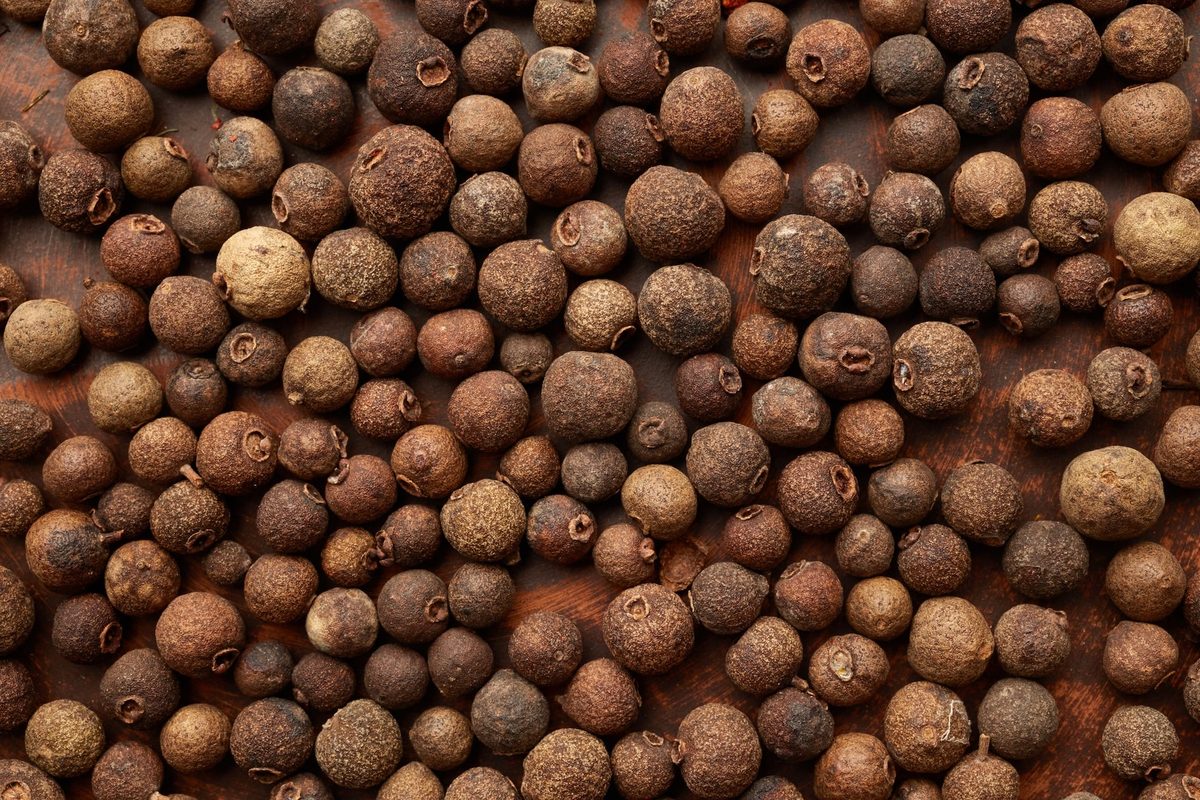
Whole, they are easy to confuse: PROSEA says the first Spanish explorers in the Caribbean took allspice berries for black pepper and called them pimienta, “pepper.”1 In the pot they do different jobs. Allspice is an aromatic, its smell led by eugenol, the compound that dominates cloves.12 Black pepper is a pungent spice, its bite coming from piperine.3 One brings warmth and perfume, the other brings heat.
Side by side
| Allspice | Black pepper | |
|---|---|---|
| Species | Pimenta dioica4 | Piper nigrum5 |
| Family | Myrtaceae (myrtle family)4 | Piperaceae (pepper family)53 |
| Plant | Tree4 | Perennial climbing vine3 |
| Native range | Southern Mexico to Central America and the Caribbean4 | Western Ghats of Kerala, India, per Kew’s species profile and PROSEA; Kew’s distribution data list only Sri Lanka as native56 |
| Part used | The fruit, picked before fully ripe and dried7 | The fruit, dried whole with its outer layer intact8 |
| What gives the bite | Britannica calls it “aromatic and pungent”;7 no source we found names a pungent compound in allspice | Piperine, 4.9–7.7% of black pepper (PROSEA)63 |
| Main aroma compounds | Eugenol, methyl eugenol and myrcene in the oil;9 eugenol 50–80% (PROSEA)1 | Mostly monoterpene and sesquiterpene hydrocarbons, about 90% of the oil (PROSEA)6 |
| Essential oil | About 4.5% for Jamaican allspice berries (Britannica)7 | Up to 3% of ground black pepper (Britannica)3 |
| Flavor (editorial) | Warm, clove-forward, faintly peppery; Britannica compares it to cloves, cinnamon and nutmeg7 | Sharp and hot, with a woody, piney aroma |
| Forms | Whole berries, ground1 | Whole black, white and green peppercorns; cracked and ground8 |
| Typical uses | Jerk, pickling liquids and broths, cakes and pies110 | Seasoning almost everything; Kew calls it one of the most widely used spices in the world5 |
| International standard | None opened for this page | Codex CXS 326-2017 sets grades, including piperine minimums8 |
| Safety | No regulator sets a concern level for allspice in food (see allspice) | Linked to a 2009–10 US Salmonella outbreak (see below)11 |
| Price | No dated, sourced retail comparison found | No dated, sourced retail comparison found |
The two essential oil figures come from different Britannica articles and describe different things, whole Jamaican berries on one side and ground pepper on the other. They show both spices carry a few percent of oil, not that one is stronger than the other.
Why they look alike, and how to tell them apart
Both are small dried fruits. Allspice berries are picked green and turn a dull reddish brown as they dry,7 while black pepper is made from berries dried with the outer skin unbroken.8 PROSEA says the Spanish mistook allspice for pepper because of its shape and flavor, which is how the name “pimento” came into English.1 Allspice is also called Jamaican pepper.7
Allspice is the larger and smoother of the two, and black peppercorns are more wrinkled; that is our description, not a measurement. Ground, allspice looks evenly brown and black pepper looks speckled, again in our observation.
Heat versus warmth
This is the difference that changes a dish.
Black pepper has real pungency. Britannica says its characteristic flavor comes principally from piperine,3 and PROSEA puts piperine at 4.9 to 7.7 percent of black pepper.6 The Codex standard sets piperine minimums of 3.5, 3.0 and 2.0 percent for its three grades of whole black pepper,8 so how hot a given jar is depends on the lot. Piperine acts on the same heat receptor as capsaicin from chiles, but in a cell study it took far more of it to get a response: about 37.9 µM against 0.29 µM for capsaicin.12 That is a laboratory measure, not a taste test, though it fits the everyday experience that pepper is milder than chile.
Allspice is warm, not hot, in our judgment. Britannica calls it pungent,7 but the compounds named in its oil are eugenol, methyl eugenol and myrcene,9 and none of the sources we read reports piperine or a comparable heat compound in it. We found no study that measures how hot allspice tastes, so “warm” here is a description, not a measurement.
Cooking changes pepper more. In a 1992 study of spices boiled in a curry for 15 to 30 minutes, 50 to 60 percent of the piperine was lost.13 That is one reason many cooks add pepper near the end. Allspice is typically used the other way: whole berries go into broths and pickling liquids and ground allspice into batters,1 where it has time to cook in. Adding it early is common practice rather than a tested rule.
Using them in the kitchen
Allspice. In Jamaica it is the heart of jerk: Smithsonian Magazine’s history calls pimento and fresh thyme essential ingredients, and notes that chicken, sausage and pork are the most common meats jerked on the island.10 PepperScale calls allspice “the dominant component in the flavor profiles of jerk dishes” and notes that traditional jerk is also smoked over allspice (pimento) wood.14 PROSEA says whole allspice goes into meat broths, gravies and pickling liquids, and ground allspice is preferred in desserts, fruit cakes and pies.1
Black pepper. Kew calls it one of the earliest known and most widely used spices in the world.5 It goes on nearly everything, from rubs and breading to a final grind over the plate; that is common kitchen practice. In jerk it is optional: Smithsonian lists the modern ingredients as Scotch bonnet peppers, scallions, garlic, ginger, pimento, thyme and cinnamon, with no black pepper.10
Can one stand in for the other?
Rarely, because one supplies heat and the other aroma. No source we found gives a ratio in either direction. The labels below follow our substitute pages: Attributed quotes a named source, Method is our starting point where no published number exists.
| Swap | When it works | Starting amount | Treatment |
|---|---|---|---|
| Black pepper for allspice | Only as a minor note alongside other warm spices | Use the blend below instead | Method |
| Cinnamon, nutmeg and cloves, plus a pinch of black pepper, for allspice | Savory dishes such as rubs and chili | 2:1:1 mix used 1:1 for ground allspice; pepper by the pinch | Attributed (mix), Method (pepper) |
| Allspice for black pepper | Caribbean-style dishes where warmth matters more than bite | A small pinch, then taste | Method |
Replacing allspice. Black pepper alone gives the bite but none of the clove-like warmth. The Spice House’s allspice stand-in is 2 parts cinnamon, 1 part nutmeg and 1 part ground cloves, used 1:1 for ground allspice, with a pinch of black pepper added for savory dishes.15 The pepper is there as an accent, not the base. More options are on our allspice substitutes page.
Replacing black pepper. Allspice will not supply pungency. Where pepper’s job is heat, use another pepper: white pepper is the closest swap, and the ratios are on our black pepper substitutes page. Where you want a warm, aromatic note instead, a small pinch of allspice can do that job, but the dish will taste different.
Safety
Neither spice raises concern at kitchen amounts in any regulator source we found. Pepper has, however, been the vehicle for food poisoning. In a 2009 to 2010 US outbreak of Salmonella Montevideo, investigators linked the illnesses to salami made with black and red pepper, and state testing found the outbreak strain in samples of both peppers.11 For allspice, see the safety section of our allspice profile.
What isn’t known
- No study measures the perceived heat of allspice, or compares it with black pepper.
- No source gives a ratio for swapping allspice and black pepper in either direction.
- The essential oil figures for the two spices come from different articles and sample types.
- No dated price comparison.
Related
- Allspice, allspice substitutes, too much allspice
- Black pepper, black pepper substitutes, too much pepper
- White pepper vs. black pepper, long pepper vs. black pepper, black pepper vs. cayenne
- Allspice vs. cloves, allspice vs. nutmeg, allspice berries vs. juniper berries
- Jerk seasoning, Jamaican spices
Footnotes
-
D. Sulistiarini, Pimenta dioica, Plant Resources of South-East Asia (PROSEA). uses.plantnet-project.org · Reference work ↩ ↩2 ↩3 ↩4 ↩5 ↩6 ↩7 ↩8
-
Batiha et al., “Syzygium aromaticum L. (Myrtaceae)”, Biomolecules, 2020. mdpi.com · Peer-reviewed ↩
-
“Black pepper”, Encyclopaedia Britannica. britannica.com · Reference work ↩ ↩2 ↩3 ↩4 ↩5 ↩6
-
Pimenta dioica (L.) Merr., Plants of the World Online, Royal Botanic Gardens, Kew. powo.science.kew.org · Reference work ↩ ↩2 ↩3 ↩4
-
Piper nigrum L., Plants of the World Online, Royal Botanic Gardens, Kew. powo.science.kew.org · Reference work ↩ ↩2 ↩3 ↩4 ↩5
-
Piper nigrum, Plant Resources of South-East Asia (PROSEA). uses.plantnet-project.org · Reference work ↩ ↩2 ↩3 ↩4
-
“Allspice”, Encyclopaedia Britannica. britannica.com · Reference work ↩ ↩2 ↩3 ↩4 ↩5 ↩6 ↩7
-
Standard for Black, White and Green Peppers, CXS 326-2017, Codex Alimentarius. fao.org · Standard ↩ ↩2 ↩3 ↩4 ↩5
-
Andrade Avila, Cruz-Olivares and Pérez-Alonso, “Antioxidant Effect and Medicinal Properties of Allspice Essential Oil”, IntechOpen, 2022. intechopen.com · Peer-reviewed ↩ ↩2
-
Vaughn Stafford Gray, “A Brief History of Jamaican Jerk”, Smithsonian Magazine, 2020. smithsonianmag.com · Publication ↩ ↩2 ↩3
-
2010 Salmonella Outbreak Linked to Red and Black Pepper/Italian-Style Meats, CDC. archive.cdc.gov · Regulator ↩ ↩2
-
McNamara, Randall and Gunthorpe, “Effects of piperine, the pungent component of black pepper, at the human vanilloid receptor (TRPV1)”, British Journal of Pharmacology, 2005. pmc.ncbi.nlm.nih.gov · Peer-reviewed ↩
-
Srinivasan, Sambaiah and Chandrasekhara, “Loss of active principles of common spices during domestic cooking”, Food Chemistry, 1992. agris.fao.org · Peer-reviewed ↩
-
Matt Bray, “What Is Jerk Seasoning? The Story Behind The Spice”, PepperScale, 2023. pepperscale.com · Publication · PepperScale is also owned by Matt Bray, the editor of this site. ↩
-
Allspice Substitute, The Spice House. thespicehouse.com · Merchant ↩