Spice Substitutes · Substitutes
Allspice Substitutes, Ranked by the Job Allspice Is Doing
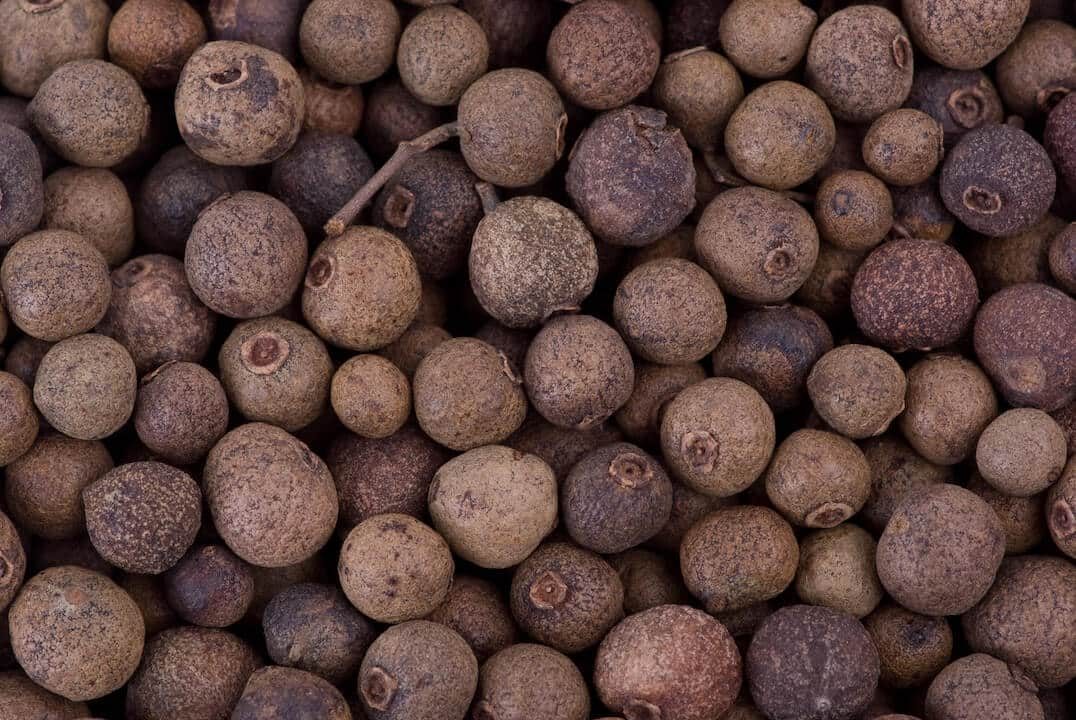
Allspice is one spice, not a blend: the dried berry of Pimenta dioica, a tree in the myrtle family. Britannica says it was named because the dried berry tastes like a combination of cloves, cinnamon and nutmeg.1 That is why those three spices, mixed, are the usual stand-in. What to reach for still depends on what allspice is doing in your recipe: sweetening the warmth of a cake, carrying a savory rub, or flavoring a pot of liquid from whole berries.
Quick answer
| What allspice is doing | Best substitute | Starting amount, per 1 part allspice | Treatment |
|---|---|---|---|
| Warm spice in baking (pies, cakes, cookies) | 2 parts cinnamon, 1 part nutmeg, 1 part cloves, mixed | 1 part of the mix | Attributed |
| Savory warmth (rubs, chili, braises) | The same mix plus a pinch of black pepper | 1 part of the mix, plus a pinch of pepper | Attributed (mix), Method (pepper) |
| A clove-like lead note | Ground cloves alone | 1/2 part, then taste | Method |
| Whole berries in a liquid (pickles, broths) | Ground allspice | 1 teaspoon ground for 5 berries | Computed |
How the ratios on this page are labeled
- Computed: based on a measurable physical relationship, with the source named.
- Attributed: a named source publishes this ratio. We quote it as theirs.
- Disputed: named sources give different answers to the same swap. We show each one and do not average them.
- Method: we found no published ratio. We give a direction and a cautious starting point, and say so.
No published study compares the flavor strength of allspice with any of its substitutes. The ratios below are merchants’ rules of thumb or our starting points, not measurements.
What you are trying to copy
The aroma of allspice sits in its essential oil, whose three main constituents are eugenol, methyl eugenol and myrcene.2 PROSEA puts eugenol at 50 to 80 percent of the berry oil.3 Eugenol is also the dominant compound in clove oil, about 85 to 92 percent of it,4 which is why cloves come closest on their own.
The other two members of the classic trio bring something different. Cinnamon bark oil is dominated by cinnamaldehyde, not eugenol,5 and nutmeg oil is mostly monoterpenes such as pinene and sabinene.6 So the mix copies the overall impression Britannica describes, not the chemistry. That is fine in a cake and less convincing where allspice is the main flavor.
If allspice is a warm spice in baking
1. Cinnamon, nutmeg and cloves, mixed
Ratio (Attributed): The Spice House says to “mix 2 parts cinnamon, 1 part nutmeg, and 1 part ground cloves,” and to use the mix 1:1 wherever a recipe calls for ground allspice.7 Its worked example is 1/2 teaspoon cinnamon, 1/4 teaspoon nutmeg and 1/4 teaspoon cloves for 1 teaspoon of allspice.7
A mix of equal parts of all three is often suggested, but we found no named source for it. With cloves at a quarter of the Spice House mix, cinnamon does most of the sweet work and the cloves supply the eugenol note.
2. Pumpkin pie spice
The Spice House lists pumpkin pie spice as a substitute and calls it “a close match for sweet recipes.”7 What is in it depends on the brand. McCormick’s lists cinnamon, ginger, nutmeg and allspice, with no cloves.8 US rules require ingredients to be listed in descending order by weight,9 so cinnamon is the largest part of that blend. Because it already contains allspice, it carries some of the real thing.
Ratio (Method): No source gives an amount. Start with the same amount as the allspice, taste, and add a pinch of ground cloves if the clove note is missing.
3. Apple pie spice
The Spice House also names apple pie spice.7 McCormick’s lists cinnamon, nutmeg and allspice.10
Ratio (Method): No source gives an amount. Start 1:1 and taste. Expect a more cinnamon-forward result.
If allspice is savory warmth
Allspice is central to Jamaican jerk. Smithsonian Magazine’s history of the dish calls pimento (allspice) and fresh thyme essential ingredients, and notes that traditional jerk meat is smoked over pimento wood.11 Nothing on this page reproduces that. In a rub, a chili or a braise where allspice is one warm note among several, a substitute works better.
1. The same mix, plus black pepper
The Spice House suggests leaning on cinnamon, with smaller equal amounts of clove and nutmeg, and adding a pinch of black pepper for savory dishes.7 The pepper link is old: PROSEA says Spanish explorers took the berries for black pepper because of their shape and flavor and called them pimienta, which English turned into “pimento.”3
Ratio: Use the 2:1:1 mix 1:1 (Attributed to The Spice House, above).7 For the pepper, no source gives an amount (Method): add a small pinch per teaspoon of mix and taste.
2. Ground cloves alone
Cloves share allspice’s main aroma compound,24 so they come closest where allspice is the lead flavor. They are also far richer in essential oil: Britannica gives 14 to 20 percent for clove buds and about 4.5 percent for Jamaican allspice.121 Nobody has measured how that translates into strength in a dish, but it is the reason to start low.
Ratio (Method): We found no published ratio. Start with half as much ground clove as the allspice called for, taste, and build up.
3. Mace
Mace is the dried covering of the nutmeg seed.13 Its oil is rich in aromatic ethers such as elemicin, and the FAO notes a higher share of these in mace than in nutmeg oil.6 It brings warmth but not allspice’s clove note.
Ratio (Method): No published ratio. Start with half the allspice amount and combine it with a little clove if you have it.
Cincinnati chili shows how these spices work together: Saveur’s recipe uses allspice alongside cinnamon, cloves and nutmeg.14 If one is missing, the others cover for it.
If allspice is whole berries in a liquid
PROSEA says whole allspice goes into meat broths, gravies and pickling liquids, while ground allspice is preferred for desserts.3 In a liquid, the berries slowly give up their flavor and are easy to fish out.
1. Ground allspice
Ratio (Computed): McCormick’s conversion is 5 whole berries (1 teaspoon) to 1 teaspoon ground allspice.15 This is a volume conversion, not a potency measurement. Ground spice releases its flavor faster and cannot be strained out, so add it later in the cooking and expect a cloudier liquid.
The Spice House suggests 4 to 6 whole berries per quart of liquid for long simmers and braises, removed before serving.7 Put the two together and five berries in a quart, or about a teaspoon of ground allspice by McCormick’s conversion, is a reasonable scale for a pot of liquid.715
2. Whole cloves with a few black peppercorns
Ratio (Method): No published ratio. Because cloves hold much more oil than allspice berries,121 start with about half as many whole cloves as the allspice berries called for, add a couple of peppercorns, and taste the liquid before it finishes.
If you have whole berries and the recipe calls for ground, The Spice House says to grind them in a spice grinder or mortar and pestle.7 Use the same McCormick conversion: 5 berries for each teaspoon.15
What isn’t known
- No published measurement compares the flavor strength of allspice and any substitute. The Spice House’s 2:1:1 mix is a merchant’s rule of thumb.
- No source gives a ratio for ground cloves, mace, pumpkin pie spice or apple pie spice in place of allspice.
- Allspice oil varies widely by origin: in studies compiled in one 2022 review, eugenol ranged from about 8 percent to about 86 percent of berry oil, and one Mexican oil was dominated by methyl eugenol.2 How close cloves come depends on the lot of allspice you are replacing.
- Brand blends do not publish their proportions, so how much allspice is in a given pumpkin or apple pie spice is not known.
Related
- Allspice, too much allspice
- Allspice vs. cloves, allspice vs. nutmeg, allspice vs. black pepper, mace vs. allspice
- Cinnamon, nutmeg, cloves, mace, black pepper
- Pumpkin pie spice, apple pie spice, jerk seasoning, pickling spice
- Substitutes for cloves, nutmeg substitutes, mace substitutes
Footnotes
-
“Allspice”, Encyclopaedia Britannica. britannica.com · Reference work ↩ ↩2 ↩3
-
Andrade Avila, Cruz-Olivares and Pérez-Alonso, “Antioxidant Effect and Medicinal Properties of Allspice Essential Oil”, IntechOpen, 2022. intechopen.com · Peer-reviewed ↩ ↩2 ↩3
-
D. Sulistiarini, Pimenta dioica, Plant Resources of South-East Asia (PROSEA). uses.plantnet-project.org · Reference work ↩ ↩2 ↩3
-
Batiha et al., “Syzygium aromaticum L. (Myrtaceae)”, Biomolecules, 2020. mdpi.com · Peer-reviewed ↩ ↩2
-
Ranasinghe et al., “Medicinal properties of ‘true’ cinnamon”, BMC Complementary and Alternative Medicine, 2013. link.springer.com · Peer-reviewed ↩
-
Production, handling and processing of nutmeg and mace, Section VI: Composition and chemistry, FAO. fao.org · Reference work ↩ ↩2
-
Allspice Substitute, The Spice House. thespicehouse.com · Merchant ↩ ↩2 ↩3 ↩4 ↩5 ↩6 ↩7 ↩8 ↩9
-
McCormick Pumpkin Pie Spice, product page, McCormick. mccormick.com · Merchant ↩
-
21 CFR 101.4, Food; designation of ingredients, eCFR. ecfr.gov · Regulator ↩
-
McCormick Apple Pie Spice, product page, McCormick. mccormick.com · Merchant ↩
-
Vaughn Stafford Gray, “A Brief History of Jamaican Jerk”, Smithsonian Magazine, 2020. smithsonianmag.com · Publication ↩
-
“Clove”, Encyclopaedia Britannica. britannica.com · Reference work ↩ ↩2
-
“Mace”, Encyclopaedia Britannica. britannica.com · Reference work ↩
-
“Cincinnati Chili”, Saveur. saveur.com · Publication ↩
-
How to Grind Your Own Spices, McCormick. mccormick.com · Merchant ↩ ↩2 ↩3