Spices · Profile
Anise Seed: Flavor, Anethole, History and How to Use It
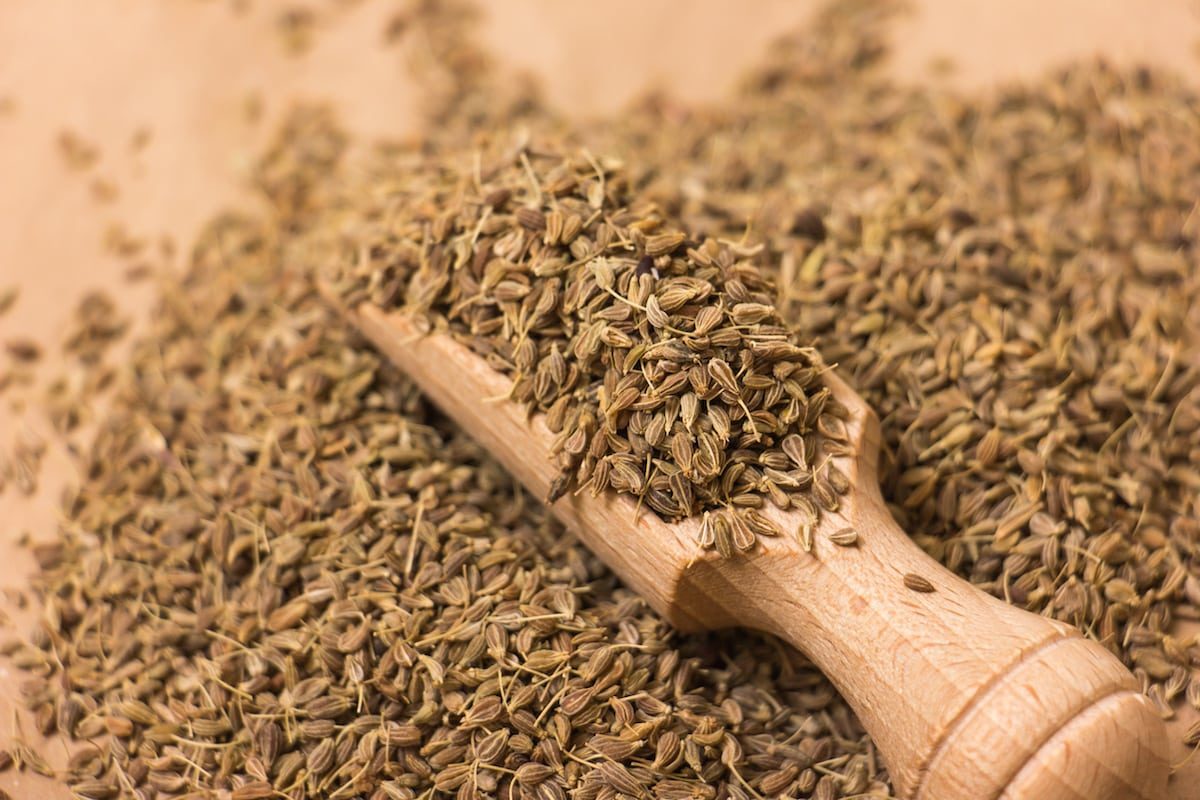
Anise seed, or aniseed, is the dried fruit of Pimpinella anisum, an annual herb in the parsley family from the eastern Mediterranean.12 Its sweet, licorice-like taste comes almost entirely from one compound, trans-anethole, and it flavors pastries, breads, candies and a family of spirits from absinthe to anisette.32 It is not the same plant as star anise, which carries the same compound. This page covers what it is, its chemistry, where it comes from, how it is used, and what regulators say about it.
At a glance
| Botanical name | Pimpinella anisum L.1 |
| Plant family | Apiaceae (carrot/parsley family)12 |
| Part used | The dried fruit (a schizocarp), sold as “seed”2 |
| Native range | Southeastern Türkiye to central Israel and Cyprus (Kew); Egypt and the eastern Mediterranean (Britannica)12 |
| Key aroma compound | trans-Anethole, 80–95% of the essential oil3 |
| Essential oil | About 2.5% (Britannica); 1.9–3.1% by hydrodistillation (PROSEA)32 |
| Forms sold | Whole seed, ground, essential oil |
| Not to be confused with | Star anise, Illicium verum, a tree in a different family34 |
Measured values
8 figures, sourced| Measure | Value | Scope | Source |
|---|---|---|---|
| trans-Anethole | 80–95 % of essential oil | PROSEA | uses.plantnet-project.org |
| Methyl chavicol (estragole) | up to 5 % of essential oil | PROSEA | uses.plantnet-project.org |
| Essential oil | about 2.5 % of seed | BritannicaSources differ | britannica.com |
| Essential oil | 1.9–3.1 % of seed, by hydrodistillation | PROSEA; yield depends on methodSources differ | uses.plantnet-project.org |
| Essential oil | 2.3 % of seed, by hydrodiffusion | PROSEA | uses.plantnet-project.org |
| Calcium Nutrient | 646 mg per 100 g | whole anise seed, USDA FoodData Central FDC 171316 | fdc.nal.usda.gov |
| Iron Nutrient | 37.0 mg per 100 g | whole anise seed, USDA FoodData Central FDC 171316 | fdc.nal.usda.gov |
| Vitamin C Nutrient | 21.0 mg per 100 g | whole anise seed, USDA FoodData Central FDC 171316 | fdc.nal.usda.gov |
Each figure is quoted as its source states it, with the samples or standard it applies to. Where sources differ, both are shown; nothing is averaged. All measured values
What anise is
Anise is an annual that grows to about 0.75 m, with small yellowish-white flowers in loose umbels.2 The “seed” is a dry fruit, nearly ovoid, about 3.5 mm long, with five ridges along its back.2 PROSEA says the fruits are ready to harvest when they turn grayish-green.3
Anise, star anise and fennel
Three common spices share the same licorice-like note, and they are easy to mix up:
| Anise seed | Star anise | Fennel seed | |
|---|---|---|---|
| Plant | Pimpinella anisum, an annual herb2 | Illicium verum, an evergreen tree4 | Foeniculum vulgare, a perennial herb5 |
| Family | Apiaceae1 | Schisandraceae4 | Apiaceae5 |
| trans-Anethole in the oil | 80–95%3 | 70–93%6 | Up to 70–80% in sweet fennel5 |
Each figure is from a separate PROSEA entry describing different samples, so the ranges show the overlap rather than a ranking. PROSEA warns that anise should not be confused with star anise,3 and notes that fennel and anise fruits are often confused and substituted for each other.5 See star anise, star anise vs. anise seed, fennel seed and fennel seed vs. anise seed.
Flavor and the compounds behind it
Anise tastes sweet and licorice-like, warmer and rounder than fennel, with a faintly herbal finish. That description is ours. Britannica says its flavor resembles licorice.2 PROSEA makes a finer point: the flavor of anise is often confused with that of licorice and wrongly called licorice-like, and anise oil is traditionally used together with licorice root in licorice candy.3
The chemistry is unusually simple. PROSEA gives the oil as 80–95% trans-anethole, which it calls the character-impact compound, with up to 5% methyl chavicol (estragole).3 Britannica gives the oil content as about 2.5% and names anethole as its principal component.2 PROSEA’s yield depends on method: 1.9–3.1% by hydrodistillation and 2.3% by hydrodiffusion, with solvent (CO2) extraction yielding more.3
Origin and history
Where anise is native depends on the reference:
| Source | Native range |
|---|---|
| Kew Plants of the World Online | Southeastern Türkiye to central Israel, and Cyprus1 |
| Britannica | Egypt and the eastern Mediterranean region2 |
| PROSEA | Probably the eastern Mediterranean region3 |
Kew lists Egypt neither as native nor as introduced.1 PROSEA says anise is known to have been used by the ancient Egyptians around 1500 BC.3 Britannica says it has been used medicinally since prehistoric times.2
The English word came in around 1300 by way of Old French and Latin from Greek, and the Online Etymology Dictionary notes that the ancients somewhat confused anise with dill.7 The popular claim that the Latin name was taken from a Greek word for dill is not what that source says.
Several stories circulate widely and could not be traced to a source: that Pythagoras praised anise, that Romans served an anise-spiced cake at weddings that was the first wedding cake, and that Hippocrates and Dioscorides prescribed it for coughs.
Where it is grown
Britannica lists anise as cultivated in southern Europe, southern Russia, the Middle East, North Africa, Pakistan, China, Chile, Mexico and the United States.2 Kew records it as introduced across much of Europe and in places as far apart as India, Morocco, Guatemala and Argentina.1
Trade figures are old and thin. PROSEA reports that in the 1980s the main exporters were the former Soviet Union, Spain and Poland, with France the main importer, and that world output of anise oil was estimated at 40–50 tonnes a year.3 We found no current official production figure for anise seed.
How anise seed is used
- Baking and sweets. Britannica says aniseed is widely used to flavor pastries and is the characteristic ingredient of the German bread Anisbrot.2 PROSEA lists sweets, confectionery and baked goods, and the traditional pairing of anise oil with licorice in licorice candy.3
- Savory dishes. Britannica notes that in the Mediterranean region and in Asia it is commonly used in meat and vegetable dishes, and PROSEA says it flavors curries.32
- Spirits. Britannica names absinthe, anisette and Pernod as liqueurs flavored with the oil; PROSEA also names anisette.32
- Tea. Britannica notes that it makes a soothing herbal tea.2
In the United States it is widely associated with Italian sausage and pizzelle cookies; that is common practice, not something the sources above address.
In the kitchen
These are cooking judgments, not measured facts. Whole seeds go into breads, cookies and sausage mixes; toasting them briefly in a dry pan brings up the aroma, and crushing them just before use releases more. Ground anise is strong and loses aroma quickly. Start small: a little anise reads as warmth, and too much reads as candy.
Buying and quality
PROSEA reports that anise fruits are adulterated with exhausted fruits left over from distillation, dust, and similar-looking fruits and seeds, and that ground anise is adulterated with ground fennel.3 Buying whole seed avoids most of that; good seed is grayish-green to brown, clean and strongly aromatic when crushed (kitchen judgment).
Storage
PROSEA says anise is hard to store because its essential-oil content falls quickly, and recommends airtight containers in a cool, dark place.3 We found no shelf-life figure from a regulator or standards body.
Nutrition
USDA FoodData Central gives a tablespoon of whole anise seed as 6.7 g and a teaspoon as 2.1 g.8 Using its per-100 g values (646 mg calcium, 37.0 mg iron, 21.0 mg vitamin C) and FDA Daily Values (1,300 mg, 18 mg and 90 mg),89 our arithmetic gives:
| Amount | Calcium | Iron | Vitamin C |
|---|---|---|---|
| 1 tablespoon (6.7 g) | 43 mg, about 3% DV | 2.5 mg, about 14% DV | 1.4 mg, about 2% DV |
| 1 teaspoon (2.1 g) | 14 mg, about 1% DV | 0.8 mg, about 4% DV | 0.4 mg, under 1% DV |
In our judgment a tablespoon is more than most recipes use, so iron is the only nutrient here that adds up to much.
Health and safety
What regulators accept. The European Medicines Agency’s herbal committee accepts aniseed medicines on the basis of traditional use only (at least 30 years, including 15 in the EU): for mild indigestion including bloating and flatulence, and as an expectorant in coughs with colds.10 It limits them to adults and adolescents over 12, advises against use for more than two weeks, and says they must not be used by people allergic to aniseed or anethole.10 The acceptance rests on long-standing use, not on clinical trials. Claims that anise treats insomnia or anxiety could not be traced to any regulator or review.
Estragole. Anise oil contains up to 5% estragole.3 The EU’s former Scientific Committee on Food concluded in 2001 that estragole has been demonstrated to be genotoxic and carcinogenic.11 We found no regulatory limit on estragole in anise seed sold as a spice.
Substitutes and comparisons
Star anise and fennel seed are the nearest substitutes because they share anethole. No source we found gives a tested swap ratio. See anise seed substitutes for the ranked list, and star anise vs. anise seed and fennel seed vs. anise seed for comparisons. Related: star anise uses, tarragon and chervil, which also have anise-like notes.
Footnotes
-
Pimpinella anisum L., Plants of the World Online, Royal Botanic Gardens, Kew. powo.science.kew.org · Reference work ↩ ↩2 ↩3 ↩4 ↩5 ↩6 ↩7 ↩8
-
“Anise”, Encyclopaedia Britannica. britannica.com · Reference work ↩ ↩2 ↩3 ↩4 ↩5 ↩6 ↩7 ↩8 ↩9 ↩10 ↩11 ↩12 ↩13 ↩14 ↩15 ↩16 ↩17 ↩18
-
L.B. Cardenas and C.C. de Guzman, Pimpinella anisum, Plant Resources of South-East Asia (PROSEA). uses.plantnet-project.org · Reference work ↩ ↩2 ↩3 ↩4 ↩5 ↩6 ↩7 ↩8 ↩9 ↩10 ↩11 ↩12 ↩13 ↩14 ↩15 ↩16 ↩17 ↩18 ↩19
-
Illicium verum Hook.f., Plants of the World Online and Kew Species Profiles, Royal Botanic Gardens, Kew. powo.science.kew.org · Reference work ↩ ↩2 ↩3
-
Purwaningsih, Harmida and M. Brink, Foeniculum vulgare, Plant Resources of South-East Asia (PROSEA). uses.plantnet-project.org · Reference work ↩ ↩2 ↩3 ↩4
-
Vu Ngoc Lô, Illicium verum, Plant Resources of South-East Asia (PROSEA). uses.plantnet-project.org · Reference work ↩
-
“anise (n.)”, Online Etymology Dictionary. etymonline.com · Reference work ↩
-
“Spices, anise seed”, FDC ID 171316, USDA FoodData Central. fdc.nal.usda.gov · Regulator ↩ ↩2
-
“Daily Value on the Nutrition and Supplement Facts Labels”, U.S. Food and Drug Administration. fda.gov · Regulator ↩
-
“Anisi fructus”, herbal medicine overview, European Medicines Agency. ema.europa.eu · Regulator ↩ ↩2
-
Opinion of the Scientific Committee on Food on Estragole, European Commission, 2001. food.ec.europa.eu · Regulator ↩