Spices · Profile
Star Anise: Flavor, Anethole, Uses and the Japanese Star Anise Danger
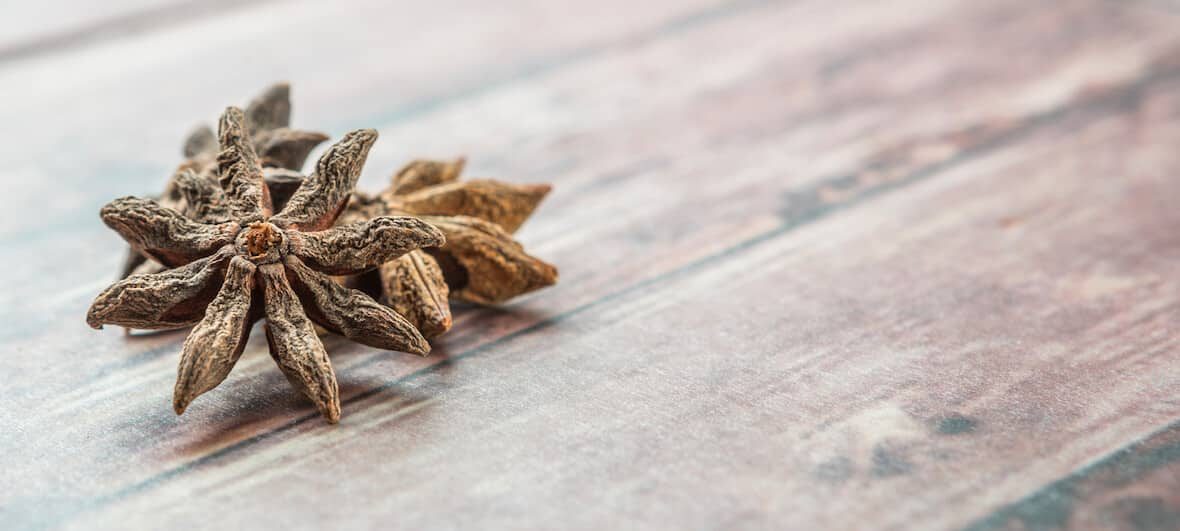
Star anise is the dried, star-shaped fruit of Illicium verum, an evergreen tree from southern China and northern Vietnam.12 It tastes strongly of licorice, and it is a defining flavor of Chinese five-spice powder and Vietnamese pho. It also has a toxic look-alike, Japanese star anise, which is the most important thing to know before buying it. This page covers both.
At a glance
| Botanical name | Illicium verum Hook.f.1 |
| Plant family | Schisandraceae1 |
| Part used | The fruit, harvested just before ripening and dried13 |
| Native range | Thought most likely southern China and northeastern Vietnam (Kew); known only from cultivation (PROSEA)13 |
| Main producers | China and Vietnam3 |
| Key aroma compound | trans-Anethole, 70–93% of the essential oil3 |
| Essential oil | 3–3.5% yield by steam distillation of the fruit3 |
| Forms sold | Whole stars, broken pieces, ground, essential oil |
| Toxic look-alike | Japanese star anise, Illicium anisatum145 |
Measured values
2 figures, sourced| Measure | Value | Scope | Source |
|---|---|---|---|
| Essential oil yield | 3–3.5 % of fruit, by steam distillation | Star anise fruit, PROSEA | uses.plantnet-project.org |
| trans-Anethole | 70–93 % of essential oil | Star anise oil, PROSEA | uses.plantnet-project.org |
Each figure is quoted as its source states it, with the samples or standard it applies to. Where sources differ, both are shown; nothing is averaged. All measured values
What star anise is
Kew describes Illicium verum as an evergreen tree up to about 15 m tall with glossy leaves and solitary yellow-green flowers.1 The fruit is a cluster of boat-shaped follicles arranged in a star: PROSEA gives usually 8 follicles (from 5 to 13), the whole fruit 2.5–4.5 cm across, each follicle 1–2 cm long, rough, rigid and reddish-brown, holding one glossy, light-brown seed.3
The fruits are picked just before they ripen, when their oil content is high, by climbing the trees and picking by hand or with a hooked pole, then dried in the sun for about 10 days.13
Flavor and the compounds behind it
Star anise smells and tastes of licorice, sweet and penetrating, with a slightly bitter, woody edge. That description is ours.
The chemistry is simple compared with most spices. PROSEA reports an essential-oil yield of 3–3.5% from the fruit, and gives trans-anethole as the oil’s chief constituent at 70–93%.3 The oil has a characteristic anise-like smell and sweet flavor.3 Anise seed and fennel are the spices it is most often compared with; see star anise vs. anise seed and fennel seed vs. anise seed. No source we reviewed for this page measured their flavor compounds side by side, so that comparison is not quantified here.
Two widely repeated claims could not be traced: that star anise is “the most pungent” of the three anise-flavored spices, and that the pods carry more flavor than the seeds. Both may be true in practice but neither appears in the sources we reviewed.
Origin and history
Kew says Illicium verum is thought most likely to be native to southern China and northeastern Vietnam, and that it has been cultivated since about 2,000 BC.1 PROSEA says it is known only from cultivation, with semi-wild populations in abandoned plantations, and most probably originated in southeastern China (Guangxi, Guangdong, Fujian, Guizhou and Yunnan).3 Kew lists it today as cultivated in China, Laos, Vietnam, Korea, Japan, Taiwan, Hainan and the Philippines.1
How it reached Europe: a date that doesn’t fit
PROSEA says Europeans long believed star anise came from the Philippines because in 1578 the navigator Thomas Cavendish brought the first fruits, which originated in southern China, to Europe by way of the Philippines.3 Britannica’s biography of Cavendish, however, dates his round-the-world voyage from July 1586 to September 1588, and places his stop in the Philippines after November 1587.6 The 1578 date and the Cavendish attribution cannot both be right. We report the conflict rather than choose a version; the date of star anise’s arrival in Europe is not settled by the sources we found.
Claims that its eight points were a sign of good luck in China, and that it was used in Russia from the 17th century and in Germany from the 18th, could not be traced to a source.
Production and trade
PROSEA names China and Vietnam as the major producers and exporters of star anise fruit and oil, with China providing the bulk of both.3 It reports that Vietnam exports 200–250 tonnes of star anise essential oil a year, mainly to France, the Czech Republic and Slovakia, but gives no year for the figure.3 We found no current official production statistics for star anise.
How star anise is used
- China. Kew says star anise is generally used in pork and chicken dishes in China.1 It is one of the five spices in Chinese five-spice powder, which The Woks of Life lists as cinnamon, cloves, fennel, star anise and Sichuan peppercorns.7
- Vietnam. Star anise is a standard pho spice. NPR’s one-day pho recipe adds two or three whole stars to the broth along with cinnamon, cloves and peppercorns.8
- Drinks. Star anise flavors liqueurs and spirits; Kew names Galliano, sambuca, pastis and some types of absinthe.1 Britannica says the essential oil flavors candies, liqueurs and perfumes.2 In Thailand, iced tea is brewed from black tea flavored with star anise powder, according to Katzer.9
- Processed foods. PROSEA lists beverages, baked goods, gelatins, puddings, and meat products among the products flavored with the fruit and oil.3
- Baking. By common practice it pairs with cinnamon, nutmeg and cloves in spiced desserts, poached fruit and mulled drinks.
In the kitchen
These are cooking judgments, not measured facts. Whole stars are simmered in braises, broths and syrups and removed before serving; one or two stars flavor a large pot. Ground star anise is very strong and easy to overdo, and too much can turn a dish bitter and medicinal. For more, see cooking with star anise and star anise uses.
Buying and quality
Know your star anise. PROSEA warns that star anise fruits are sometimes adulterated with similar-looking fruits of Illicium cambodianum or Illicium anisatum, the toxic Japanese star anise.3 It describes Japanese star anise fruits as more irregular, with wrinkled sides and finer, longer tips, a balsamic smell and a bitter taste.3 Those differences are not a reliable home test: FDA’s 2003 advice applied until the agency was able to differentiate between Japanese and Chinese star anise,5 and Kew researchers developed a laboratory method (thermal desorption gas chromatography-mass spectrometry) to distinguish the two.10 The practical safeguard is to buy star anise sold as a food spice from a reputable supplier and never use star anise sold for decoration or potpourri in food.
Whole stars should be intact, deep reddish-brown and strongly aromatic. That is kitchen judgment; we found no Codex grading standard for star anise to check it against.
Storage
After drying, PROSEA says the fruits are kept in a cool, dry place.3 For the essential oil, it specifies airtight containers at no more than 25 °C, protected from light.3 We found no shelf-life figure for whole or ground star anise from a regulator or standards body.
Safety: Japanese star anise
Japanese star anise (Illicium anisatum) is a separate species in the same genus.4 Kew’s star anise profile calls it highly toxic,1 and PROSEA describes its fruits as poisonous.3
In September 2003 the US Food and Drug Administration advised the public not to drink “teas” brewed from star anise.5 FDA had learned of about 40 illnesses over the previous two years, including about 15 in infants, with symptoms ranging from seizures to vomiting, jitteriness and rapid eye movement.5 The agency’s concern was that Chinese star anise, which it considers generally recognized as safe, may contain Japanese star anise, which “has long been recognized as toxic in many countries” and should be used only for decoration.5 Until it could tell the two apart, FDA advised against tea brewed from any star anise, and it said it would monitor imports so that Japanese star anise is not labeled or marketed as food.5 All the affected people, including the infants, recovered without complications.5
The first cases were identified at Miami Children’s Hospital, and FDA also received similar reports from several other US states and from the Netherlands, France and Spain.5
Health claims
Kew records that star anise is used in traditional Chinese medicine as a stimulant and expectorant and to relieve flatulence.1 That is a record of traditional use, not evidence that it works.
Shikimic acid and Tamiflu. Star anise contains shikimic acid, which is used in making an anti-influenza drug.2 Kew’s profile says star anise has been used as a source of shikimic acid, a primary precursor in the production of anti-influenza drugs such as Tamiflu.1 That is an industrial use of an extracted chemical; it does not mean that eating star anise or drinking star anise tea protects against or treats the flu. Given FDA’s advice above, star anise tea is not a safe home remedy.
Widely repeated claims that star anise fights candida, kills antibiotic-resistant bacteria, boosts immunity with quercetin, or acts as a significant antioxidant could not be traced to any review or regulator, and are not made here.
Substitutes and comparisons
Anise seed is the nearest flavor match; Chinese five-spice powder can stand in where the dish is already Chinese-spiced. See star anise substitutes for the ranked list, and star anise vs. anise seed and cloves vs. star anise for side-by-side comparisons. Related: anise seed and fennel seed.
Footnotes
-
Illicium verum Hook.f., Plants of the World Online and Kew Species Profiles, Royal Botanic Gardens, Kew. powo.science.kew.org · Reference work ↩ ↩2 ↩3 ↩4 ↩5 ↩6 ↩7 ↩8 ↩9 ↩10 ↩11 ↩12 ↩13 ↩14 ↩15
-
“Star anise”, Encyclopaedia Britannica. britannica.com · Reference work ↩ ↩2 ↩3
-
Vu Ngoc Lô, Illicium verum, Plant Resources of South-East Asia (PROSEA). uses.plantnet-project.org · Reference work ↩ ↩2 ↩3 ↩4 ↩5 ↩6 ↩7 ↩8 ↩9 ↩10 ↩11 ↩12 ↩13 ↩14 ↩15 ↩16 ↩17 ↩18 ↩19
-
Illicium anisatum L., Plants of the World Online, Royal Botanic Gardens, Kew. powo.science.kew.org · Reference work ↩ ↩2
-
“Teas Made from Star Anise Were Associated With Illnesses Including Seizures”, Center for Food Safety and Applied Nutrition 2003, U.S. Food and Drug Administration Enforcement Story Archive. fda.gov · Regulator ↩ ↩2 ↩3 ↩4 ↩5 ↩6 ↩7 ↩8
-
“Thomas Cavendish”, Encyclopaedia Britannica. britannica.com · Reference work ↩
-
“Five Spice Powder”, The Woks of Life, 2020. thewoksoflife.com · Publication ↩
-
T. Susan Chang, “One-Day Pho”, NPR, 2012. npr.org · Publication ↩
-
Gernot Katzer, “Star Anise”, Gernot Katzer’s Spice Pages. gernot-katzers-spice-pages.com · Reference work ↩
-
Melanie-Jayne R. Howes, Geoffrey C. Kite and Monique S. J. Simmonds, “Distinguishing Chinese Star Anise from Japanese Star Anise Using Thermal Desorption-Gas Chromatography-Mass Spectrometry”, Journal of Agricultural and Food Chemistry, 2009 (Kew research repository). kew.iro.bl.uk · Peer-reviewed ↩