Spice Comparisons · Comparison
Star Anise vs. Anise Seed: Same Licorice Compound, Unrelated Plants
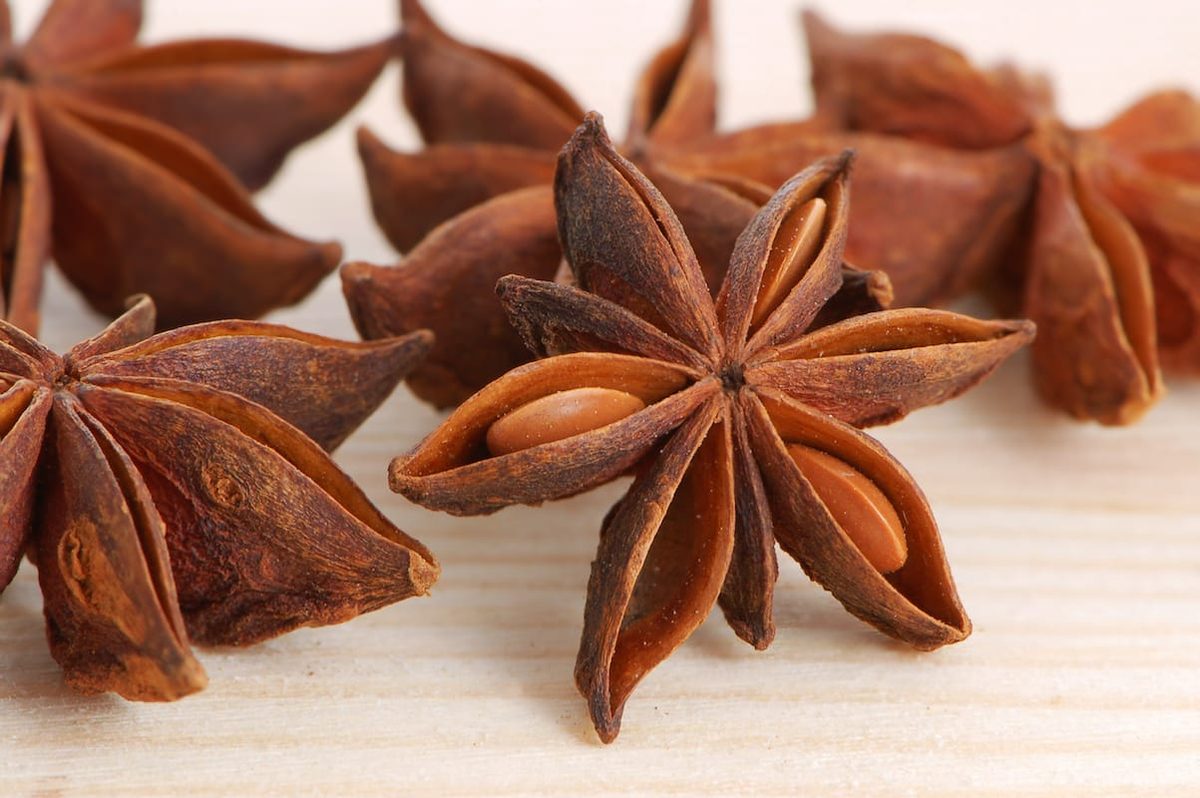
Star anise and anise seed taste alike for one reason: the essential oil of each is mostly trans-anethole, the licorice-like compound.12 Otherwise they have nothing in common. Star anise is the star-shaped fruit of a tree from southern China and northeastern Vietnam; anise seed is the tiny fruit of an annual herb in the parsley family from the eastern Mediterranean.345 Star anise is the stronger of the two by volume,6 it has a toxic look-alike that anise seed does not, and whether one can stand in for the other depends on how much the licorice note matters in the dish.
Side by side
| Star anise | Anise seed | |
|---|---|---|
| Species | Illicium verum3 | Pimpinella anisum4 |
| Family | Schisandraceae3 | Apiaceae (parsley family)45 |
| Plant | A tree3 | An annual herb up to 0.75 m (2.5 ft) tall5 |
| Native range | Thought most likely southern China and northeastern Vietnam (Kew); known only from cultivation (PROSEA)31 | Southeastern Türkiye to central Israel and Cyprus (Kew); Egypt and the eastern Mediterranean (Britannica)45 |
| Part used | The whole fruit, a star of usually 8 boat-shaped pods, 2.5–4.5 cm across1 | The dried fruit, about 3.5 mm long with five ridges5 |
| Essential oil | 3–3.5% yield by steam distillation1 | About 2.5% (Britannica); 1.9–3.1% by hydrodistillation (PROSEA)52 |
| trans-Anethole, share of the oil | 70–93%1 | 80–95%, which PROSEA calls the character-impact compound2 |
| Flavor (editorial) | Sweet licorice with a woody, slightly bitter edge | Sweet licorice, rounder and more herbal |
| Typical uses | Pork and chicken dishes in China; pho; five-spice378 | Pastries and breads such as Anisbrot; meat and vegetable dishes5 |
| Spirits | Galliano, sambuca, pastis, some absinthes (Kew)3 | Absinthe, anisette, Pernod (Britannica)5 |
| Safety | Toxic look-alike, Japanese star anise (see below)910 | No comparable look-alike issue in the sources reviewed |
| Price | No dated, sourced retail comparison found | No dated, sourced retail comparison found |
The oil and anethole figures come from separate PROSEA and Britannica entries describing different samples, so the ranges show overlap, not a ranking. PROSEA notes that star anise products compete with those of anise precisely because anethole is the main oil component of both.1
Why they taste alike, and why tasters can still tell
America’s Test Kitchen puts it this way: the licorice character of anise seed, fennel seed and star anise comes from high concentrations of trans-anethole, but each comes from a different plant with its own secondary compounds.11 Those are what a careful taster picks up. In our judgment, star anise reads woodier and a little bitter, anise seed sweeter and more herbal. PROSEA adds a point about the word itself: the flavor of anise is often confused with licorice and wrongly called licorice-like, and anise oil is traditionally paired with licorice root in licorice candy.2
What you’re looking at
Star anise. The “star” is a cluster of boat-shaped pods, usually 8 but anywhere from 5 to 13, forming a fruit 2.5 to 4.5 cm across. Each rough, reddish-brown pod holds one smooth, glossy, light-brown seed about 8 to 9 mm long.1 The fruits are harvested just before ripening, when their oil content is high.3 In the kitchen the whole star is used, pods and seeds together (common practice).
Anise seed. What is sold as anise seed is a whole dry fruit, nearly ovoid, about 3.5 mm long, with five ridges down its back.5 PROSEA says the fruits are ready to harvest when they turn grayish-green.2
How each is used
Star anise. Kew says star anise is generally used in pork and chicken dishes in China.3 It is one of the spices in Chinese five-spice, though not the largest part: The Woks of Life’s recipe uses 2 parts fennel seed to 1 part star anise.8 NPR’s one-day pho adds star anise to the broth with cinnamon, cloves and peppercorns.7 Whole stars are usually simmered and lifted out before serving (common practice). A star in apple pie filling or poached fruit is a cook’s choice rather than a tradition (our judgment).
Anise seed. Britannica says aniseed is widely used to flavor pastries and is the characteristic ingredient of the German bread Anisbrot, and that in the Mediterranean and Asia it goes into meat and vegetable dishes.5 America’s Test Kitchen tested the swap in anise biscotti and in Italian sausage meatballs,11 two dishes where anise seed is commonly used (common practice).
Spirits. The two split the anise-flavored drinks between them. Kew names Galliano, sambuca, pastis and some types of absinthe as made with star anise;3 Britannica names absinthe, anisette and Pernod as flavored with anise oil.5 Which a given brand uses is up to its maker. A widely repeated claim lists ouzo as flavored with anise seed; neither source opened here names ouzo.
Can one stand in for the other?
Sources disagree on whether they should, not on how much. America’s Test Kitchen’s tasters “easily picked out differences” in biscotti and quickly noticed when fennel and then anise seed went into pho, though differences were harder to detect in meatballs crowded with other spices; it advises against treating them as interchangeable.11 The Spice House calls anise seed “a great substitute for star anise.”6 Our reading: where licorice is the flavor you would name, expect a noticeable change; in a busy spice mix, it may pass.
The amounts below come from our star anise substitutes and anise seed substitutes pages and keep their labels: Attributed quotes a named source, Method is our starting point where no published number exists.
| Swap | Starting amount | Treatment |
|---|---|---|
| Anise seed for 1 whole star anise | 1/2 teaspoon | Attributed (The Spice House; A Couple Cooks) |
| 1 whole star anise for 1/2 teaspoon anise seed | 1 star | Attributed (The Spice House, read in reverse) |
| Ground star anise for anise seed in baking | Roughly equal volumes; start a little under | Method |
| Whole star anise to ground | 1 star = 1/2 teaspoon ground | Attributed (McCormick conversion) |
Anise seed in place of star anise. The Spice House says star anise is the stronger of the two and that 1/2 teaspoon of anise seed replaces one whole star; A Couple Cooks gives the same figure.612 Neither says how the figure was set. In a broth or braise, tie the seeds in a tea ball or cheesecloth so they can come out with the other whole spices.
Star anise in place of anise seed. For a steeped liquid, use one whole star per 1/2 teaspoon of anise seed. For baking, grind it: McCormick puts one whole star at 1/2 teaspoon ground,13 so the two swaps together give roughly equal volumes of ground star anise and anise seed. That is arithmetic across two sources, not a tested ratio, so start a little under it in a delicate cookie and taste.
Safety: Japanese star anise
Japanese star anise, Illicium anisatum, is a separate species in the same genus as star anise.10 In September 2003 the FDA advised the public not to drink “teas” brewed from star anise after learning of about 40 illnesses, about 15 of them in infants, with symptoms that included seizures.9 Its concern was that Chinese star anise, which it considers generally recognized as safe, may contain Japanese star anise, which “has long been recognized as toxic in many countries.”9 PROSEA notes that star anise is sometimes adulterated with similar-looking fruits, including Japanese star anise.1 Buy star anise sold as a food spice, and never cook with stars sold for decoration or potpourri.
Anise seed has no comparable look-alike problem in the sources reviewed here. PROSEA’s adulteration concerns for anise are exhausted fruits, dust, and ground fennel mixed into ground anise.2 For anise seed’s own safety notes, see anise seed.
What isn’t known
- No study measures the flavor strength of star anise against anise seed; the 1/2-teaspoon-per-star figure is a merchant’s and a food writer’s, with no stated basis.
- The oil and anethole ranges come from different references and samples and cannot be ranked.
- Anise seed’s native range differs between Kew and Britannica.
- Which anise spirits use which spice varies by brand; no source opened names the spice in ouzo.
- No dated price comparison.
Related
- Star anise, star anise substitutes, star anise uses, cooking with star anise
- Anise seed, anise seed substitutes
- Fennel seed vs. anise seed, cloves vs. star anise, fennel seed
- Chinese five-spice powder
Footnotes
-
Vu Ngoc Lô, Illicium verum, Plant Resources of South-East Asia (PROSEA). uses.plantnet-project.org · Reference work ↩ ↩2 ↩3 ↩4 ↩5 ↩6 ↩7 ↩8
-
Pimpinella anisum, Plant Resources of South-East Asia (PROSEA). uses.plantnet-project.org · Reference work ↩ ↩2 ↩3 ↩4 ↩5 ↩6
-
Illicium verum Hook.f., Plants of the World Online and Kew Species Profiles, Royal Botanic Gardens, Kew. powo.science.kew.org · Reference work ↩ ↩2 ↩3 ↩4 ↩5 ↩6 ↩7 ↩8 ↩9 ↩10
-
Pimpinella anisum L., Plants of the World Online, Royal Botanic Gardens, Kew. powo.science.kew.org · Reference work ↩ ↩2 ↩3 ↩4
-
“Anise”, Encyclopaedia Britannica. britannica.com · Reference work ↩ ↩2 ↩3 ↩4 ↩5 ↩6 ↩7 ↩8 ↩9 ↩10 ↩11
-
“Star Anise Substitute”, The Spice House, 2018. thespicehouse.com · Merchant ↩ ↩2 ↩3
-
T. Susan Chang, “One-Day Pho”, NPR, 2012. npr.org · Publication ↩ ↩2
-
“How to Make Five Spice Powder”, The Woks of Life, 2020. thewoksoflife.com · Publication ↩ ↩2
-
“Teas Made from Star Anise Were Associated With Illnesses Including Seizures”, U.S. Food and Drug Administration, 2003. fda.gov · Regulator ↩ ↩2 ↩3
-
Illicium anisatum L., Plants of the World Online, Royal Botanic Gardens, Kew. powo.science.kew.org · Reference work ↩ ↩2
-
Andrew Janjigian, “Why Anise Seed, Fennel Seed, and Star Anise aren’t Interchangeable”, America’s Test Kitchen, 2020. americastestkitchen.com · Publication ↩ ↩2 ↩3
-
Sonja Overhiser, “Best Star Anise Substitute”, A Couple Cooks, 2026. acouplecooks.com · Publication ↩
-
“How to Grind Your Own Spices, Plus Spice Conversions”, McCormick, 2025. mccormick.com · Merchant ↩