Herbs · Profile
Apple Mint: The Mild, Woolly Mint, Its Name Tangle, and the Compounds Behind Its Scent
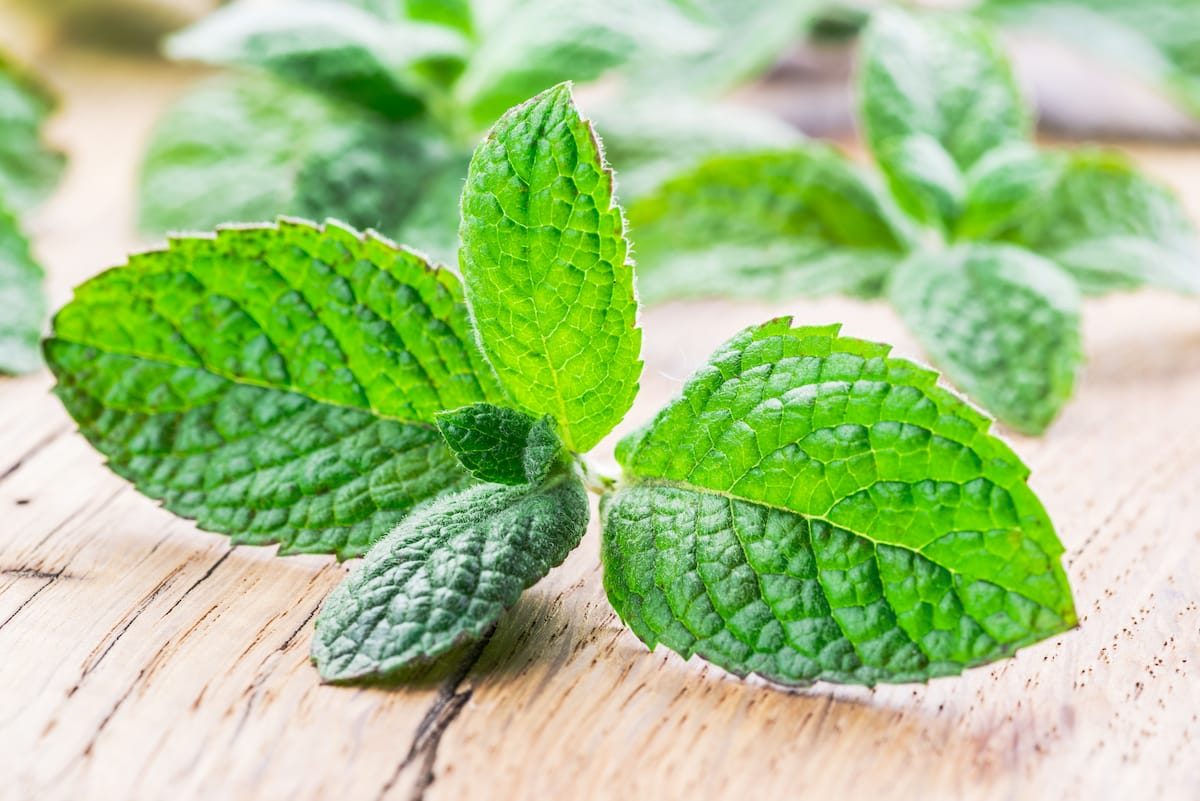
Apple mint is a soft, mild mint with round, hairy leaves, usually sold under the name Mentha suaveolens.12 It is native to southern and western Europe,2 and its aroma owes little to menthol: in most oils analyzed, the main compound is piperitenone oxide.2 The flavor is gentle enough that apple mint is used more for tea than for cooking.3 Pineapple mint is a cream-edged, variegated form of the same plant.4
At a glance
| Botanical name | Mentha suaveolens Ehrh. (Kew, RHS); see the naming note below51 |
| Plant family | Lamiaceae (mint family)5 |
| Other names | Apple-scented mint, round-leaved mint, woolly mint12 |
| Part used | Leaves, fresh or dried |
| Native range | Macaronesia and Europe to the Mediterranean (Kew); southern and western Europe, north to the Netherlands (Božović et al.)52 |
| Main aroma compound | Usually piperitenone oxide; pulegone-rich and other types exist2 |
| Growth | Perennial, spreading by rhizomes, to about 90 cm; hardy in most of the UK1 |
| Variegated form | Pineapple mint, M. suaveolens ‘Variegata’4 |
Measured values
4 figures, sourced| Measure | Value | Scope | Source |
|---|---|---|---|
| Piperitenone oxide | 74.69 and 81.67 % of oil | Morocco, two samples, as tabulated in Božović et al. 2015 reviewIndividual samples; not merged | mdpi.com |
| Piperitenone oxide | above 90 % of oil | Italy (Tarquinia), as tabulated in Božović et al. 2015 review | mdpi.com |
| Piperitenone or piperitenone oxide | 73.5 (piperitenone) or 72 (piperitenone oxide) % of oil | Corsica (subsp. suaveolens), as tabulated in Božović et al. 2015 review | mdpi.com |
| Pulegone and menthol | 85.5 (pulegone); 40.50 (menthol) % of oil | Morocco (Béni-Mellal and Boulmane), major compounds, as tabulated in Božović et al. 2015 review | mdpi.com |
Each figure is quoted as its source states it, with the samples or standard it applies to. Where sources differ, both are shown; nothing is averaged. All measured values
What apple mint is
The RHS describes apple mint as a vigorous, rhizomatous perennial up to 90 cm tall, with rounded, softly hairy, apple-scented leaves up to 4 cm long and dense spikes of tiny pale purple flowers in late summer and early fall.1 The hairs give it the name woolly mint; Božović and colleagues describe the leaves as hairy above and often gray- or white-felted.12
Pineapple mint is the variegated cultivar M. suaveolens ‘Variegata’, a smaller plant (up to 40 cm) with pale green leaves edged in cream.4 The RHS also lists it as variegated apple mint.4
A naming tangle
Sources do not agree on what “apple mint” is botanically:
| Source | What it calls apple mint |
|---|---|
| RHS | Mentha suaveolens1 |
| Božović et al. (2015 review) | Mentha suaveolens, also called woolly or round-leafed mint2 |
| Kew | Accepts M. suaveolens as a species and treats the hybrid-style name M. × rotundifolia var. suaveolens as a synonym of it5 |
| Katzer | M. rotundifolia, described as a hybrid of M. longifolia and M. suaveolens3 |
The review itself flags one sample, from Córdoba, Argentina, as probably a hybrid rather than true M. suaveolens.2 Katzer and the RHS also differ on the scent: the RHS calls the leaves apple-scented, while Katzer finds apple mint very mild, slightly minty and not reminiscent of apples.13
Flavor and aroma
Apple mint is soft and rounded rather than cold: a mild mint note with a faintly sweet, fruity edge, and none of peppermint’s bite. That description is ours.
The compounds
Božović, Pirolli and Ragno’s 2015 review collects analyses of M. suaveolens oil from many places and sorts them into three broad profiles: one rich in pulegone, one rich in piperitenone oxide, and one with similar amounts of piperitenone oxide and piperitone oxide.2 Samples differ widely:
| Sample (as tabulated in the review) | Main compounds in the oil |
|---|---|
| Morocco (two samples) | Piperitenone oxide 74.69% and 81.67% |
| Italy (Tarquinia) | Piperitenone oxide above 90% |
| Corsica (subsp. suaveolens) | Either piperitenone 73.5% or piperitenone oxide 72% |
| Morocco (Béni-Mellal and Boulmane) | Pulegone 85.5% and menthol 40.50% as major compounds |
| Egypt (one study) | Carvone and limonene |
Source: Božović et al., Molecules 2015.2 These are individual samples and should not be merged into a single typical figure. What they show is that apple mint usually smells of piperitenone oxide rather than menthol or carvone, with real chemical variation from place to place.
Origin and history
Božović and colleagues give the native range as southern and western Europe, reaching north to the Netherlands, and note that it is grown as a pot herb and has naturalized in parts of northern and central Europe, usually along streams and in damp places.2 Kew’s range is Macaronesia and Europe to the Mediterranean, with introductions as far as North America, New Zealand and western Siberia.5 The review also notes that M. suaveolens has been used in the traditional medicine of the Mediterranean region.2
Several stories about apple mint circulate: that ancient Greeks cleaned banquet tables and scented baths with it, that it was strewn on temple floors, that it was called monk’s herb because monasteries grew it to treat the aftermath of epileptic seizures, and that it got its name from the shape of its leaves. None could be traced to a source we could open. The Spanish name hierbabuena is also often linked to apple mint; Katzer lists it as a Spanish name for peppermint, and we found no source tying it to apple mint specifically.3
How apple mint is used
Katzer says apple mint and pineapple mint are used more as tea herbs than in cooking, while allowing that a good cook can find uses for them.3 The Božović review notes that mint leaves, flowers and stems generally go into herbal teas and commercial spice mixtures.2 The RHS files apple mint among culinary herbaceous perennials.1
Kitchen suggestions (editorial, not sourced):
- Tea, fresh or dried, where its softness is an advantage.
- Fruit salads and drinks, in place of spearmint when you want less mint intensity.
- Yogurt sauces and mint jelly, for a gentler result than spearmint.
- Garnish. The fuzzy leaves look less glossy than spearmint; small tips or candied leaves work better than large leaves.
Like other soft herbs, it loses flavor with long cooking; LSU AgCenter advises adding delicate herbs, mint among them, near the end.6
Buying and storage
Look for bright, unwilted leaves with no browning (kitchen judgment). We found no published shelf-life figure for fresh or dried apple mint. For methods that apply to all mints, see how to store mint and how to dry mint.
Health and safety
We found no NIH or regulator review of apple mint itself, and no food-composition data for its leaves. The health research gathered in the Božović review concerns the essential oil and piperitenone oxide in laboratory tests, such as antimicrobial and insecticidal activity, not people eating the leaf.2 Claims that apple mint relieves arthritis, heart disease, constipation or fever could not be traced to human evidence, and this page makes no such claim.
Some apple mint oils are dominated by pulegone.2 We found no regulator statement on apple mint leaf specifically. The common advice to avoid all mints in pregnancy could not be traced to a source for apple mint; for peppermint, see the safety notes on the peppermint page.
Substitutes and comparisons
Spearmint is the closest stand-in; use a little less, since it is stronger (editorial, Method: no tested ratio exists). See mint substitutes.
Other mints: mint, spearmint, peppermint, orange mint, ginger mint and chocolate mint.
Footnotes
-
Mentha suaveolens (apple mint), Royal Horticultural Society. rhs.org.uk · Reference work ↩ ↩2 ↩3 ↩4 ↩5 ↩6 ↩7 ↩8 ↩9
-
Božović, Pirolli and Ragno, “Mentha suaveolens Ehrh. (Lamiaceae) Essential Oil and Its Main Constituent Piperitenone Oxide: Biological Activities and Chemistry”, Molecules, 2015. mdpi.com · Peer-reviewed ↩ ↩2 ↩3 ↩4 ↩5 ↩6 ↩7 ↩8 ↩9 ↩10 ↩11 ↩12 ↩13 ↩14 ↩15 ↩16
-
“Mint (Mentha)”, Gernot Katzer’s Spice Pages. gernot-katzers-spice-pages.com · Reference work ↩ ↩2 ↩3 ↩4 ↩5
-
Mentha suaveolens ‘Variegata’ (pineapple mint), Royal Horticultural Society. rhs.org.uk · Reference work ↩ ↩2 ↩3 ↩4
-
Mentha suaveolens Ehrh., Plants of the World Online, Royal Botanic Gardens, Kew. powo.science.kew.org · Reference work ↩ ↩2 ↩3 ↩4 ↩5
-
“Flavorful Herbs”, LSU AgCenter. lsuagcenter.com · Reference work ↩