Spice Comparisons · Comparison
Apple Mint vs. Peppermint: Two Mints With Different Chemistry
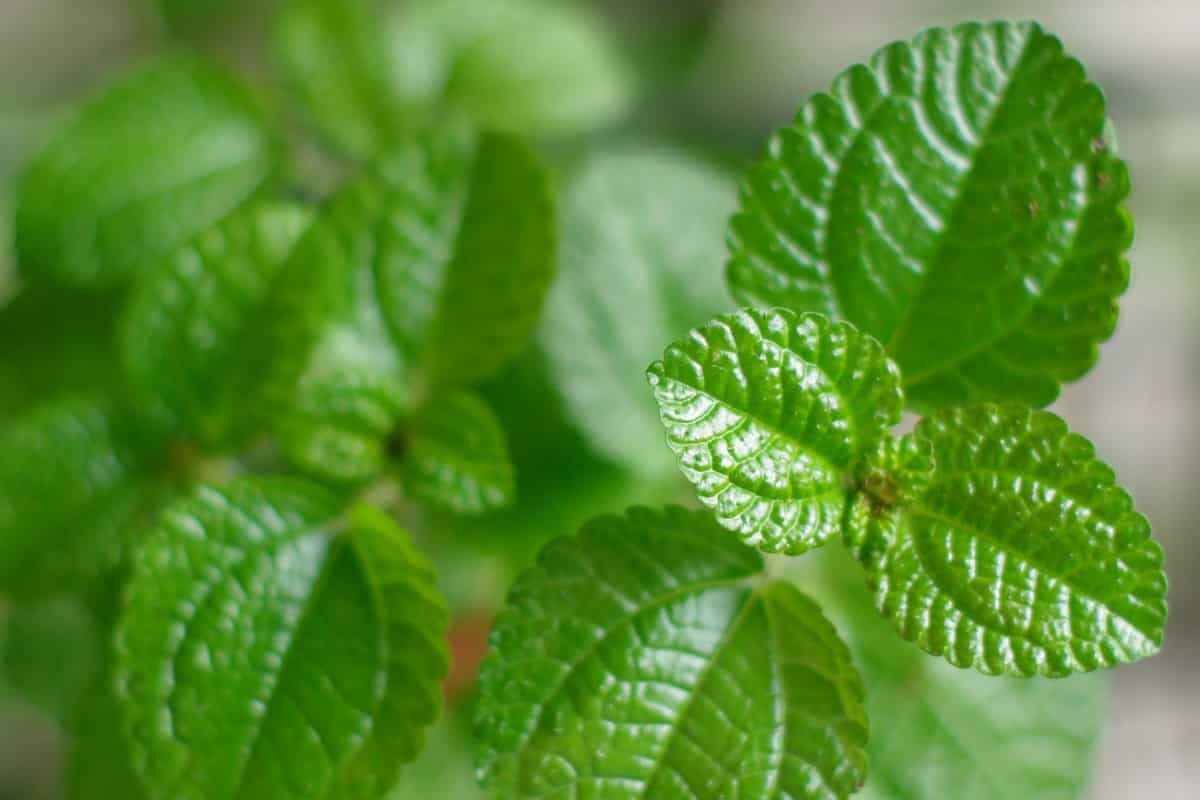
Apple mint and peppermint are both mints, but they do not run on the same chemistry. Peppermint is a menthol mint: its oil is built on menthol and menthone.12 Apple mint, in most oils analyzed, is led by a different compound, piperitenone oxide, and it is mild enough that one spice reference finds it barely minty.34 That is why one cannot simply replace the other.
Side by side
| Apple mint | Peppermint | |
|---|---|---|
| Species | Mentha suaveolens Ehrh. (Kew, RHS); one reference treats apple mint as a hybrid, M. rotundifolia564 | Mentha × piperita L., a natural cross of water mint and spearmint718 |
| Family | Lamiaceae (mint family)5 | Lamiaceae (mint family)2 |
| Native range | Macaronesia and Europe to the Mediterranean5 | Europe to Central Asia; mostly known in cultivation7 |
| Plant and leaf | Rounded, softly hairy leaves up to 4 cm; plant to about 90 cm6 | Square stems, stalked, dark green leaves1 |
| Other names | Woolly mint, round-leaved mint63 | Black peppermint, also called English or Mitcham mint, is one form1 |
| Lead oil compound | Usually piperitenone oxide; pulegone-rich and other types exist3 | Menthol and menthone12 |
| Menthol | A major compound only in some samples (see below)3 | 30–55% of the oil under European Pharmacopoeia limits9 |
| Flavor (editorial) | Soft, rounded, faintly sweet; little cold bite | Sharp, sweet and intensely cool |
| Main uses | Used more as a tea herb than in cooking4 | Confections and sweet liqueurs; leaves used fresh; oil for flavoring41 |
| Forms | Fresh or dried leaves | Fresh or dried leaves, essential oil, extract110 |
| Cost | No dated, sourced price comparison found | No dated, sourced price comparison found |
The difference that matters: what is in the oil
The two columns of oil figures below are not the same kind of number, so read them separately.
Peppermint has a published quality range. The European Pharmacopoeia, quoted in the European Medicines Agency’s assessment, sets menthol at 30–55% and menthone at 14–32% of peppermint oil, and caps pulegone at 3%.9 One peppermint oil tabulated in a 2018 review had 29–48% menthol.2
Apple mint has no such standard. A 2015 review of M. suaveolens oils sorts them into three broad profiles: one rich in pulegone, one rich in piperitenone oxide, and one with similar amounts of piperitenone oxide and piperitone oxide.3 Individual samples in that review include:
| Apple mint sample (as tabulated in the review) | Main compounds |
|---|---|
| Morocco, two samples | Piperitenone oxide 74.69% and 81.67% |
| Italy (Tarquinia) | Piperitenone oxide above 90% |
| Corsica | Either piperitenone 73.5% or piperitenone oxide 72% |
| Morocco (Béni-Mellal and Boulmane) | Pulegone 85.5% and menthol 40.50% as major compounds |
Source: Božović, Pirolli and Ragno, 2015.3 These are single samples from different studies, not a typical apple mint value, and they should not be set against the Pharmacopoeia range as if both described the same thing. What the comparison does show is direction: menthol is the defining compound of peppermint and an occasional one in apple mint. A widely repeated claim says both mints owe their flavor mainly to menthol; for apple mint, the sources reviewed here do not support it.
Two practical consequences, both our judgment rather than tested findings:
- Coolness. If a recipe depends on peppermint’s cold, clean bite (peppermint bark, a peppermint tea, mint chocolate), apple mint will not supply it.
- Strength. Apple mint is the gentler herb. Katzer calls it very mild and only slightly minty, and says it does not remind him of apples, although the RHS describes its leaves as apple-scented.46
Leaves and looks
Apple mint’s leaves are rounded and softly hairy.6 A 2015 review gives woolly mint as another name and describes the leaves as hairy above and often gray- or white-felted.3 Peppermint has the familiar square stems and stalked, dark green leaves of the mint family.1 For garnishing a plate or a drink, peppermint’s smooth leaves look more conventional; apple mint’s fuzzy leaves are better chopped or used as small tips (editorial). A widely repeated claim says apple mint is named for the round shape of its leaves; we found no source for that.
How each is used
- Apple mint. Katzer says apple mint and pineapple mint are used more as tea herbs than for cooking.4 Its mildness suits fruit salads, drinks and yogurt sauces where you want only a little mint (editorial).
- Peppermint. By Katzer’s account, true peppermint is used almost exclusively in confectionery and sweet liqueurs, and its freshness goes extremely well with chocolate.4 Britannica notes that the leaves are typically used fresh and the oil for flavoring.1 For baking, most cooks use peppermint extract, which carries the oil: McCormick’s lists alcohol, water and oil of peppermint.10
- Both. LSU AgCenter groups mint with the delicate herbs best added near the end of cooking, since prolonged heat costs flavor and aroma.11 America’s Test Kitchen lists mint among herbs that are much weaker in flavor when dried.12
Tea and digestion
Peppermint does have a formal medicinal standing that apple mint lacks. The EMA accepts peppermint leaf as a traditional herbal medicine for indigestion and flatulence in adults and children over 4, based on long-standing use rather than clinical trials.13 NCCIH says peppermint tea appears to be safe, and that very little research has been done on peppermint leaf.8 We found no regulator review of apple mint leaf at all, and the health research on M. suaveolens concerns its oil in laboratory tests.3 Neither herb is presented here as a treatment.
Can one stand in for the other?
Neither the peppermint substitutes page nor the mint substitutes page found a published ratio for this swap, so both directions below are Method: a starting point, not a measurement.
- Peppermint in place of apple mint. Start with about half as much and taste. Peppermint is far more forceful, and in a delicate fruit salad or drink it can take over (editorial).
- Apple mint in place of peppermint. Fine for a herb salad, a mild tea or a muddled drink. Use at least as much, but expect a softer result with little cooling effect. It will not reproduce peppermint in desserts or candy (editorial).
- When peppermint is the flavor in a sweet. Neither leaf is the best choice. McCormick suggests stirring a few drops of its peppermint extract into hot cocoa, frosting or brownie batter (Attributed, merchant guidance).10
In our judgment spearmint sits between the two in strength and is often the more practical stand-in for either; see spearmint vs. peppermint.
Safety notes
Peppermint oil is controlled in medicinal use: the Pharmacopoeia limits pulegone and menthofuran, and the EMA accepted a combined intake of up to 37.5 mg a day for a 50 kg adult in assessing medicines.9 Some apple mint oils are dominated by pulegone,3 but we found no regulator statement on apple mint leaf, and no evidence either way on whether culinary amounts matter. For peppermint’s side effects and pregnancy advice, see the peppermint profile.
What isn’t known
- No study we found measures the same compounds in apple mint leaf and peppermint leaf side by side; every figure above is for essential oil, from different studies.
- No source gives a tested ratio for swapping the two.
- Apple mint’s botanical identity is not fully settled: Kew and the RHS call it M. suaveolens, while Katzer treats it as a hybrid.564
- We found no source for the common explanation that the “pepper” in peppermint refers to menthol’s bite.
Related
- Profiles: apple mint, peppermint, spearmint, mint
- Types of mint and spearmint vs. peppermint
- Peppermint substitutes and mint substitutes
- Lemon balm vs. mint and basil vs. mint
- How to store mint and too much mint
Footnotes
-
“Peppermint”, Encyclopaedia Britannica. britannica.com · Reference work ↩ ↩2 ↩3 ↩4 ↩5 ↩6 ↩7 ↩8 ↩9
-
Pooja Singh and Abhay K. Pandey, “Prospective of Essential Oils of the Genus Mentha as Biopesticides: A Review”, Frontiers in Plant Science, 2018. frontiersin.org · Peer-reviewed ↩ ↩2 ↩3 ↩4
-
Božović, Pirolli and Ragno, “Mentha suaveolens Ehrh. (Lamiaceae) Essential Oil and Its Main Constituent Piperitenone Oxide”, Molecules, 2015. mdpi.com · Peer-reviewed ↩ ↩2 ↩3 ↩4 ↩5 ↩6 ↩7 ↩8 ↩9
-
“Mint (Mentha)”, Gernot Katzer’s Spice Pages. gernot-katzers-spice-pages.com · Reference work ↩ ↩2 ↩3 ↩4 ↩5 ↩6 ↩7 ↩8
-
Mentha suaveolens Ehrh., Plants of the World Online, Royal Botanic Gardens, Kew. powo.science.kew.org · Reference work ↩ ↩2 ↩3 ↩4
-
Mentha suaveolens (apple mint), Royal Horticultural Society. rhs.org.uk · Reference work ↩ ↩2 ↩3 ↩4 ↩5 ↩6
-
Mentha × piperita L., Plants of the World Online, Royal Botanic Gardens, Kew. powo.science.kew.org · Reference work ↩ ↩2
-
“Peppermint Oil”, National Center for Complementary and Integrative Health, 2025. nccih.nih.gov · Regulator ↩ ↩2
-
Assessment report on Mentha x piperita L., folium and aetheroleum, Revision 1, European Medicines Agency. ema.europa.eu · Regulator ↩ ↩2 ↩3
-
Pure Peppermint Extract, McCormick product page. mccormick.com · Merchant ↩ ↩2 ↩3
-
“Flavorful Herbs”, LSU AgCenter. lsuagcenter.com · Reference work ↩
-
Danielle Lapierre, “When You Should Actually Use Dried Herbs (and Which Ones to Avoid)”, America’s Test Kitchen, 2022. americastestkitchen.com · Publication ↩
-
“Menthae piperitae folium”, herbal medicine overview, European Medicines Agency. ema.europa.eu · Regulator ↩