Spice Substitutes · Substitutes
Mint Substitutes, Ranked by the Job Mint Is Doing
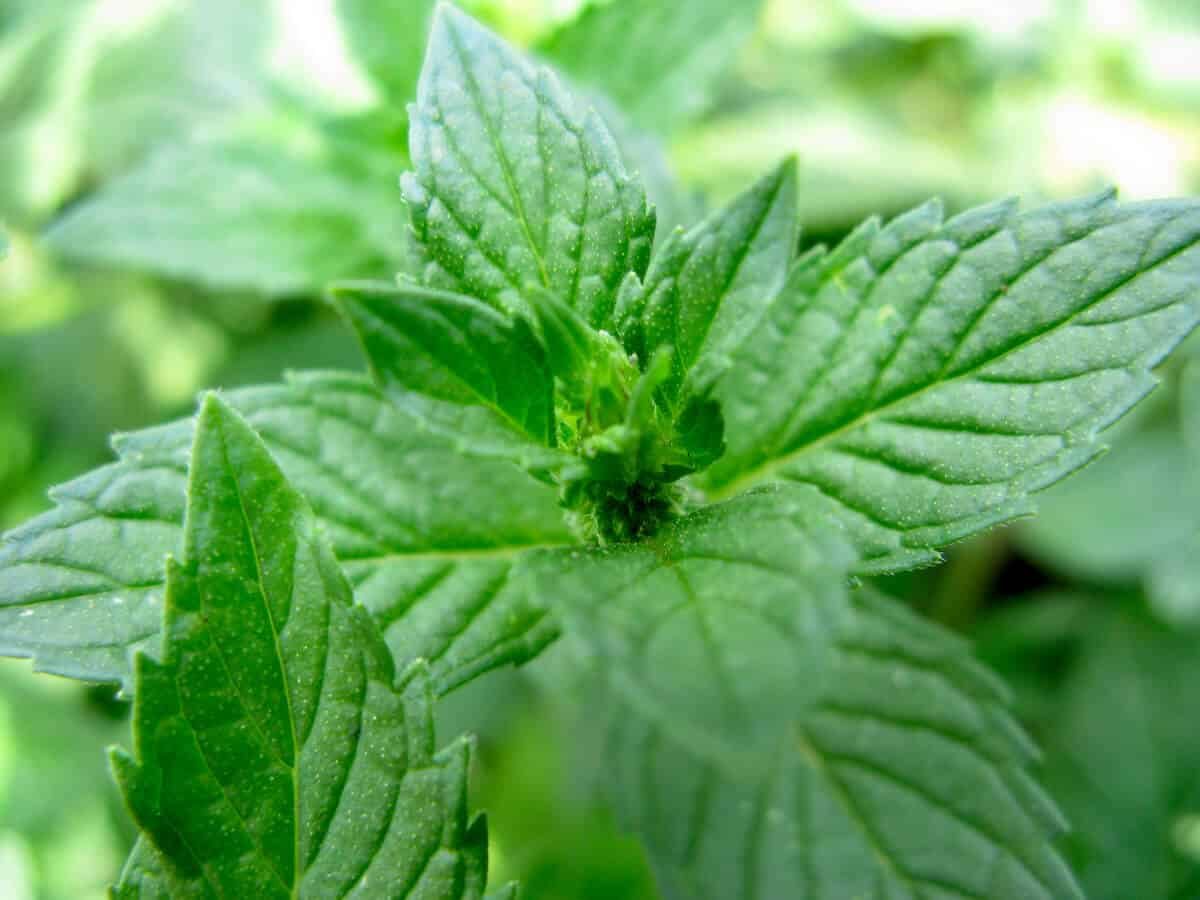
In cooking, “mint” usually means one of two plants, peppermint or spearmint.1 They taste different because their oils are built on different compounds: peppermint oil is prized mainly for menthol and menthone, while spearmint is rich in carvone.2 McCormick describes spearmint as milder than peppermint and lacking menthol.3 No other herb shares either chemistry closely, so the best substitute for one mint is nearly always the other. When there is no mint at all, the right swap depends on whether mint is bringing coolness to a drink or dessert or fresh green flavor to a savory dish.
Quick answer
| What mint is doing | Best substitute | Starting amount, per 1 part fresh mint | Treatment |
|---|---|---|---|
| Cool, minty flavor in a drink, dessert or tea | The other mint (spearmint or peppermint) | 1 part spearmint for peppermint; 1/2 part peppermint for spearmint | Method |
| Same job, flavor only, no leaves needed | Mint extract | 1 tsp extract per bunch of leaves | Attributed |
| Fresh green herb in a salad, yogurt sauce or herb sauce | Basil | 1/2 part, then taste | Method |
| Herb in a cooked dish | Dried mint | 1 part dried per 3 parts fresh | Computed |
The rest of the page explains each choice.
How the ratios on this page are labeled
Every ratio carries one of four labels.
- Computed: based on a measurable physical relationship, such as converting fresh herbs to dried, with the source named.
- Attributed: a named source publishes this ratio. We quote it as theirs.
- Disputed: named sources give different answers to the same swap. We show each one and do not average them.
- Method: we found no published ratio. We give a direction and a cautious starting point, and say so.
No published study compares the strength of mint with any other herb. Only the extract and dried-herb figures below come from a named source.
If mint is the cool, minty flavor in a drink, dessert or tea
This is mint as the flavor itself: mint tea, a mojito or julep, mint chocolate, a fruit salad. Here you need the mint compounds. No other herb in the kitchen supplies them.
1. The other mint
Spearmint and peppermint differ in character, but both read clearly as mint. Peppermint oil consists mainly of menthol and menthone,2 and McCormick puts peppermint’s menthol at about 40 percent, which it says gives a sharper taste that borders on spicy.3 Spearmint’s principal compound is carvone,4 and Katzer calls its flavor minty but not pungent.5 By Katzer’s account, true peppermint is used almost exclusively for confections and sweet liqueurs, and its freshness suits chocolate, while spearmint is the mint for British mint sauce.5
Ratio (Method): No published ratio was found. Spearmint in place of peppermint: start with the same amount and add more if the dish needs more lift. Peppermint in place of spearmint: start with about half, because of peppermint’s sharper menthol bite, and taste.
2. Mint extract
If the leaves themselves don’t matter, as in a frosting, a smoothie or a batter, an extract is the simplest swap. Read the label. McCormick’s Pure Mint Extract contains oil of spearmint and oil of peppermint in alcohol and water,6 while its Pure Peppermint Extract contains only oil of peppermint in alcohol and water.7 McCormick suggests the mint extract for smoothies, cocktails and baked goods,6 and a few drops of the peppermint extract for hot cocoa, frosting or brownie batter.7
Ratio (Attributed): McCormick’s label for its Pure Mint Extract gives 1 bunch of mint leaves as equal to 1 teaspoon of extract.6 McCormick does not say how large a bunch is, and the figure applies to that product, not to peppermint extract or other brands. Extract adds alcohol and no green color or texture.
Flavoring oil in place of extract (Attributed): LorAnn says its peppermint super-strength flavor is 3 to 4 times stronger than alcohol-based extracts, and advises using 1/3 to 1/4 of the extract amount a recipe calls for.8 That is the manufacturer’s figure for its own product.
If mint is a fresh green herb in a savory dish
In a salad, a yogurt sauce, a herb sauce for lamb or a grain salad, mint is one green note among others. Here a leafy herb from the same plant family can fill the gap, though none tastes like mint.
1. Basil
Basil is a member of the mint family.9 Its flavor comes from different compounds. PROSEA reports a French-type basil oil at 53.3 percent methyl chavicol and describes that oil’s aroma as sweet-spicy, slightly green and fresh.10 That is a sweet, spicy profile, not a menthol-led one, so basil brings sweetness and green freshness but not mint’s coolness. It suits a herb salad or pesto-style sauce better than a mint tea.
Ratio (Method): No published ratio was found. Start with about half the mint amount, torn or chopped, and add more to taste. Add it at the end: LSU AgCenter lists basil and mint among the delicate herbs best added in the last minutes of cooking.11
2. Marjoram
Marjoram is mild and sweet, which suits some of the same savory dishes. Its chemistry is not minty: a 2022 review describes two main types of marjoram oil, one led by terpinen-4-ol and cis-sabinene hydrate, which it links to marjoram’s sweet flavor, and one led by carvacrol and thymol, the compounds of oregano.12 Neither type is led by menthol.
Ratio (Method): No published ratio was found. Start with half the mint amount and add more if needed.
3. Tarragon, for an anise note
PROSEA describes tarragon’s scent as sweet and anise-like, with a peculiar bittersweet flavor, and cites a French tarragon oil at 77 percent methyl chavicol.13 It brings sweetness and anise, not mint. In our judgment it works best in a fruit salad, a sweet drink or a sauce for fish or chicken.
Ratio (Method): No published ratio was found. Tarragon is assertive, so start with about a quarter of the mint amount, chopped fine.
4. Rosemary, for cooked meat only
Rosemary is often suggested for mint’s savory uses, especially lamb. Its oil is a different profile, dominated in one study by alpha-pinene (13.5 to 37.7 percent) and 1,8-cineole (16.1 to 29.3 percent).14 The University of Delaware’s extension service puts rosemary among the strong herbs, while mint sits in the medium group.15 It will season a roast well but will not taste of mint, and it is too strong to use raw in place of mint leaves.
Ratio (Method): No published ratio was found. Start with about a quarter of the mint amount, finely chopped, in cooked dishes only.
If mint is going into a cooked dish
Dried mint is the obvious stand-in for fresh when the herb is cooked into a dish rather than scattered over it. It is a compromise: America’s Test Kitchen lists mint among the herbs that are better fresh, saying such delicate herbs are much weaker in flavor when dried.16
Ratio (Computed): America’s Test Kitchen’s tests found that 1 part dried herb to 3 parts fresh came closest to equal strength,17 and LSU AgCenter’s rule of thumb is 1 tablespoon finely cut fresh herbs to 1 teaspoon crumbled dried.11 These are general rules for herbs, not a test on mint. Use 1 teaspoon dried mint for each tablespoon of chopped fresh mint, and taste.
What isn’t known
- No published measurement compares the strength of mint with basil, marjoram, tarragon or rosemary. Every amount for those herbs is a Method starting point.
- McCormick’s 1-bunch-to-1-teaspoon figure does not define a bunch, and no source we found gives a drop count for replacing chopped mint with peppermint extract or oil.
- Mint oil composition varies a great deal by sample.2 McCormick’s figure of about 40 percent menthol for peppermint is a general statement, not a measurement of any particular leaf.3
- A widely repeated claim says basil and marjoram have mint’s menthol coolness. The chemistry sources reviewed here do not list menthol among their main compounds.1012
Related
- Mint, types of mint, mint uses and cooking with mint
- Peppermint, spearmint, spearmint vs. peppermint and peppermint substitutes
- Basil, basil vs. mint, marjoram, tarragon and rosemary
- Oregano vs. mint and lemon balm vs. mint
- How to dry mint, how to store mint and too much mint
Footnotes
-
“Mint (plant)”, Encyclopaedia Britannica. britannica.com · Reference work ↩
-
Pooja Singh and Abhay K. Pandey, “Prospective of Essential Oils of the Genus Mentha as Biopesticides: A Review”, Frontiers in Plant Science, 2018. frontiersin.org · Peer-reviewed ↩ ↩2 ↩3
-
McCormick Kitchens, “About Mint: Uses, Pairings and Recipes”, McCormick, 2026. mccormick.com · Merchant ↩ ↩2 ↩3
-
“Spearmint”, Encyclopaedia Britannica. britannica.com · Reference work ↩
-
Gernot Katzer, “Mint (Mentha)”, Gernot Katzer’s Spice Pages. gernot-katzers-spice-pages.com · Reference work ↩ ↩2
-
Pure Mint Extract, 2 oz, McCormick product page. mccormick.com · Merchant ↩ ↩2 ↩3
-
Pure Peppermint Extract, 1 fl oz, McCormick product page. mccormick.com · Merchant ↩ ↩2
-
LorAnn Oils All-Natural Peppermint Super Strength Flavor, WebstaurantStore listing. webstaurantstore.com · Merchant ↩
-
Sohini Dasgupta (rev.), “Basil”, Encyclopaedia Britannica, 2026. britannica.com · Reference work ↩
-
N.O. Aguilar, Pham Truong Thi Tho and L.P.A. Oyen, Ocimum basilicum, Plant Resources of South-East Asia (PROSEA). uses.plantnet-project.org · Reference work ↩ ↩2
-
“Flavorful Herbs”, LSU AgCenter. lsuagcenter.com · Reference work ↩ ↩2
-
Kakouri et al., “Origanum majorana Essential Oil: A Review of Its Chemical Profile and Pesticide Activity”, Life, 2022. mdpi.com · Peer-reviewed ↩ ↩2
-
C.C. de Guzman and R.A. Reglos, Artemisia dracunculus, Plant Resources of South-East Asia (PROSEA). uses.plantnet-project.org · Reference work ↩
-
Satyal et al., “Chemotypic Characterization and Biological Activity of Rosmarinus officinalis”, Foods, 2017. mdpi.com · Peer-reviewed ↩
-
“Using Herbs and Spices”, University of Delaware Cooperative Extension, 2025. udel.edu · Reference work ↩
-
Danielle Lapierre, “When You Should Actually Use Dried Herbs (and Which Ones to Avoid)”, America’s Test Kitchen, 2022. americastestkitchen.com · Publication ↩
-
“Science: Substituting Dried Herbs for Fresh”, America’s Test Kitchen. americastestkitchen.com · Publication ↩