Spices · Profile
Cassia Buds: What They Are, How They Taste and How to Use Them
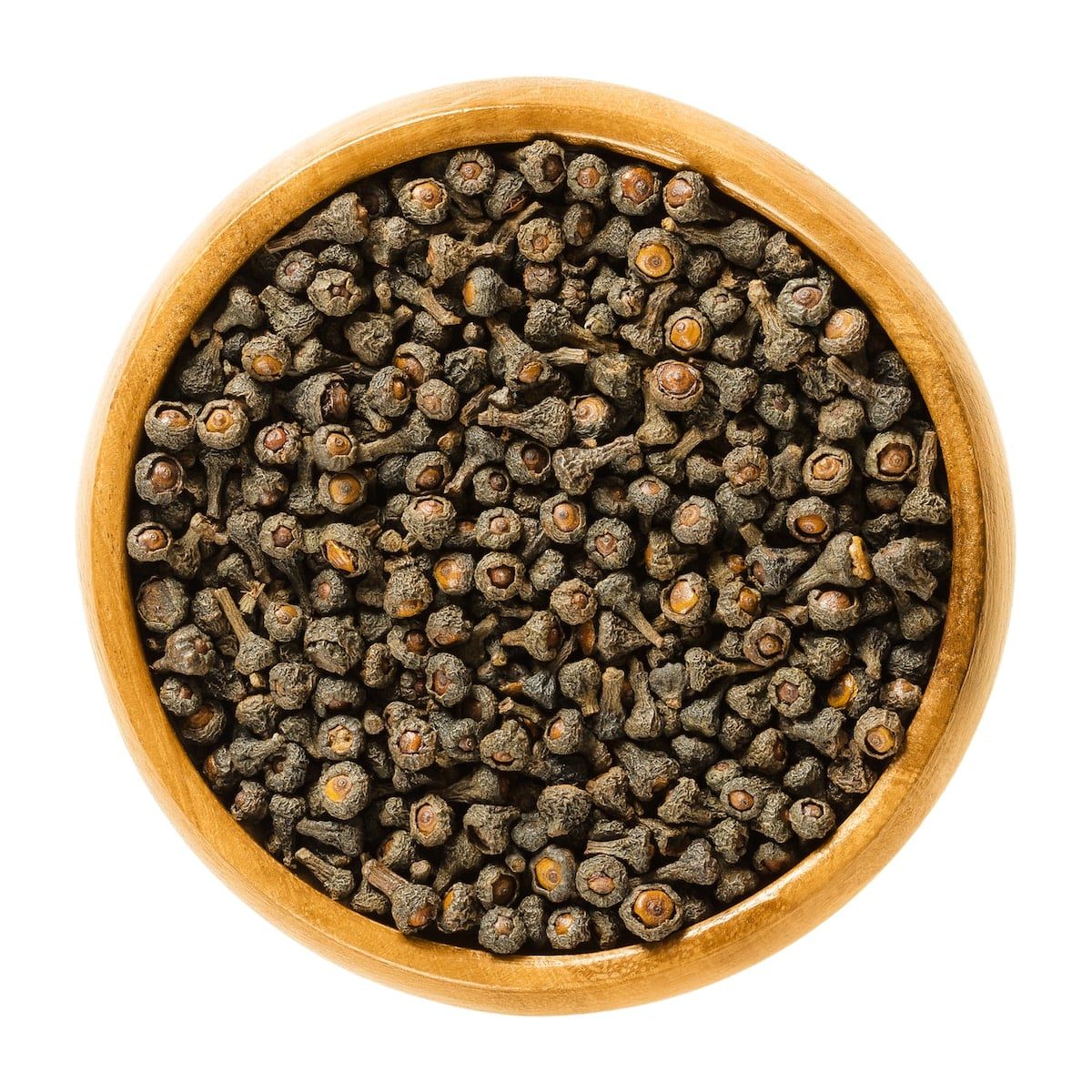
Cassia buds are the small dried fruits of the Chinese cassia tree, Cinnamomum cassia, picked while still immature.1 They look a little like cloves, smell and taste like cassia cinnamon, and are mostly used whole. Medieval European cooks probably knew them well; today they are a specialty item. This page covers what they are, what is in them, how they compare with cassia bark on coumarin, and how to use them.
At a glance
| Source plant | Cinnamomum cassia, Chinese cassia (Kew’s accepted name: Cinnamomum aromaticum)12 |
| Plant family | Lauraceae (laurel family)2 |
| Part used | Dried immature fruits1 |
| Native range of the tree | Southeast China to Vietnam (Kew)2 |
| Main producer of Chinese cassia | China (Guangxi and Guangdong); commercially cultivated only in China and Vietnam (PROSEA)1 |
| Essential oil | 1.9%, about 80% aldehydes (PROSEA)1 |
| Key aroma compound | Cinnamaldehyde13 |
| Coumarin | Below 0.48 mg/g in commercial samples tested in one 2018 study3 |
| Forms sold | Whole dried buds |
Measured values
4 figures, sourced| Measure | Value | Scope | Source |
|---|---|---|---|
| Essential oil | 1.9 % of buds | PROSEA | prosea.prota4u.org |
| Aldehydes | about 80 % of essential oil | PROSEA | prosea.prota4u.org |
| Cinnamaldehyde | up to 40 mg per g of sample | commercial cassia buds bought on the German market, 2018 analysis | degruyterbrill.com |
| Coumarin | below 0.48 (480 mg/kg) mg/g | commercial samples on the German market, one 2018 study | degruyterbrill.com |
Each figure is quoted as its source states it, with the samples or standard it applies to. Where sources differ, both are shown; nothing is averaged. All measured values
What cassia buds are
Despite the name, cassia buds are not flower buds. PROSEA describes them as the dried immature fruits of Cinnamomum cassia.1 On the tree the mature fruit is an ovoid berry 1–1.5 cm long that ripens black to blackish-purple; cassia buds are that fruit picked immature.1 The tree itself is an evergreen up to 18 m tall and aromatic in all its parts.1
PROSEA places Chinese cassia in southern China, Myanmar, Laos and Vietnam, with commercial cultivation only in China and Vietnam.1 Kew lists it under the accepted name Cinnamomum aromaticum, native from southeast China to Vietnam.2 The same tree supplies Chinese cassia bark; see cassia cinnamon. It is one of three species traded as cassia, alongside Indonesian and Vietnamese cassia, and PROSEA names the buds only for C. cassia.1
Flavor and aroma
Cassia buds taste like a gentler, rounder cassia cinnamon: sweet, warm and a little peppery, with a faintly floral note the bark lacks. That description is ours.
The compounds
- Essential oil. PROSEA gives 1.9% essential oil, about 80% of it aldehydes.1
- Cinnamaldehyde. A 2018 analysis of commercial cassia buds bought on the German market found cinnamaldehyde was the most abundant compound, at up to 40 mg per gram of sample.3 In sniffing tests on the extracts (GC-olfactometry), cinnamaldehyde was the strongest contributor, followed by 2-phenylethanol and cinnamyl alcohol.3 In all, 36 compounds were identified.3
- Slow release. The same authors describe the buds as strongly lignified, a woody “depot” of cinnamaldehyde suited to slow-release uses.3 That fits the usual way of cooking with them whole in liquids, though the study did not test cooking.
Coumarin: buds versus bark
Cassia bark is known for its coumarin content.4 The European Food Safety Authority’s tolerable daily intake is 0.1 mg of coumarin per kg of body weight,5 and Germany’s BfR says that in a small group of especially sensitive people, even relatively low doses can lead to liver damage.4
| Product | Coumarin | Scope | Source |
|---|---|---|---|
| Cassia buds | Below 0.48 mg/g (480 mg/kg) | Commercial samples on the German market, one study | 3 |
| Cassia cinnamon (bark) | About 3,000 mg/kg on average | German food monitoring data, as summarized by BfR | 4 |
| Ceylon cinnamon (C. verum) bark | Only traces | US study (Wang et al., 2013) | 6 |
The study’s authors call the buds’ coumarin “comparably low.”3 These figures come from different sampling programs, so they show a clear difference in scale rather than an exact ratio. For a rough sense of what it means: at the 60 kg adult’s tolerable intake of 6 mg a day, buds at the top of the measured range would take more than 12 g a day to reach it. That arithmetic is ours, not a regulator’s. BfR estimates the same adult reaches the limit with about 2 g a day of cassia with average coumarin content.7
History
The ancient record
Several origin stories for the word cassia circulate, from Hebrew and from the Khasi people of northeast India. We could not trace either to a source that settles it, so neither is given here.
Medieval Europe
The medieval English cookbook The Forme of Cury (compiled around 1390) calls for “flour of canel”, including in one recipe the instruction to add cloves and “flour of canel hool” (whole).8 Christopher Monk, who writes the Modern Medieval Cuisine site, counts eight uses of “flour of canel” in that manuscript and one Anglo-Norman “flour de quenel”, and six uses of fleur de canelle in the French Ménagier de Paris.9 He reads these as cassia buds. Not every scholar is certain: he quotes Constance Hieatt’s note that the term “may mean cassia buds”, and Terence Scully’s glossary to the Viandier of Taillevent translates fleur de canelle as ground cassia bark or buds.9 So the medieval “cinnamon flower” was probably, but not certainly, the spice sold today as cassia buds.
Monk also quotes the Forme of Cury recipe for ypocras (hippocras, a spiced wine), which lists “flour de queynel” among its spices.9 A widely repeated claim that King John II of France bought flor de canelle for hippocras in 1359–60 could not be traced to a source for this review.
How cassia buds are used
- Pickles. PROSEA says cassia buds are used as a flavoring and extensively in sweet pickles.1
- Whole in liquids. Simmered in syrups, poached fruit, mulled wine or cider, rice or braises and then strained out. This is common practice, and the 2018 study’s description of the buds as a slow-release depot of cinnamaldehyde is consistent with it.3
- Ground. They can be ground in a spice grinder and used where you would use ground cinnamon, for a milder, more aromatic result (kitchen judgment).
Cassia buds are sometimes listed in Chinese five-spice powder, German pfeffernüsse, paan and ras el hanout. Britannica’s list of the five spices names cassia (Chinese cinnamon) without saying whether bark or buds,10 and we found no source for the other uses, so they are not given as fact here.
Buying and quality
Cassia buds are sold whole, usually by specialty spice merchants. Sandner and colleagues described them in 2018 as having appeared recently on German markets.3 No international grade standard for cassia buds was found. Look for whole buds that smell clearly of cinnamon when crushed; that is kitchen judgment, not a standard.
Storage
No published shelf-life figure from a regulator or standards body was found. Common practice is to keep them whole, sealed and away from heat and light. Crush one: a faint smell means they have faded.
Health claims
NCCIH, the US government’s center for complementary health, says research does not clearly support using cinnamon for any health condition.11 No research on cassia buds themselves as a remedy was found, and this page makes no claim that they treat or prevent any disease. Cinnamaldehyde gives them their flavor; that is not a health finding.
Substitutes and comparisons
Cassia cinnamon sticks are the nearest swap, with more bite and more coumarin; whole cloves bring the look but a very different, eugenol-driven taste. See cassia bud substitutes for the ranked list; no source we found gives a tested ratio. Related pages: cassia cinnamon, cinnamon, Ceylon vs. cassia cinnamon, cloves, star anise and too much cinnamon.
Footnotes
-
Cinnamomum (cassia species), PROSEA Handbook No. 13: Spices. prosea.prota4u.org · Reference work ↩ ↩2 ↩3 ↩4 ↩5 ↩6 ↩7 ↩8 ↩9 ↩10 ↩11 ↩12 ↩13
-
Cinnamomum aromaticum Nees, Plants of the World Online, Royal Botanic Gardens, Kew. powo.science.kew.org · Reference work ↩ ↩2 ↩3 ↩4
-
Sandner, Krings and Berger, “Volatiles from Cinnamomum cassia buds”, Zeitschrift für Naturforschung C, 2018. degruyterbrill.com · Peer-reviewed ↩ ↩2 ↩3 ↩4 ↩5 ↩6 ↩7 ↩8 ↩9 ↩10
-
FAQ on coumarin in cinnamon and other foods, German Federal Institute for Risk Assessment (BfR). bfr.bund.de · Regulator ↩ ↩2 ↩3
-
Coumarin in flavourings and other food ingredients with flavouring properties, EFSA, 2008. efsa.europa.eu · Regulator ↩
-
Wang et al., “Cassia cinnamon as a source of coumarin in cinnamon-flavored food and food supplements in the United States”, Journal of Agricultural and Food Chemistry, 2013. hero.epa.gov · Peer-reviewed ↩
-
“Cassia cinnamon with high coumarin contents to be consumed in moderation”, BfR press release. bfr.bund.de · Regulator ↩
-
The Forme of Cury (c. 1390), Samuel Pegge’s 1780 edition, Project Gutenberg. gutenberg.org · Reference work ↩
-
Christopher Monk, “Cassia buds, the ‘flower’ of medieval spices”, Modern Medieval Cuisine, 2024. modernmedievalcuisine.com · Publication ↩ ↩2 ↩3
-
Tony Hill, “Five-spice powder”, Encyclopaedia Britannica. britannica.com · Reference work ↩
-
Cinnamon: Usefulness and Safety, National Center for Complementary and Integrative Health. nccih.nih.gov · Regulator ↩