Spice Substitutes · Substitutes
Cassia Bud Substitutes: Cinnamon Sticks, Ceylon Cinnamon and Indian Bay Leaf
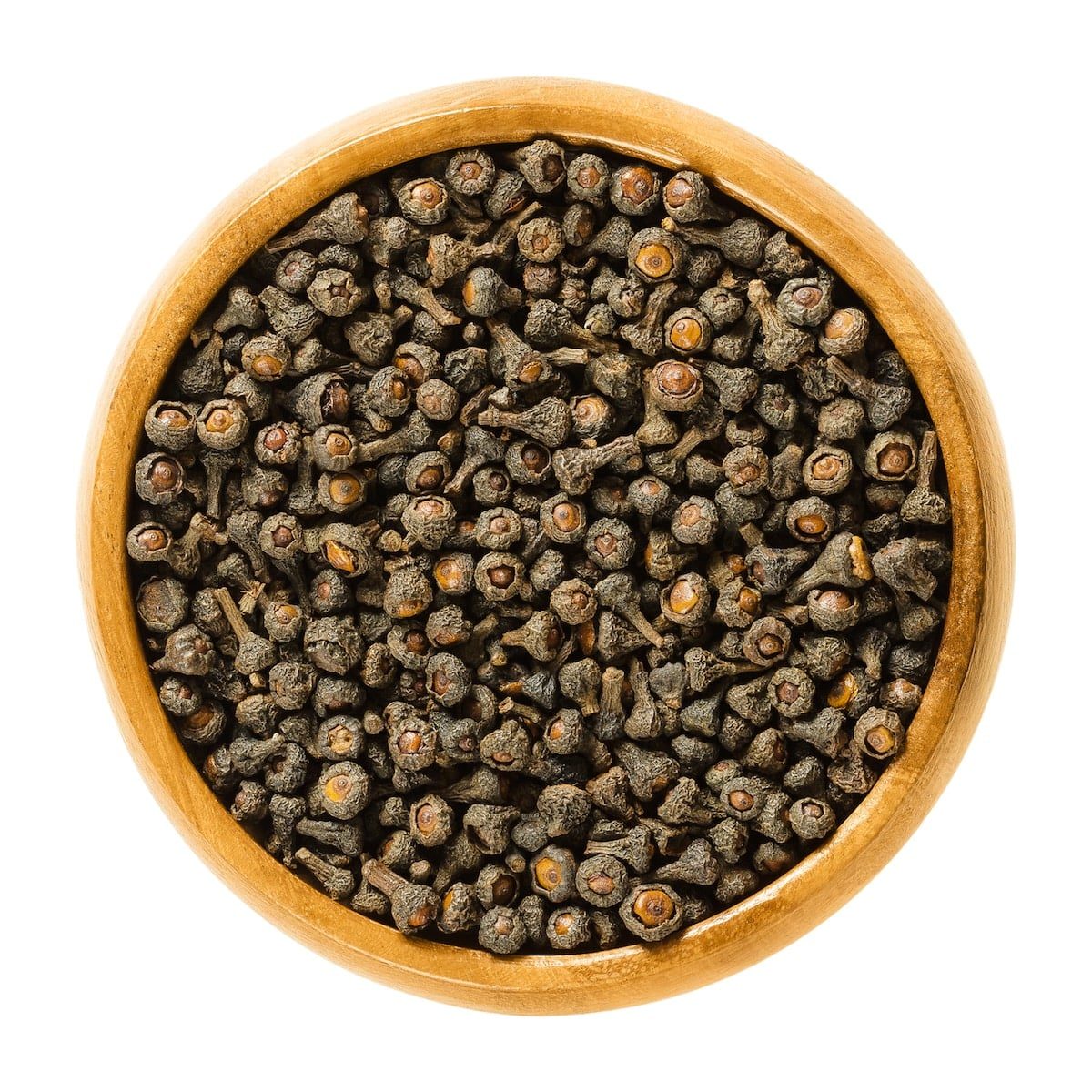
Cassia buds are the dried immature fruits of the Chinese cassia tree, Cinnamomum cassia.1 They taste of cassia cinnamon, and cooks mostly use them whole, simmered in a liquid and strained out. The spice merchant Silk Road Spices describes their flavor as “a more floral, peppery cinnamon.”2 They are hard to find, so most cooks need a stand-in. The right one depends on whether you use the buds whole to infuse a liquid or ground into a dish.
Quick answer
| How you are using cassia buds | Best substitute | Starting amount | Treatment |
|---|---|---|---|
| Whole, to infuse syrups, mulled drinks, pickles or braises | A piece of cassia cinnamon stick | About 1 inch (2.5 cm) of stick per teaspoon of buds, then taste | Method |
| Ground, in baking or spice mixes | Ground cinnamon | About 3/4 the amount of ground buds, then taste | Method |
| Ground, when you only have sticks | Cassia stick, ground | One 1 1/2-inch stick = 1 tsp ground cinnamon | Computed |
| Whole, for a milder flavor | Ceylon cinnamon stick | About 1 inch per teaspoon of buds, then taste | Method |
| Whole, in rice dishes and curries | Indian bay leaf (tej patta) | One leaf, then taste | Method |
How the ratios on this page are labeled
Every ratio carries one of four labels.
- Computed: based on a measurable physical relationship, with the source named.
- Attributed: a named source publishes this ratio. We quote it as theirs.
- Disputed: named sources give different answers to the same swap. We show each one and do not average them.
- Method: we found no published ratio. We give a direction and a cautious starting point, and say so.
We found no published ratio for replacing cassia buds with anything. The one cassia-bud merchant page we reviewed goes the other way: Silk Road Spices says buds can replace cinnamon sticks or chips “for a more nuanced and peppery flavour,” without giving an amount.2 Every bud-to-bark amount on this page is a Method starting point. The only measured figure is McCormick’s stick-to-ground conversion for cinnamon.
If you use the buds whole, to infuse a liquid
1. Cassia cinnamon stick
This is the closest substitute, because it comes from the same tree. PROSEA describes the buds as fruits of Cinnamomum cassia,1 the same species that supplies Chinese cassia bark, which is sun-dried into reddish-brown quills.1 PROSEA also notes that cinnamon and cassia barks are interchangeable in many applications.1
The flavor match comes from cinnamaldehyde. A 2018 analysis of commercial cassia buds found it was the most abundant compound, at up to 40 mg per gram, and the strongest contributor to their aroma, followed by 2-phenylethanol and cinnamyl alcohol.3 In Chinese cassia bark, PROSEA puts essential oil at 1 to 4 percent,1 and the buds hold 1.9 percent essential oil, about 80 percent of it aldehydes.1 The bark will taste close but not identical; Silk Road Spices describes the buds as more floral and peppery than cinnamon.2
Cinnamon sticks are easy to find, and NCCIH says cassia is the most common type of cinnamon sold in North America.4
Coumarin is the real difference. Cassia bark is known for its coumarin content: the German Federal Institute for Risk Assessment (BfR) reports an average of about 3,000 mg per kg in cassia cinnamon.5 The one analysis of cassia buds we found measured “comparably low” coumarin, below 0.48 mg per gram (480 mg per kg).3 The figures come from different sampling programs, so they show a difference in scale, not an exact ratio. EFSA’s tolerable daily intake is 0.1 mg of coumarin per kg of body weight,6 and BfR estimates that a 60 kg adult reaches it with about 2 g a day of cassia with average coumarin content.7 NCCIH notes that prolonged use of cassia cinnamon could be an issue for sensitive people.4
Ratio (Method): No published ratio. Start with about a 1-inch (2.5 cm) piece of cassia stick for each teaspoon of buds, simmer, taste, and add more if needed.
2. Ceylon cinnamon stick
Ceylon cinnamon (Cinnamomum verum) is a different species. NCCIH calls it “true” cinnamon and says it grows primarily in Sri Lanka.4 CBI describes it as milder and finer than cassia.8 Its bark oil is 50 to 75 percent cinnamaldehyde, with 5 to 18 percent eugenol, the main compound in cloves.910 Commercial Ceylon bark is no more than 0.5 cm thick.9
It has an advantage on coumarin: a US study found only traces in C. verum bark.11 The trade-off is flavor. It is milder than cassia, so it moves further from the buds’ cassia character.
Ratio (Method): No published ratio. Start with about a 1-inch piece per teaspoon of buds, and expect to need more for the same strength.
3. Indian bay leaf (tej patta), for rice dishes and curries
Indian bay leaf is not a cassia leaf. Katzer identifies it as Cinnamomum tamala, the foliage of a tree closely related to cinnamon, and describes its aroma as “strongly aromatic, somewhat reminiscent of cinnamon or cloves.”12 It is used almost exclusively in northern Indian cooking, including Mughal rice dishes and biryanis.12 Katzer warns that flavor and intensity vary, because the leaves usually come from wild or semi-cultivated plants.12
In our judgment it suits savory dishes where whole spices simmer in the pot, not syrups or desserts.
Ratio (Method): No published ratio. Start with one leaf per teaspoon of buds and taste.
For looks only: whole cloves
Cassia buds look a lot like cloves.2 The flavor is different: clove bud oil is 70 to 90 percent eugenol,10 while cassia buds are led by cinnamaldehyde.3 Use cloves only if appearance matters more than taste, and use far fewer.
Ratio (Method): No published ratio. Start with one or two cloves in place of a teaspoon of buds.
If you use the buds ground
Ground cinnamon
Silk Road Spices says cassia buds can be ground in an electric blade grinder but are usually used whole.2 If your recipe calls for ground buds, ordinary ground cinnamon is the practical swap, and in North America that is usually cassia.4
Ratio (Method): No published ratio. Start with about three quarters of the amount of ground buds called for and taste. This is a cautious starting point, not a measured equivalence.
Grinding a stick yourself
Ratio (Computed): McCormick’s conversion is one 1 1/2-inch (4 cm) cinnamon stick to 1 teaspoon ground cinnamon.13 This is a volume figure. It tells you how much powder a stick makes, not how strong it is compared with buds.
What isn’t known
- No published ratio compares cassia buds with cinnamon bark, Ceylon cinnamon, Indian bay leaf or cloves. The strength of the buds against the bark has not been measured.
- Only one analytical study of cassia bud coumarin was found, and its abstract does not give the number of samples.3
- Cinnamon extract is sometimes suggested in place of buds. We found no source for that swap or for a conversion, so it is not recommended here.
Related
- Cassia buds, cassia cinnamon and Ceylon cinnamon
- Ceylon vs. cassia cinnamon, Saigon cinnamon and Korintje cinnamon
- Cinnamon, cinnamon substitutes and ground cinnamon vs. cinnamon sticks
- Cloves and cloves vs. cinnamon
- Too much cinnamon? and French toast spices
Footnotes
-
Cinnamomum (cassia species), PROSEA Handbook No. 13: Spices, Plant Resources of South-East Asia. prosea.prota4u.org · Reference work ↩ ↩2 ↩3 ↩4 ↩5 ↩6
-
“Cassia Buds”, Silk Road Spices (product page). silkroadspices.ca · Merchant ↩ ↩2 ↩3 ↩4 ↩5
-
Sandner, Krings and Berger, “Volatiles from Cinnamomum cassia buds”, Zeitschrift für Naturforschung C, 2018. degruyterbrill.com · Peer-reviewed ↩ ↩2 ↩3 ↩4
-
“Cinnamon: Usefulness and Safety”, National Center for Complementary and Integrative Health, 2024. nccih.nih.gov · Regulator ↩ ↩2 ↩3 ↩4
-
“FAQ on coumarin in cinnamon and other foods”, German Federal Institute for Risk Assessment. bfr.bund.de · Regulator ↩
-
“Coumarin in flavourings and other food ingredients with flavouring properties”, European Food Safety Authority, 2008. efsa.europa.eu · Regulator ↩
-
“Cassia cinnamon with high coumarin contents to be consumed in moderation”, German Federal Institute for Risk Assessment. bfr.bund.de · Regulator ↩
-
“The European market potential for cinnamon”, CBI, 2026. cbi.eu · Regulator ↩
-
Flach and Siemonsma, Cinnamomum verum, PROSEA Handbook No. 13: Spices. prosea.prota4u.org · Reference work ↩ ↩2
-
Verheij and Snijders, Syzygium aromaticum, Plant Resources of South-East Asia (PROSEA). uses.plantnet-project.org · Reference work ↩ ↩2
-
Wang et al., “Cassia cinnamon as a source of coumarin in cinnamon-flavored food and food supplements in the United States”, 2013. hero.epa.gov · Peer-reviewed ↩
-
Gernot Katzer, “Indian Bay Leaf (Cinnamomum tamala)”, Gernot Katzer’s Spice Pages. gernot-katzers-spice-pages.com · Reference work ↩ ↩2 ↩3
-
“How to Grind Your Own Spices, Plus Spice Conversions”, McCormick, 2025. mccormick.com · Merchant ↩