Spice Comparisons · Comparison
Ceylon vs. Cassia Cinnamon: Species, Flavor and Coumarin Compared
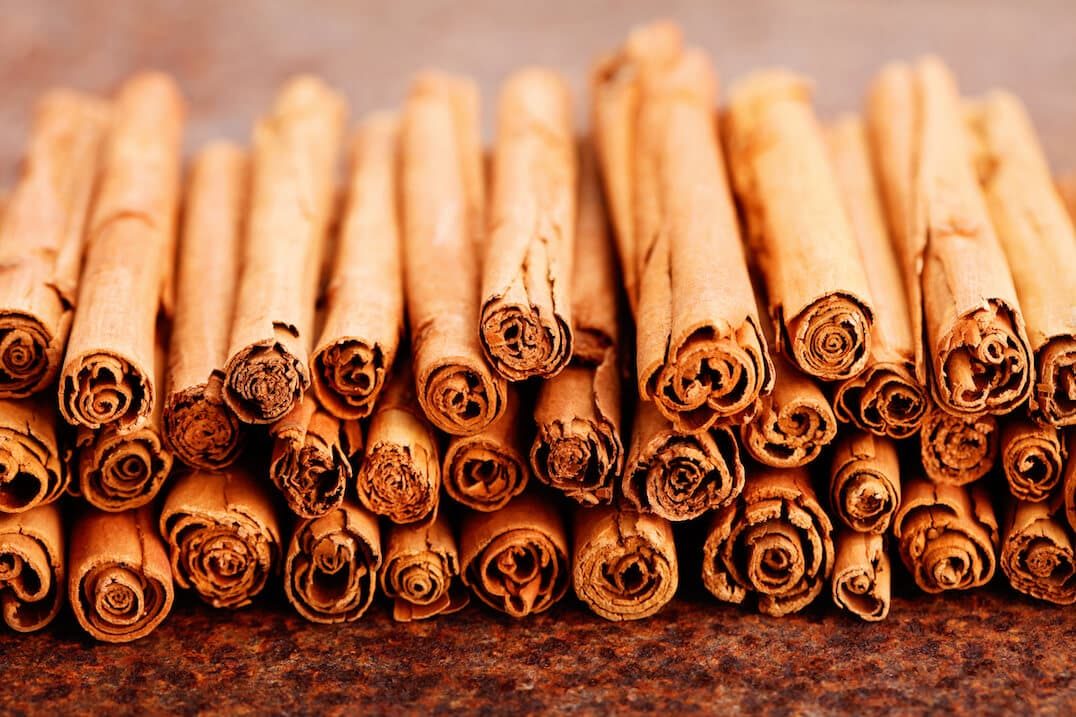
“Cinnamon” on a label can mean one of at least four tree species. Ceylon cinnamon comes from Cinnamomum verum, a tree native to Sri Lanka.1 “Cassia” is a trade group of three others: Chinese cassia, Indonesian cassia and Vietnamese (Saigon) cassia.2 The NIH calls Ceylon the “true” cinnamon and cassia the type most commonly sold in North America.3 For a cook the differences show up in three places: the shape of the stick, the balance of flavor compounds, and coumarin, a natural flavor compound that cassia can carry in large amounts and Ceylon carries only in traces.45
All of these trees belong to the laurel family, Lauraceae, the same family as the bay laurel that gives us bay leaves.167
Side by side
| Ceylon cinnamon | Cassia (the group) | |
|---|---|---|
| Species | Cinnamomum verum (syn. C. zeylanicum)1 | Chinese cassia: C. aromaticum, often still cited as C. cassia;62 Indonesian cassia: C. burmanni;28 Vietnamese/Saigon cassia: C. loureiroi29 |
| Native range | Sri Lanka1 | C. aromaticum: SE China to Vietnam;6 C. burmanni: S China to W and Central Malesia;8 C. loureiroi: Vietnam9 |
| Main producers | Sri Lanka dominates; also grown in southern India, the Seychelles and Madagascar10 | China (Chinese cassia), Indonesia (Indonesian), Vietnam (Vietnamese)11 |
| Part used | Dried inner bark11 | Dried inner bark11 |
| The stick | Thin bark, at most 0.5 cm thick and dull pale brown; smaller curled pieces are slid inside longer ones to build compound quills10 | No source opened for this page describes retail cassia sticks. PROSEA describes Chinese cassia bark on the tree as thick.11 |
| Bark oil | 50–75% cinnamaldehyde, with eugenol at 5–18%10 | Chinese cassia: 70–95% cinnamaldehyde, eugenol only in traces;2 Indonesian: mainly cinnamaldehyde, no eugenol;2 Vietnamese: mainly cinnamaldehyde, traces of eugenol2 |
| Coumarin | Trace amounts in authenticated bark (see the table below)512 | Substantial, and highly variable between species and lots (see below)512 |
| Flavor (editorial) | Milder and more layered | Stronger, hotter and more one-note |
| Price | No dated, sourced retail comparison found | No dated, sourced retail comparison found |
The flavor row is our description, not a measurement. It is consistent with the oil chemistry: Ceylon bark oil carries a meaningful share of eugenol alongside its cinnamaldehyde, while the cassia oils are mostly cinnamaldehyde with little or no eugenol.102 For more on the individual spices, see Ceylon cinnamon, cassia cinnamon, Saigon cinnamon and Korintje cinnamon, the Indonesian type.
Coumarin: how much is in each
Coumarin figures vary so much by species, origin and sample that a single “cassia number” is misleading. Each figure below belongs to the samples it was measured on.
| Sample (scope) | Coumarin | Source |
|---|---|---|
| C. verum, authenticated sample | 0.017 g/kg | Wang et al. 2013, as tabulated by Lončar et al. 202012 |
| C. verum bark, commercial, Sri Lanka | 0.007 to 0.9 g/kg | same12 |
| C. verum bark, commercial, US | 0.013 g/kg | same12 |
| C. cassia, authenticated sample | 0.310 g/kg | same12 |
| C. cassia bark, commercial, US | 0.085 to 0.262 g/kg | same12 |
| C. burmannii, authenticated sample | 2.14 g/kg | same12 |
| C. burmannii, commercial, US | 3.99 to 9.30 g/kg | same12 |
| C. loureiroi, authenticated sample | 6.97 g/kg | same12 |
| C. loureiroi bark, commercial, Vietnam | 1.06 g/kg | same12 |
| Cassia cinnamon, German food monitoring | about 3,000 mg/kg (3 g/kg) on average; highest measured 10,000 mg/kg | BfR4 |
| Cassia cinnamon powder, figures known to BfR in 2006 | about 2,100 to about 4,400 mg/kg | BfR13 |
| Ground cinnamon, Czech retail, 60 samples from 12 brands | brand means 2,650 to 7,017 mg/kg | Blahová & Svobodová 201214 |
Some things the table shows, and some it doesn’t:
- Cassia is not one number. In the US study, the authenticated Chinese cassia sample (0.310 g/kg) was far lower in coumarin than the Indonesian (2.14 g/kg) and Vietnamese (6.97 g/kg) samples, and US commercial Indonesian cassia ran higher still.12 The authors found substantial coumarin in all three cassia species.5
- Ceylon is low, not zero. The Sri Lankan commercial bark range reaches 0.9 g/kg at the top,12 and the NIH says Ceylon “may contain a trace amount.”3 Why that range runs so high is not explained in the table we read.
- Every grocery-store sample in the US study contained some coumarin. That covered every cinnamon, cinnamon-flavored food and supplement bought locally.5
- The German retail ratio. In a 2010 study of 91 cinnamon samples bought in German stores, cassia powder averaged up to 63 times more coumarin than Ceylon powder, and cassia sticks 18 times more than Ceylon sticks.15 That ratio belongs to those German samples, not to cinnamon in general.
What the coumarin limit means in practice
EFSA set a tolerable daily intake (TDI) of 0.1 mg of coumarin per kg of body weight in 2004 and kept it in its 2008 review.16 BfR uses the same figure.4 EFSA also concluded that three times the TDI for one to two weeks is not a safety concern,16 so an occasional heavy-cinnamon week is not the issue. Steady daily intake is.
Using cassia at its average German monitoring level of about 3 g/kg, BfR works out that:4
- a 60 kg adult reaches the TDI with about 2 g of cassia a day;
- a 15 kg small child reaches it with about 0.5 g a day.
Those figures scale with coumarin content. Our own arithmetic: at the 10 g/kg maximum BfR reports, the adult figure drops to about 0.6 g. At the Ceylon authenticated-sample level of 0.017 g/kg, it rises to more than 300 g, far more than anyone eats.
Coumarin in cinnamon is absorbed almost as well as pure coumarin. In a crossover trial with 24 volunteers, the authors concluded that the TDI can be used to judge exposure from cinnamon-containing meals.17
What the risk is. BfR says relatively low doses can cause liver damage in a small group of especially sensitive people, in severe cases inflammation of the liver with jaundice. It also notes that no such cases had been described after eating cinnamon itself.4 Very large doses given over long periods caused cancer in rats and mice. BfR says there are no indications that coumarin triggers tumors in humans.4 The NIH adds that ordinary use of cassia usually doesn’t supply enough coumarin to cause significant problems, but prolonged use could matter for sensitive people such as those with liver disease.3
Not the blood thinner. A widely repeated claim ties the coumarin in cinnamon to the anticoagulant warfarin. France’s food-safety agency, ANSES, says the anticoagulant properties attributed to coumarins belong to dimeric derivatives, in particular dicoumarol, which forms when sweet clover ferments after fungal contamination. Simple coumarins do not have them.18 Warfarin and acenocoumarol, the oral anticoagulant drugs, are coumarin derivatives made synthetically, and ANSES found no published data showing drug interactions with coumarin itself or with plants that contain only coumarin.18
Where it adds up. The EU sets no coumarin limit for cinnamon itself. It does limit coumarin in some foods made with it, for example 50 mg/kg in traditional or seasonal baked goods labeled as containing cinnamon and 5 mg/kg in desserts.4 BfR calculates that a small child would reach the TDI by eating 30 g of cinnamon stars a day, and an adult with more than 120 g.4 Cinnamon supplements are the other concern. BfR warns they can be high in coumarin,4 and its 2006 assessment recommended warnings on cinnamon products sold to lower blood sugar.13 (The NIH finds no clear support for using cinnamon for any health condition.3)
Telling them apart. Once ground, the two are hard to tell apart by eye, so BfR points to packs that state “Ceylon cinnamon” on the label.4
Can one stand in for the other?
Mostly yes. PROSEA’s spice handbook says cinnamon and cassia bark are interchangeable in many applications.2 What changes is the result, not whether the dish works:
- Cassia in place of Ceylon. In our judgment the flavor is stronger and more one-note, so start with less and taste. The bigger reason to choose Ceylon is coumarin: if cinnamon is a daily habit (oatmeal, coffee, smoothies) or you cook for small children, Ceylon keeps you far from the TDI.
- Ceylon in place of cassia. You may need more to get the same intensity, and the difference shows most in simple preparations such as cinnamon toast. In spice blends and long braises it narrows. (Editorial judgment; no source measures these swaps.)
- Sticks vs. ground. For whole-to-ground swaps, see ground cinnamon vs. cinnamon sticks.
Where you’ll find Ceylon
In North America, the cinnamon on most shelves is cassia,3 and PROSEA notes a clear US preference for cassia, especially Vietnamese.2 Mexico is a different market. Cinnamon heads Sri Lanka’s list of exports to Mexico, worth USD 91 million in 2025,19 and Sri Lanka is the main producer of Ceylon cinnamon.10 It is often said that Mexican and Latin American groceries are a good place to find Ceylon; no source reviewed here measures what those shops stock. Anywhere else, check the label for “Ceylon” or Cinnamomum verum.
Related
- Saigon vs. Ceylon cinnamon: Vietnamese cassia against true cinnamon.
- Cassia buds
- Too much cinnamon? How to rescue a dish.
- Cinnamon substitutes: what to use when the jar is empty.
Footnotes
-
Cinnamomum verum, Plants of the World Online, Kew. powo.science.kew.org · Reference work ↩ ↩2 ↩3 ↩4
-
Cinnamomum (PROSEA Spices), Pl@ntUse. uses.plantnet-project.org · Reference work ↩ ↩2 ↩3 ↩4 ↩5 ↩6 ↩7 ↩8 ↩9 ↩10
-
Cinnamon: Usefulness and Safety, NCCIH. nccih.nih.gov · Regulator ↩ ↩2 ↩3 ↩4 ↩5
-
FAQ on coumarin in cinnamon and other foods, BfR. bfr.bund.de · Regulator ↩ ↩2 ↩3 ↩4 ↩5 ↩6 ↩7 ↩8 ↩9 ↩10
-
Wang et al., Cassia cinnamon as a source of coumarin…, J. Agric. Food Chem., 2013. hero.epa.gov · Peer-reviewed ↩ ↩2 ↩3 ↩4 ↩5
-
Cinnamomum aromaticum, Plants of the World Online, Kew. powo.science.kew.org · Reference work ↩ ↩2 ↩3
-
Laurus nobilis, Plants of the World Online, Kew. powo.science.kew.org · Reference work ↩
-
Cinnamomum burmanni, Plants of the World Online, Kew. powo.science.kew.org · Reference work ↩ ↩2
-
Cinnamomum loureiroi, Plants of the World Online, Kew. powo.science.kew.org · Reference work ↩ ↩2
-
Cinnamomum verum, PROSEA Handbook No. 13: Spices. prosea.prota4u.org · Reference work ↩ ↩2 ↩3 ↩4 ↩5
-
Cinnamomum (cassia species), PROSEA Handbook No. 13: Spices. prosea.prota4u.org · Reference work ↩ ↩2 ↩3 ↩4
-
Lončar et al., Coumarins in Food and Methods of Their Determination, Foods, 2020 (Table 4, values from Wang et al. 2013). mdpi.com · Peer-reviewed ↩ ↩2 ↩3 ↩4 ↩5 ↩6 ↩7 ↩8 ↩9 ↩10 ↩11 ↩12 ↩13
-
High daily intakes of cinnamon: Health risk cannot be ruled out (044/2006), BfR. bfr.bund.de · Regulator ↩ ↩2
-
Blahová & Svobodová, Assessment of Coumarin Levels in Ground Cinnamon Available in the Czech Retail Market, Scientific World Journal, 2012. doaj.org · Peer-reviewed ↩
-
ScienceDaily, news release on Woehrlin et al., J. Agric. Food Chem., 2010. sciencedaily.com · Publication ↩
-
Coumarin in flavourings and other food ingredients with flavouring properties, EFSA AFC Panel, 2008. efsa.europa.eu · Regulator ↩ ↩2
-
Abraham et al., Relative bioavailability of coumarin from cinnamon…, Mol. Nutr. Food Res., 2011. agris.fao.org · Peer-reviewed ↩
-
Opinion on the risk of hepatotoxicity associated with the coumarin content of certain plants (2018-SA-0180), ANSES, 2021. anses.fr · Regulator ↩ ↩2
-
Market Profile: Mexico 2026, Export Development Board of Sri Lanka. srilankabusiness.com · Reference work ↩