Seasonings · Profile
Chinese Five-Spice Powder: What’s in It, How It Tastes and How to Use It
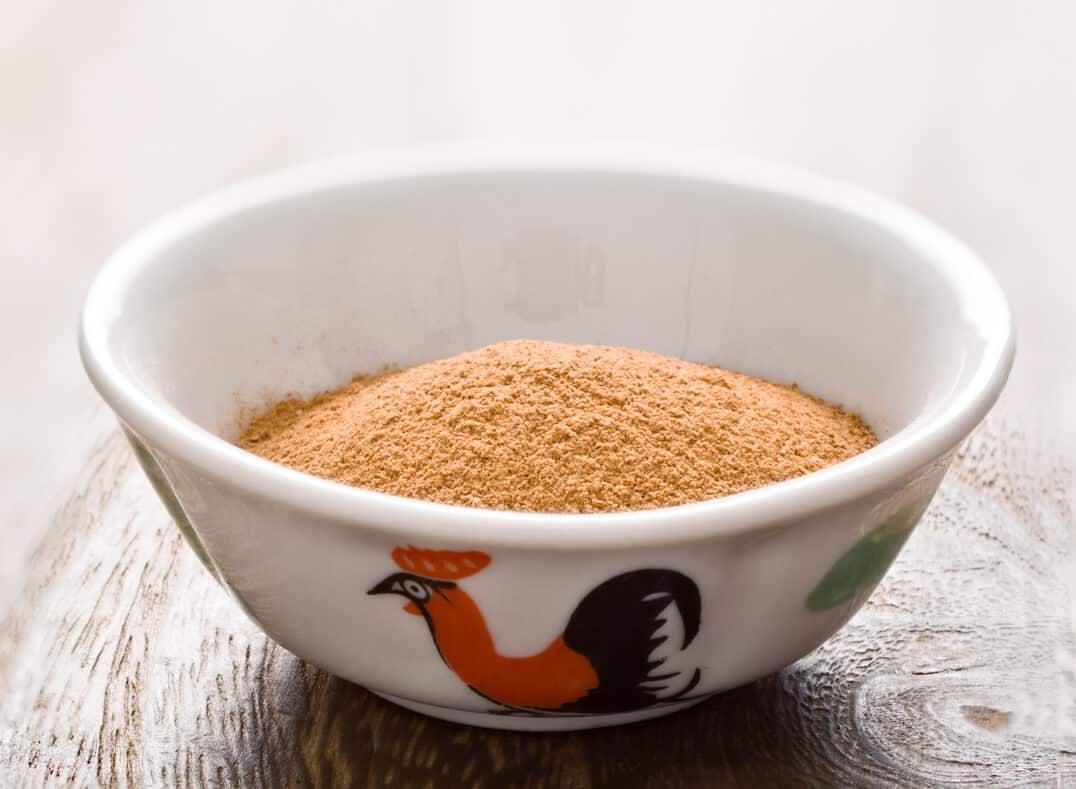
Chinese five-spice powder is a ground blend, usually of fennel seed, cassia (Chinese cinnamon), cloves, star anise and Sichuan pepper, though many variations exist.1 It tastes sweet and licorice-like up front, warm and woody underneath, with a faint numbing tingle when Sichuan pepper is in the mix. There is no single recipe: home cooks, restaurants and spice companies all make it differently, and some commercial versions leave out two of the “classic” five.
At a glance
| Type | Ground spice blend of Chinese origin1 |
| Usual components | Fennel seed, cassia, cloves, star anise, Sichuan pepper12 |
| Common extras | Ginger, nutmeg, licorice, orange peel, galangal (Woks of Life); sand ginger (one recipe); black pepper and garlic (one UK brand)234 |
| Dominant flavors | Anise-like sweetness (star anise and fennel), cinnamon warmth (cassia), clove, numbing tingle (Sichuan pepper)1 |
| Typical uses | Roast and braised meats, especially fatty cuts; marinades and dry rubs; dipping salt12 |
| Safety notes | Coumarin in cassia; Japanese star anise is toxic (see Safety)56 |
What the name means
Britannica describes the blend as five dried spices and says the components are thought to represent the five classical flavors of Chinese cooking: salty, bitter, aromatic, sweet and sour.1 A widely repeated explanation ties the name instead to the five elements of traditional Chinese medicine and says the blend was devised to balance them; no source meeting this site’s standard was found for that, or for claims that the blend dates back thousands of years.
What the sources do agree on is that proportions vary. Britannica says many versions exist across Asia,1 and The Woks of Life encourages cooks to adjust the proportions to taste rather than use equal amounts.2
What’s in it: four blends compared
There is no standard recipe, so here are four published ingredient lists side by side. None of them is “the” recipe.
| Source | Ingredients | Fennel? | Sichuan pepper? |
|---|---|---|---|
| Britannica (Tony Hill) | Fennel seeds, cassia (Chinese cinnamon), cloves, star anise, Szechuan pepper; “many variations exist”1 | Yes | Yes |
| The Woks of Life, homemade recipe (Kaitlin, 2020) | 1 tbsp ground Chinese cassia; 2 tbsp fennel seeds; 1 tbsp Sichuan peppercorns; 1 tsp cloves; 4 star anise; optional 1 tbsp sand ginger powder3 | Yes | Yes |
| McCormick Culinary Chinese Five Spice (U.S., label) | Anise, cinnamon, star anise, cloves, ginger, sulfiting agents7 | No | No |
| Schwartz Chinese 5 Spice Seasoning (UK, product description) | Star anise, fennel, cinnamon, cloves, black pepper, garlic4 | Yes | No |
The Woks of Life recipe expresses its amounts as parts: fennel 2, cassia 1, Sichuan pepper 1, star anise 1 (counting four stars as a part), and cloves one-third of a part.3 Its author notes that the fifth spice can be “a bit of a wild card” between ginger, white pepper and Sichuan pepper.3 The McCormick blend uses anise seed and ginger in place of fennel and Sichuan pepper,7 and the Schwartz blend adds black pepper and garlic.4 The result is that “five-spice” from two jars can taste quite different.
Flavor and the compounds behind it
Britannica describes five-spice as a balance of warm with cool and bitter with sweet: licorice base notes, sweet top notes, and the slightly numbing effect of Sichuan pepper.1 The main aroma compounds of the core spices explain much of that:
| Component | Main aroma compound in its oil | Source |
|---|---|---|
| Star anise | trans-Anethole, 70–93% of the oil | PROSEA8 |
| Fennel seed | Anethole, which gives fennel its anise fragrance and sweet taste | PROSEA9 |
| Cassia (Chinese) | Cinnamaldehyde, 70–95% of bark oil | PROSEA10 |
| Cloves | Eugenol, 70–90% of bud oil | PROSEA11 |
Two of the usual five, star anise and fennel, share anethole. The numbing tingle of Sichuan pepper comes from a different kind of compound; it was not covered by any source opened for this page.
For the individual spices, see star anise, fennel seed, cassia cinnamon, cloves and Szechuan pepper.
How it is used
Britannica says five-spice flavors the full range of Chinese dishes, from roast meats to simmered rice, and has spread into fusion cooking worldwide.1 The Woks of Life says it is perhaps best on meat, especially fatty cuts, that it often goes into Chinese marinades and dry rubs, and that Cantonese restaurants often mix it with salt as a dip; it plays a large role in their Cantonese roast pork belly.2 McCormick suggests it for Chinese barbecued pork, braised pork belly and pho, and also in cakes, cookies and chocolate desserts.7 Schwartz suggests sprinkling it over prawns, chicken or stir-fried vegetables toward the end of cooking, or mixing it with soy sauce, garlic and honey as a marinade.4
Making your own. The Woks of Life recipe toasts whole spices in a dry pan over low heat until fragrant, then grinds them to a fine powder.3 Making it yourself lets you choose which version you want; for what to use when you have none, see five-spice substitutes.
In sweets. Its cinnamon-clove side makes it a reasonable stand-in for pumpkin pie spice if you like a licorice note; that is our judgment, not a tested swap.
Buying and quality
Read the label. As the table above shows, a jar called five-spice may or may not contain fennel or Sichuan pepper,74 and the McCormick Culinary blend lists sulfiting agents among its ingredients.7 No grade standard for the blend was found.
Storage
The Woks of Life says five-spice stored somewhere cool, dark and dry will keep for several months, and that a jar three years old or more is probably due for replacement.2 We found no shelf-life figure from a regulator or standards body. In practice, a faint smell when you open the jar means it has faded.
Safety
Star anise must be the right species. In 2003 the U.S. Food and Drug Administration warned consumers not to drink teas made from star anise after about 40 illnesses, including seizures, vomiting and jitteriness, about 15 of them in infants. Its concern was that Chinese star anise may contain Japanese star anise, which “has long been recognized as toxic in many countries”, and it said it would monitor imports.5 The advice concerned teas, not five-spice powder; the practical point is that star anise for food should be Chinese star anise (Illicium verum) from a food supplier. See star anise.
Coumarin in cassia. Cassia contains coumarin, which European regulators limit in some foods; BfR reports German monitoring averages of about 3,000 mg/kg in cassia.6 No measurement of coumarin in five-spice blends was found for this review. For what the coumarin limits mean in practice, see Ceylon vs. cassia cinnamon.
Health claims
Britannica notes that traditional Chinese medicine often uses five-spice powder as a remedy for indigestion.1 That is a record of traditional use, not evidence. For cinnamon, NCCIH says research does not clearly support using it for any health condition.12 This page makes no claim that five-spice or its components prevent clotting, lower blood sugar, aid digestion or boost immunity.
Substitutes and related pages
- Five-spice substitutes
- Spices for Chinese food
- Star anise uses and cooking with star anise
- Cloves vs. star anise
- Garam masala, another blend built on cinnamon and cloves
Footnotes
-
Tony Hill, “Five-spice powder”, Encyclopaedia Britannica. britannica.com · Reference work ↩ ↩2 ↩3 ↩4 ↩5 ↩6 ↩7 ↩8 ↩9 ↩10 ↩11
-
“Five Spice Powder”, The Woks of Life, 2020 (updated 2021). thewoksoflife.com · Publication ↩ ↩2 ↩3 ↩4 ↩5 ↩6
-
Kaitlin, “How to Make Five Spice Powder”, The Woks of Life, 2020. thewoksoflife.com · Publication ↩ ↩2 ↩3 ↩4 ↩5
-
Schwartz Chinese 5 Spice Seasoning, product page, Schwartz. schwartz.co.uk · Merchant ↩ ↩2 ↩3 ↩4 ↩5
-
Teas Made from Star Anise Were Associated With Illnesses Including Seizures, U.S. FDA, 2003. fda.gov · Regulator ↩ ↩2
-
FAQ on coumarin in cinnamon and other foods, German Federal Institute for Risk Assessment (BfR). bfr.bund.de · Regulator ↩ ↩2
-
McCormick Culinary Chinese Five Spice, product page, McCormick. mccormick.com · Merchant ↩ ↩2 ↩3 ↩4 ↩5
-
Vu Ngoc Lô, Illicium verum, PROSEA, via Pl@ntUse. uses.plantnet-project.org · Reference work ↩
-
Purwaningsih, Harmida & M. Brink, Foeniculum vulgare, PROSEA, via Pl@ntUse. uses.plantnet-project.org · Reference work ↩
-
Cinnamomum (PROSEA Spices), Pl@ntUse. uses.plantnet-project.org · Reference work ↩
-
E.W.M. Verheij and C.H.A. Snijders, Syzygium aromaticum, PROSEA, via Pl@ntUse. uses.plantnet-project.org · Reference work ↩
-
Cinnamon: Usefulness and Safety, National Center for Complementary and Integrative Health, 2024. nccih.nih.gov · Regulator ↩