Spice Comparisons · Comparison
Dill Seed vs. Dill Weed: Same Plant, Different Oils
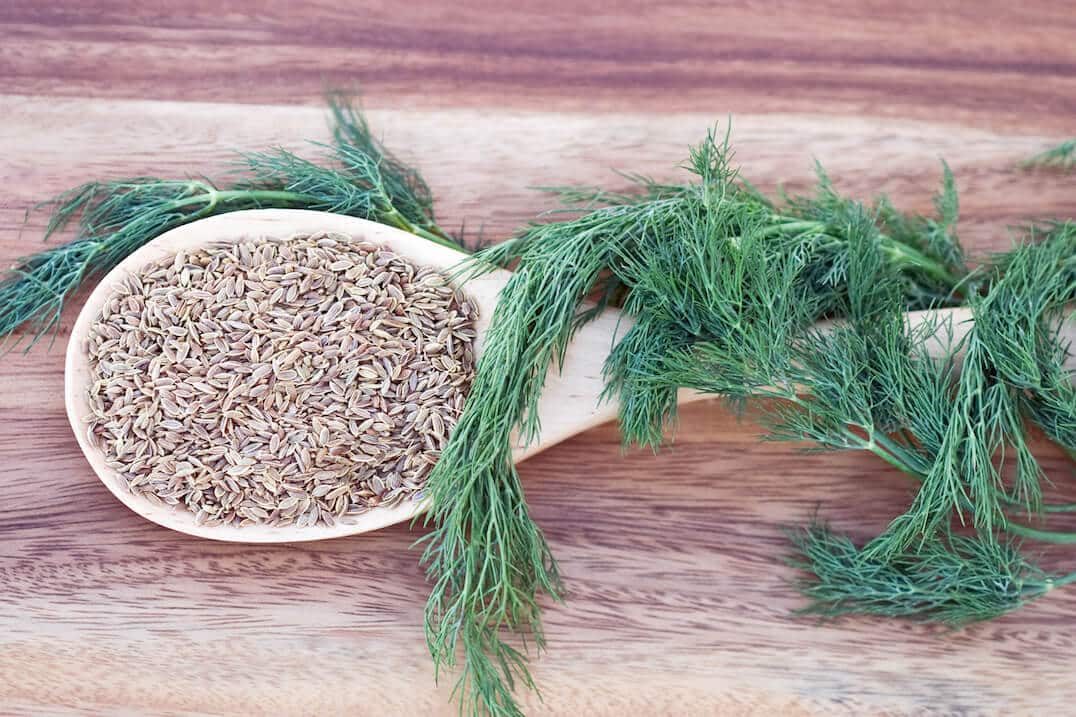
Dill seed and dill weed both come from Anethum graveolens, an annual in the parsley family.12 Dill weed is the feathery leaf; dill seed is the dried fruit. They taste different because their essential oils are different. PROSEA, the Southeast Asian plant-resources handbook, gives the leaf oil as led by phellandrene and dill ether, and the fruit oil by limonene and carvone,3 the same pair that leads caraway oil.4 The seed also carries far more oil and stands up to cooking; the leaf is delicate and belongs near the end. They can replace each other in pickles, at a published ratio, but rarely elsewhere.
Side by side
| Dill seed | Dill weed | |
|---|---|---|
| Plant | Anethum graveolens, Apiaceae12 | Same plant |
| Part used | The small dry fruit, often mistaken for a seed: broadly oval, about 3.5 mm long, light brown2 | The leaves and small stems, plus immature flower heads, used fresh or dried2 |
| When it’s harvested | When the fruits are fully developed but still green, 7 to 9 days after the petals drop3 | Usually before flowering, about 40 to 50 days after sowing3 |
| Essential oil | 2 to 6 percent (PROSEA);3 about 3 percent, mainly carvone (Britannica)2 | 0.1 to 1.5 percent of the dry herb (PROSEA)3 |
| Leading oil compounds | Limonene up to 70% and carvone up to 60% (PROSEA);3 carvone 40 to 60% and limonene about 40% (Katzer)5 | Phellandrene about 35% and dill ether about 25% (PROSEA);3 carvone 30 to 40%, limonene 30 to 40%, phellandrene 10 to 20%, with dill ether characteristic (Katzer)5 |
| In the heat | Sturdier; LSU AgCenter lists dill seed among herbs that can go in the last 20 minutes;6 Katzer says the fruits are briefly fried in hot fat to develop their aroma5 | Delicate; best added at the end, since prolonged heat costs flavor and aroma (LSU AgCenter)6 |
| Typical uses | With the flower heads, pickled cucumbers and onions, vinegar, sauces, pastries and bread;3 in India, curry powder and dals35 | Soups, salads and sauces;3 fish, where Katzer says the leaves are preferred;5 a garnish for boiled potatoes in the Baltic states5 |
| Flavor (editorial) | Warm, sharper and caraway-like, a little bitter | Fresh, grassy and lighter |
The two sources disagree about the leaf oil. PROSEA puts phellandrene and dill ether at the top; Katzer lists carvone and limonene first, with phellandrene lower and dill ether as the characteristic leaf compound.35 Leaf oil composition varies with the plant and the sample, and we show both rather than pick one. They agree on the seed: carvone and limonene lead.35
Why they taste different
The chemistry explains most of it. Dill seed’s oil is dominated by carvone and limonene,3 the same two compounds Britannica names as the principal components of caraway oil.4 That is why Britannica describes dill’s flavor as warm, slightly sharp and somewhat reminiscent of caraway.2 The leaf has much less oil overall, 0.1 to 1.5 percent of the dry herb against 2 to 6 percent in the fruit,3 and its oil is characterized by phellandrene and dill ether.35 PROSEA describes dill as having a pleasant aromatic smell but a slightly bitter and pungent taste,3 without saying which part it means.
Katzer adds that fresh dill herb is much more aromatic than dried, and has a much sweeter fragrance than the dried fruits.5 He also notes that Indian cooks use the dried fruits rather than the leaves, and that Indian dill fruits have a more pungent flavor than European dill.5
How each is cooked
Dill weed goes in late. LSU AgCenter lists dill leaves with basil, chives, cilantro, parsley and mint as delicate herbs to add at the end, and warns that prolonged heat causes flavor and aroma losses.6 America’s Test Kitchen likewise groups dill with the delicate, more volatile herbs.7 PROSEA notes that leaving harvested dill to dry in the field causes considerable loss of oil by evaporation, especially of the more volatile terpenes.3
Dill seed can go in earlier. LSU AgCenter puts dill seeds with oregano, rosemary and thyme among the less delicate seasonings that can be added in the last 20 minutes.6 In Indian cooking, Katzer writes, dill fruits are briefly fried in hot fat to develop their aroma, like many related spices.5
Where each is used
- Pickles. PROSEA says dill’s flower heads and ripe fruits flavor pickled cucumbers, onions and vinegar.3 Katzer says fresh dill sprigs are mandatory in most European pickle recipes of this kind.5
- Fish. Both Britannica and Katzer name fish; Katzer says the leaves are preferred for it.25
- Breads and pastries. PROSEA lists the fruits for pastries and bread.3
- India. PROSEA says the fruits are an ingredient of curry powder in India,3 and Katzer calls dill an occasional spice in dals.5
- Eastern Europe and Scandinavia. Britannica says dill is especially popular in these cuisines,2 and Katzer notes Scandinavian fish and shellfish dishes flavored with it and chopped dill sprinkled over boiled potatoes in the Baltic states.5
- Herbal vinegar. Katzer says dill adds depth and body to herbal vinegar and should never be left out.5
Can one stand in for the other?
In pickles (Attributed). The National Center for Home Food Preservation’s tested recipe for quick fresh-pack dill pickles gives each pint jar either 1½ heads of fresh dill or 1½ teaspoons of dill seed.8 That works out to 1 teaspoon of seed per flower head. Note that the recipe means flower heads, not leaves. For canned pickles, keep to a tested recipe; the Center says not to alter the proportions of vinegar, food and water.9 Because the tested recipe itself offers either form, this swap stays within its tested proportions.
Dill weed in place of seed elsewhere (Method). We found no published ratio. The leaf carries far less oil than the seed,3 so expect a lighter, greener result, and add the leaves at the end rather than at the start.6
Dill seed in place of dill weed (Method). We found no published ratio here either. Crush the seed and start small, about a quarter of the volume of chopped fresh dill called for, then taste. Its carvone-and-limonene oil is the caraway pair,34 so it will taste warmer and less fresh, and it suits cooked dishes and dressings better than garnishes.
Fresh and dried dill weed. For fresh-to-dried leaf swaps, LSU AgCenter’s general rule is that one tablespoon of fresh herbs equals one teaspoon of dried.6 See fresh dill vs. dried dill.
What isn’t known
- No study compares the flavor strength of dill seed and dill weed, so the non-pickle swaps are Method starting points.
- Leaf oil composition differs between PROSEA and Katzer; the reasons (cultivar, origin, plant stage, method) are not given in either source.
- A widely repeated claim that dill seed gets stronger when heated has no measurement behind it in the sources we reviewed; Katzer says only that frying develops the aroma.
Related
- Dill, dill substitutes, cooking with dill, how to store dill and too much dill?
- Fresh dill vs. dried dill, fennel vs. dill and tarragon vs. dill
- Caraway seeds and pickling spice
Footnotes
-
Anethum graveolens L., Plants of the World Online, Royal Botanic Gardens, Kew. powo.science.kew.org · Reference work ↩ ↩2
-
“Dill”, Encyclopaedia Britannica. britannica.com · Reference work ↩ ↩2 ↩3 ↩4 ↩5 ↩6 ↩7 ↩8
-
Nguyen Thi Tâm, C.C. de Guzman and P.C.M. Jansen, Anethum graveolens, Plant Resources of South-East Asia (PROSEA). uses.plantnet-project.org · Reference work ↩ ↩2 ↩3 ↩4 ↩5 ↩6 ↩7 ↩8 ↩9 ↩10 ↩11 ↩12 ↩13 ↩14 ↩15 ↩16 ↩17 ↩18 ↩19 ↩20 ↩21 ↩22
-
“Caraway”, Encyclopaedia Britannica. britannica.com · Reference work ↩ ↩2 ↩3
-
Gernot Katzer, “Dill (Anethum graveolens)”, Gernot Katzer’s Spice Pages. gernot-katzers-spice-pages.com · Reference work ↩ ↩2 ↩3 ↩4 ↩5 ↩6 ↩7 ↩8 ↩9 ↩10 ↩11 ↩12 ↩13 ↩14 ↩15 ↩16 ↩17
-
“Flavorful Herbs”, LSU AgCenter. lsuagcenter.com · Reference work ↩ ↩2 ↩3 ↩4 ↩5 ↩6
-
“Science: Substituting Dried Herbs for Fresh”, America’s Test Kitchen. americastestkitchen.com · Publication ↩
-
“Quick Fresh-Pack Dill Pickles”, National Center for Home Food Preservation. nchfp.uga.edu · Reference work ↩
-
“General Information on Pickling”, National Center for Home Food Preservation. nchfp.uga.edu · Reference work ↩