Spices · Cooking with
Cooking With Saffron: Steeping, Amounts, Timing and Classic Dishes
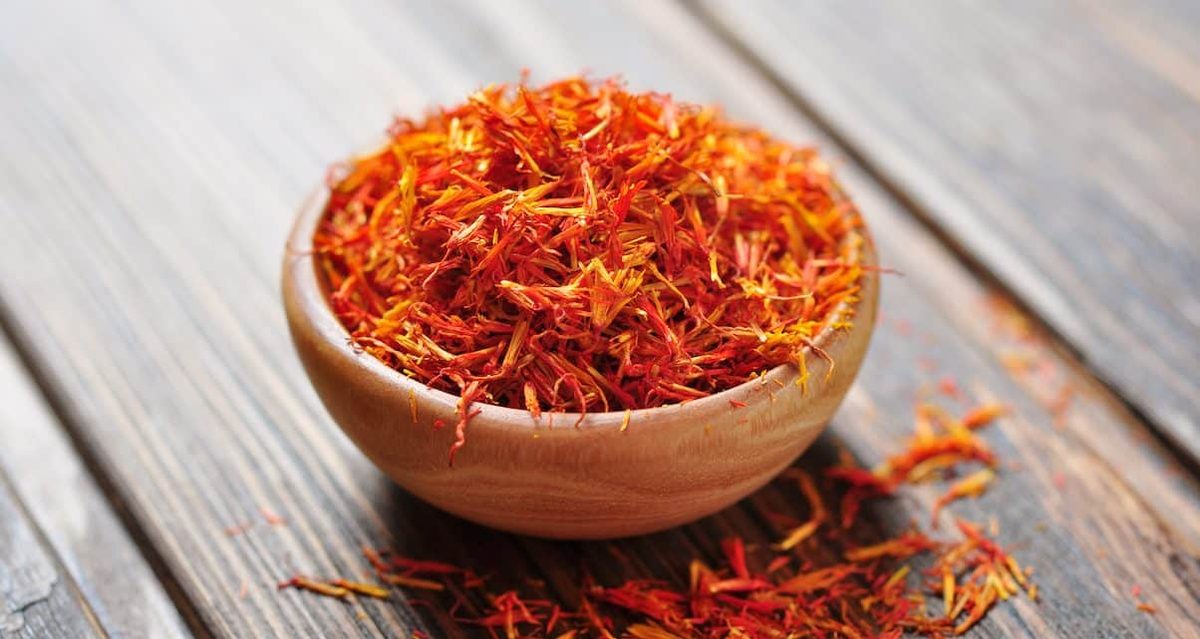
Saffron is the most expensive spice in the world, and a pound of it represents 75,000 blossoms, so technique matters more than with any other spice.1 A small amount does three jobs: crocin colors the dish, picrocrocin gives a bitter edge, and safranal carries much of the aroma.12 The color is drawn out by liquid, the aroma fades with long cooking, and the bitterness is what you taste when you overdo it. This page covers how to steep and grind saffron, how much to use, when to add it, the dishes it defines, and how to buy and keep it. For the spice itself, see saffron.
At a glance
| Question | Short answer |
|---|---|
| Steep or add dry? | Steep first; Gernot Katzer says dry saffron releases its fragrance too slowly3 |
| Hot or cold liquid? | Sources differ: Katzer prefers a cold extract; University of Vermont recipes use hot water or warm wine34 |
| How long to steep | 10 minutes to overnight in named recipes34 |
| How much | Recipes use about 1/4 to 1 teaspoon of threads; Katzer says 1/2 teaspoon is enough for one liter34 |
| When to add | With the cooking liquid in rice dishes; avoid prolonged cooking for aroma’s sake35 |
| Threads or powder? | Threads: adulterants are very hard to spot in ground saffron3 |
Releasing color and aroma
Gernot Katzer, whose spice reference covers saffron in detail, says using the dry spice directly in cooking is not favorable because it releases its fragrance too slowly.3 The usual answer is to steep it first, then add the liquid and the threads to the dish. Sources describe several ways to do that:
| Method | Details | Source |
|---|---|---|
| Cold soak | Soak the threads overnight in water, filter, and add the water for a pure, even color | Katzer3 |
| Ground, extracted in milk | Powder the saffron and extract it in a little milk; after half an hour the milk turns the deep color of egg yolk | Katzer3 |
| Hot water | 1 teaspoon of threads sprinkled into 1/4 cup hot water and set aside, for Persian jeweled rice | University of Vermont4 |
| Warm wine | 1/4 teaspoon of gently crushed threads in 1 tablespoon of hot white wine (or water), left 30 minutes or overnight, for shortbread | University of Vermont4 |
| Ground, then lemon juice | 1/2 teaspoon ground in a mortar and pestle, then left in lemon juice about 10 minutes until the liquid turns yellow, for mayonnaise | University of Vermont4 |
Hot or cold? Katzer recommends preparing the extract with cold liquid and adding it to hot food.3 The Vermont recipes use hot water or warm wine.4 Neither source measures the difference, so this is a genuine disagreement in practice rather than a settled point. Either way, give it time: the recipes above range from 10 minutes to overnight.34
Grinding. The Vermont mayonnaise recipe grinds the saffron in a mortar and pestle before steeping it.4 A Vermont rub for Moroccan chicken uses 1/4 teaspoon of pulverized threads mixed straight into garlic, ginger, paprika, cumin and turmeric, with no steeping, and then marinates for 3 to 4 hours.4 Crumbling dry, brittle threads between your fingers is a quicker route to the same end (our judgment).
When to add it
A common rule says to add saffron at the start so its flavor infuses the dish. The sources point to a more careful version: add the infusion with the cooking liquid, but don’t cook it longer than the dish needs. Katzer warns that prolonged cooking should be avoided because the aroma is lost.3 In paella, Britannica describes rice, tomatoes, saffron and stock being simmered together,5 and the Spain.info recipe adds the saffron strands along with a sprig of rosemary.6 For baking and sauces, the Vermont recipes stir the infusion into the batter or the emulsion; the shortbread recipe also brushes the leftover infused wine on top before baking.4
How much to use
Most recipes measure saffron by the teaspoon or the pinch, and a few by weight. A common claim says counting threads is the most accurate way to measure; we found no source that recommends it or tests it. Named recipes give these amounts (Attributed):
| Dish | Saffron | Source |
|---|---|---|
| Persian jeweled rice | 1 teaspoon threads, “about 1/2 gram” | University of Vermont4 |
| Saffron mayonnaise | 1/2 teaspoon, ground | University of Vermont4 |
| Saffron shortbread | 1/4 teaspoon threads, “a good pinch” | University of Vermont4 |
| Moroccan chicken | 1/4 teaspoon threads, pulverized | University of Vermont4 |
| General guide | 1/2 teaspoon, “which might well be a fifth of a gram,” for one liter | Katzer3 |
The two weight estimates differ: Vermont puts a teaspoon at about half a gram, while Katzer’s half teaspoon at a fifth of a gram implies about 0.4 grams per teaspoon.34 Thread size and how loosely they are packed both vary, so a scale that reads to 0.01 gram is the only precise measure; that is our suggestion, not a sourced method. Katzer also notes that old European recipes sometimes call for “astronomical” amounts.3
Dishes saffron defines
Britannica says saffron colors and flavors many Mediterranean and Asian dishes, particularly rice and fish, and names English, Scandinavian and Balkan breads and bouillabaisse.1 Katzer adds several more:
| Region | Dish | Source |
|---|---|---|
| Spain | Paella: rice, tomatoes, saffron and stock simmered together | Britannica5 |
| Italy | Risotto alla milanese | Katzer3 |
| France | Bouillabaisse, the Provençal fish soup | Britannica; Katzer13 |
| Northern India | Biryani, flavored with saffron, Indian bay leaves, cinnamon and cloves | Katzer3 |
| India | Sweets such as kheer and ras malai; zarda, a sweet rice; sometimes lassi | Katzer3 |
| Iran | Jeweled (wedding) rice | University of Vermont4 |
| Morocco | Spiced chicken with garlic, ginger, paprika, cumin and turmeric | University of Vermont4 |
| England, Scandinavia, the Balkans | Breads | Britannica1 |
See paella spices and saffron uses for more.
Pairings
The sourced pairings come from the dishes above: rosemary in paella,6 cinnamon, cloves and Indian bay leaves in biryani,3 warm spices in the Moroccan rub,4 and vanilla in the Vermont shortbread, where the infused wine goes in with the vanilla.4 Katzer singles out saffron with peppermint in Persian-style biryanis.3 Pairings with cilantro or basil are sometimes suggested, but we found no named recipe for them.
A common claim says saffron should not share a dish with other strong spices because it gets lost. Biryani and the Moroccan rub show that it can, as long as the other spices are in balance. In a lightly seasoned dish such as risotto, its aroma comes through more clearly; that is our judgment.
Too much saffron
Britannica describes saffron’s taste as bitter,1 and a 2022 quality study names picrocrocin as the molecule responsible.2 More saffron means more bitterness, and many cooks describe an overdosed dish as medicinal; the sometimes-quoted “chlorine” taste could not be traced to a source. If it happens, see too much saffron.
At kitchen amounts saffron is not a safety concern. The Drugs.com monograph says it is not generally associated with toxicity in culinary amounts, and that amounts above 5 grams, far more than food uses, are a different matter.7
Buying saffron for cooking
- Threads, not powder. Katzer says saffron should preferably be bought whole, because adulterants are very difficult to detect in ground saffron.3 A 2022 adulterants bulletin, as reported by NutraIngredients, describes powdered saffron mixed with ground turmeric or paprika.8
- Red stigmas, not yellow. Katzer notes that cheaper grades include yellow parts of the flower that have no taste of their own.3
- Grade. Under ISO 3632, saffron is tested by spectroscopy and sorted into four commercial grades: Extra Class, I, II and III.9 A seller who states the grade tells you more than one who says “premium.”
A common claim says threads keep longer than powder. Katzer says ground saffron can keep its aroma better than many herbs if it is kept dry and cool.3 The stronger reason to buy threads is fraud, not shelf life. See why saffron is so expensive.
Keeping saffron
Buy amounts you will use, but the often-quoted “use within six months” rule could not be traced. A 2008 study stored saffron in airtight glass containers and found that heat, humidity and light all sped the loss of coloring strength, with light acting as a catalyst for crocin breakdown.10 At the lowest humidity tested, in the dark, the authors put shelf life at more than 3 years.10 Vermont’s saffron researchers warn that saffron left out on a humid day absorbs moisture.11 So keep it sealed, dry, cool and dark, and don’t open the jar over a steaming pot (our suggestion). See how to store saffron.
If you have none
Nothing reproduces saffron’s aroma. Turmeric, safflower and annatto can supply color. See saffron substitutes, saffron vs. turmeric and safflower vs. saffron.
Footnotes
-
“Saffron”, Encyclopaedia Britannica. britannica.com · Reference work ↩ ↩2 ↩3 ↩4 ↩5 ↩6
-
Bergomi et al., “Determination of Saffron Quality through a Multi-Analytical Approach”, Foods, 2022. mdpi.com · Peer-reviewed ↩ ↩2
-
Gernot Katzer, “Saffron (Crocus sativus L.)”, Gernot Katzer’s Spice Pages. gernot-katzers-spice-pages.com · Reference work ↩ ↩2 ↩3 ↩4 ↩5 ↩6 ↩7 ↩8 ↩9 ↩10 ↩11 ↩12 ↩13 ↩14 ↩15 ↩16 ↩17 ↩18 ↩19 ↩20 ↩21 ↩22 ↩23 ↩24
-
Margaret Skinner, “A Sample of Saffron Delicacies”, North American Center for Saffron Research and Development, University of Vermont, 2021. uvm.edu · Reference work ↩ ↩2 ↩3 ↩4 ↩5 ↩6 ↩7 ↩8 ↩9 ↩10 ↩11 ↩12 ↩13 ↩14 ↩15 ↩16 ↩17 ↩18 ↩19 ↩20
-
“Paella”, Encyclopaedia Britannica. britannica.com · Reference work ↩ ↩2 ↩3
-
“Paella”, Spain.info (Turespaña). spain.info · Publication ↩ ↩2
-
“Saffron”, Drugs.com professional monograph. drugs.com · Reference work ↩
-
Stephen Daniells, “Adulterants Bulletin highlights ‘multifaceted fraud’ associated with saffron”, NutraIngredients, 2022. nutraingredients.com · Publication ↩
-
“Quality Assessment of Saffron by UV-Vis Spectroscopy in Accordance with ISO 3632”, Agilent Technologies, 2025. agilent.com · Publication ↩
-
Bolandi et al., “Shelf-life determination of saffron stigma: water activity and temperature studies”, World Applied Sciences Journal, 2008. idosi.org · Peer-reviewed ↩ ↩2
-
Ghalehgolabbehbahani et al., “Saffron Drying Methods”, University of Vermont, 2021. uvm.edu · Reference work ↩