Spice Substitutes · Substitutes
Saffron Substitutes: What Replaces the Color, and Why Nothing Replaces the Aroma
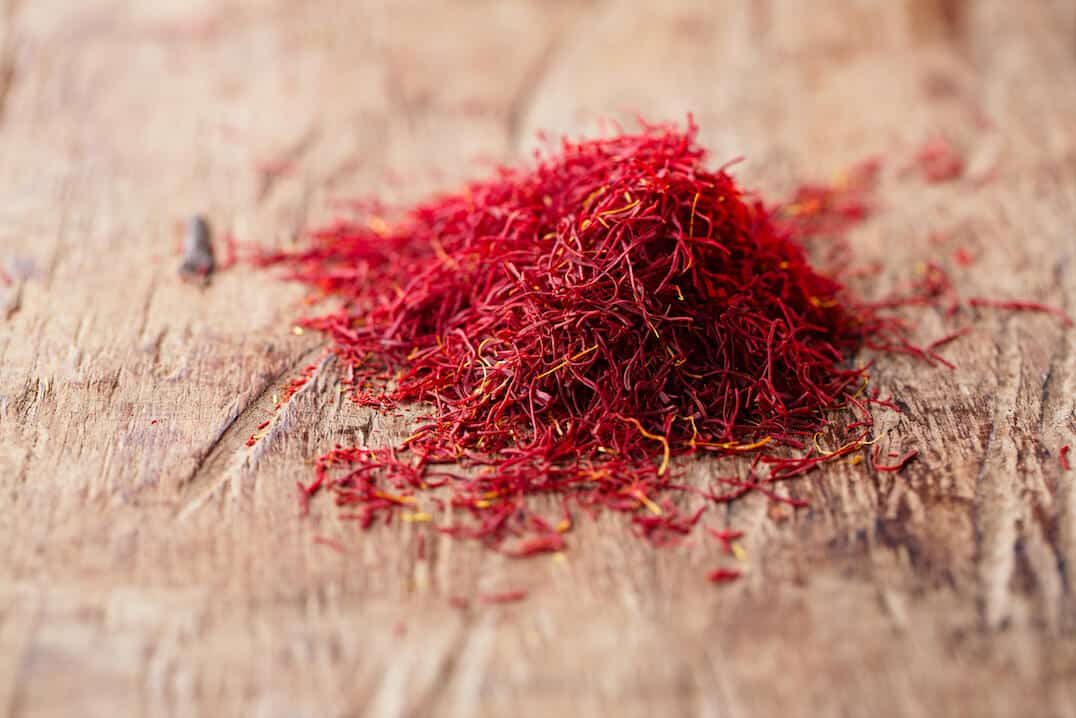
Saffron is the dried, golden stigmas of the saffron crocus, and Britannica still calls it the most expensive spice in the world.1 It does three things in a dish. Crocin gives the color, picrocrocin the bitterness, and safranal is one of the main molecules behind the aroma.12 Every substitute below copies the color, and none of them copies the aroma. Pick the substitute by which of those jobs matters in your recipe.
Quick answer
| What saffron is doing | Best substitute | Starting amount, per large pinch of saffron | Treatment |
|---|---|---|---|
| Golden color in rice (paella, pilaf, risotto) | Ground turmeric, alone or with sweet paprika | 1/4 to 1/2 teaspoon turmeric | Disputed |
| Color with as little added flavor as possible | Dried safflower petals | About 1 teaspoon, steeped | Method |
| Golden-orange color in a dish that starts with oil | Annatto, bloomed in the oil | Bloom the seeds in the oil until it looks right | Method |
| The aroma itself (saffron breads, bouillabaisse) | Nothing matches it; keep the color and leave out the aroma | n/a | Method |
“A large pinch” is how the sources below measure saffron. None of them define it by weight.
How the ratios on this page are labeled
- Computed: based on a measurable physical relationship, with the source named.
- Attributed: a named source publishes this ratio. We quote it as theirs.
- Disputed: named sources give different answers to the same swap. We show each one and do not average them.
- Method: we found no published ratio. We give a direction and a cautious starting point, and say so.
No published study measures how much of any substitute matches saffron’s color or flavor. The turmeric figures are a merchant’s and a food writer’s rules of thumb.
Why the substitutes only cover color
Each substitute gets its color from a different pigment, and none of the sources reviewed here report safranal or picrocrocin in any of them.
| Main coloring compound | Taste, per the sources | |
|---|---|---|
| Saffron | Crocin1 | Strong aroma, bitter taste1; picrocrocin is the bitter molecule2 |
| Turmeric | Curcumin3 | Bitter, slightly acrid, yet sweet4 |
| Safflower | Carthamidin (yellow, water-soluble) and carthamin5 | “Very weak, herbaceous”6 |
| Annatto | Bixin (oil-soluble) and norbixin (water-soluble)7 | Weak, perfumed odor that does not carry into food8 |
| Paprika | Capsanthin and capsorubin (red)9 | Mild, slightly sweet pepper note10 |
The overlap is real enough that most of these have been used to fake saffron. A 2022 industry adulterants bulletin, as reported by NutraIngredients, lists safflower and calendula flowers among saffron adulterants and describes powdered saffron mixed with ground turmeric or paprika.11
If saffron is coloring rice
Britannica defines paella as saffron-flavored rice cooked with meats, seafood and vegetables,12 and this is the job most cooks are trying to fill. Here the color matters most, and the aroma is the part you will miss.
1. Turmeric, with or without sweet paprika
Turmeric is a ginger-family plant, and curcumin gives the spice its yellow color.3 The Spice House says it will give paella its traditional yellow, but that turmeric is “more earthy and peppery” than saffron.10 A Couple Cooks makes the same point the other way, calling saffron’s taste more delicate and floral.13 Turmeric is bitter in its own right,4 so it is easy to overdo.
Sweet paprika adds a redder tone. The Spice House says it brings a mild, slightly sweet pepper note,10 and its red comes from capsanthin and capsorubin.9
Ratio (Disputed): Two sources give different turmeric amounts for the same job.
| Source | Per large pinch of saffron |
|---|---|
| The Spice House (merchant) | 1/4 teaspoon turmeric plus 1/2 teaspoon sweet paprika10 |
| A Couple Cooks (Sonja Overhiser) | 1/2 teaspoon turmeric, paprika optional and unmeasured13 |
Neither says how the figure was arrived at. Our starting point (Method): begin with 1/4 teaspoon of turmeric, add it to the cooking liquid, and look at the color before adding more. Adding more turmeric deepens the color and the bitterness together, so stop when the rice looks right.
2. Safflower
Safflower is a different plant altogether, Carthamus tinctorius, grown mainly for the oil pressed from its seed.14 Its flowers are what substitute for saffron. Katzer says they “sometimes serve as a substitute for saffron” because they give food a rather pale color.6 PROSEA describes safflower as a natural food colorant that is a substitute or adulterant for saffron.5 Katzer calls its flavor very weak and its value as a spice nearly nil,6 which is the point of using it: color with almost nothing else.
You may see it sold as “false saffron” or “bastard saffron.”6 Both names flag that it is not saffron.
Ratio (Method): None of the sources gives an amount. Its yellow pigment is water-soluble,5 so steep about 1 teaspoon of dried petals in some of the recipe’s warm liquid, then add the liquid and judge the color. Expect a paler result than saffron.6
If saffron is coloring a dish that starts with oil
Annatto
Annatto seeds come from Bixa orellana, and their color comes mostly from bixin, which is oil-soluble, along with the water-soluble norbixin.7 The Spice House sells annatto as a cheaper way to get saffron’s golden color and says it “does not replicate saffron’s distinct flavor.”15 Katzer notes that the seeds’ weak, perfumed smell does not carry into food.8
The Spice House’s method is to warm the seeds in oil and discard them once the oil turns bright yellow.15 Use that oil to start the dish.
Ratio (Method): We found no published ratio for annatto in place of saffron. Start with a small spoonful of seeds in a few tablespoons of oil, and stop when the oil reaches the shade you want.
If saffron’s aroma is the point
In saffron breads, which Britannica places in English, Scandinavian and Balkan baking, and in bouillabaisse, where it calls saffron an important ingredient,1 the aroma is what people taste. Safranal is one of the molecules responsible for it,2 and none of the substitutes on this page contains it in the sources reviewed.
Method: We found no substitute that any source claims reproduces saffron’s aroma. If you have no saffron, keep the color with one of the options above and accept a different-tasting dish, or choose a recipe built around another spice.
Marigold flowers
Katzer reports that Georgian cooking uses yellow marigold flowers (Tagetes erecta), often in the spice mix khmeli-suneli, with a mild, honey-like scent that disappears on cooking.6 That makes it another colorant, not an aroma substitute. We found no ratio for it. Use only petals sold as food.
What isn’t known
- No source defines “a large pinch” of saffron by weight, so every ratio above is approximate even on its own terms.
- No published measurement compares the coloring strength of turmeric, safflower or annatto with saffron.
- A claim that cardamom can stand in for saffron’s flavor circulates widely. No source reviewed here supports it.
- The only published ratio for safflower in place of saffron is Food Republic’s equal swap,16 which gives no basis for it; safflower brings color with very little of saffron’s flavor. No source gives a ratio for annatto in place of saffron.
Related
- Saffron, why saffron is so expensive, how to store saffron
- Saffron vs turmeric, safflower vs saffron
- Turmeric, safflower, annatto seeds, paprika
- Cooking with saffron, saffron uses, too much saffron? how to fix the dish
- Turmeric substitutes, annatto seed substitutes
Footnotes
-
Saffron, Encyclopaedia Britannica. britannica.com · Reference work ↩ ↩2 ↩3 ↩4 ↩5
-
Bergomi et al., Determination of Saffron Quality through a Multi-Analytical Approach, Foods, 2022. mdpi.com · Peer-reviewed ↩ ↩2 ↩3
-
Turmeric: Usefulness and Safety, NCCIH, 2025. nccih.nih.gov · Regulator ↩ ↩2
-
Prasad and Aggarwal, Turmeric, the Golden Spice, in Herbal Medicine, CRC Press. ncbi.nlm.nih.gov · Reference work ↩ ↩2
-
Oyen and Umali, Carthamus tinctorius, PROSEA. uses.plantnet-project.org · Reference work ↩ ↩2 ↩3
-
Safflower, Gernot Katzer’s Spice Pages. gernot-katzers-spice-pages.com · Reference work ↩ ↩2 ↩3 ↩4 ↩5 ↩6
-
Rivera-Madrid et al., Carotenoid Derivates in Achiote (Bixa orellana) Seeds, Frontiers in Plant Science, 2016. frontiersin.org · Peer-reviewed ↩ ↩2
-
Annatto, Gernot Katzer’s Spice Pages. gernot-katzers-spice-pages.com · Reference work ↩ ↩2
-
Paprika extract, Chemical and Technical Assessment, 77th JECFA. fao.org · Regulator ↩ ↩2
-
Saffron Substitute, The Spice House, 2018. thespicehouse.com · Merchant ↩ ↩2 ↩3 ↩4
-
Daniells, Adulterants Bulletin highlights multifaceted fraud associated with saffron, NutraIngredients, 2022. nutraingredients.com · Publication ↩
-
Paella, Encyclopaedia Britannica. britannica.com · Reference work ↩
-
Overhiser, Best Saffron Substitute, A Couple Cooks, 2026. acouplecooks.com · Publication ↩ ↩2
-
Safflower, Encyclopaedia Britannica. britannica.com · Reference work ↩
-
Annatto Seeds, The Spice House. thespicehouse.com · Merchant ↩ ↩2
-
Khyati Dand, “The Best Money-Saving Substitute For Saffron”, Food Republic, 2024. foodrepublic.com · Publication ↩