Cooking · Cooking with
Cooking With Lemongrass: Trimming, Bruising, Mincing and When to Take It Out
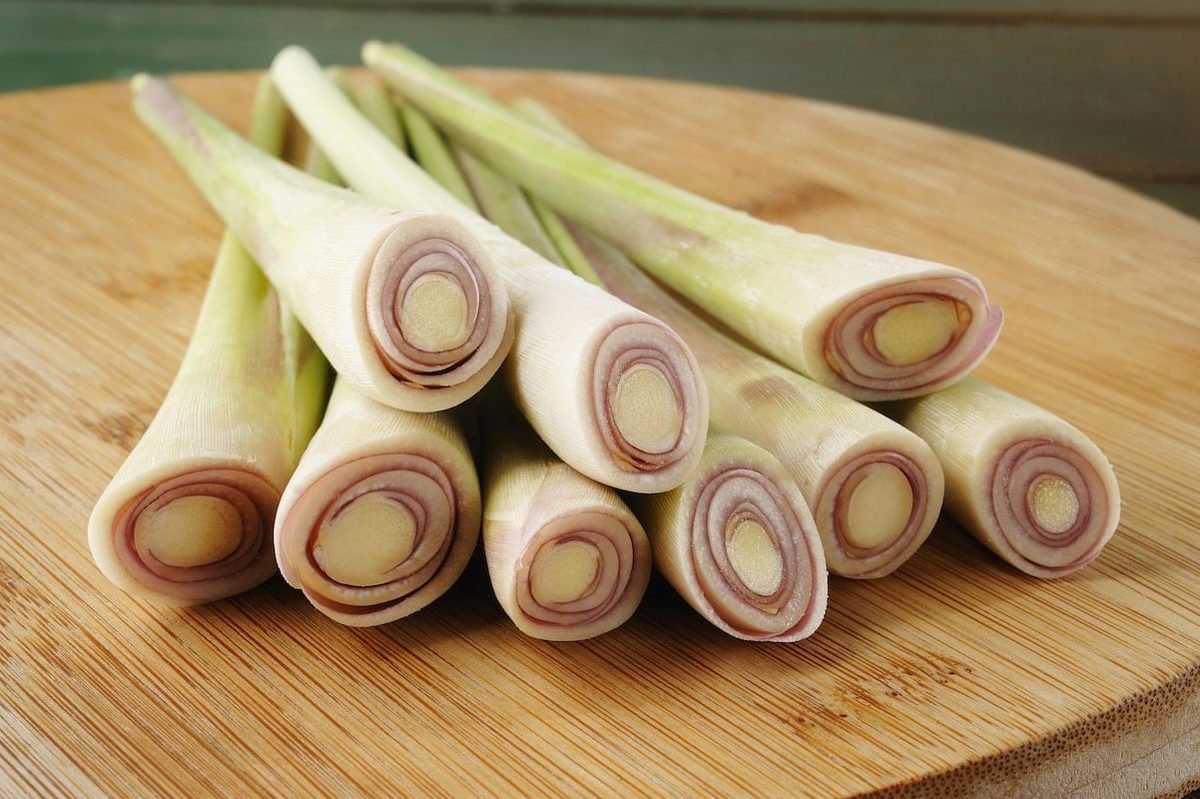
Lemongrass, Cymbopogon citratus, gives a dish lemon scent without sourness: Britannica calls its flavor a rich lemon without the acidity.1 Almost all of that flavor sits in the lower stalk and the slight bulb at its base, and the stalk is woody and tough.1 So cooking with lemongrass comes down to two moves. Either you bruise the stalk, let it infuse, and take it out, or you strip it to its tender core and mince it fine enough to eat.
At a glance
| Question | Short answer |
|---|---|
| Which part? | The lower stalk and the bulb at its base hold most of the flavor.1 |
| Trim | About an inch off the hard base, and enough of the green top to leave roughly 6 inches of stalk.2 |
| Peel | The tough outer layers, usually three or four.23 |
| Removed before serving (soups, broths) | Crush the stalk to release its oils, cut it into lengths, and fish it out at the end.2 |
| Eaten (pastes, marinades) | Mince the pale core or slice it thin.2 |
| Buying | Green, firm and fragrant; very dry outer leaves suggest long storage.2 |
| Fresh keeping | Wrapped, in the fridge, up to 2 weeks; frozen, up to 3 months.2 |
| Dried | Half as much dried as fresh, and only where there is liquid to soften it.4 |
Buying lemongrass
America’s Test Kitchen (ATK) advises choosing stalks that are green, firm and fragrant, and says outer leaves that are very dried out are a sign of long storage.2 A common rule says to pick heavy stalks over light ones; we found no source for weight as a test, though a firm stalk is the same idea.
Preparing the stalk
Every prep method we found starts the same way. ATK trims about an inch from the hard, woody base and cuts off enough of the green top to leave about 6 inches of stalk, then peels away the tough outer layers, usually three or four, to reach the pale core.2 delicious. magazine gives the same count, three or four layers depending on the thickness of the stalk.3
What happens next depends on whether anyone will eat the lemongrass.
If it comes out before serving: bruise it
For soups and broths, ATK crushes the prepped stalk with a meat mallet, the side of a knife or the bottom of a pan, then cuts it into lengths.2 delicious. magazine bashes the stalk along its length with the flat of a heavy knife and says this helps release the aromatic oils.3 Britannica describes the same principle in Southeast Asian kitchens: pounding lemongrass in a tall mortar releases its lemony flavor.1
The stalks are then infused and lifted out. Britannica notes that they are commonly steeped in oil with other spices and removed, and that a tied bundle can be simmered in stock in the same way.1 In Nancie McDermott’s tom yum goong for Saveur, the trimmed stalks are smashed flat, each tied into a knot, simmered in stock with makrut lime leaves until the broth is fragrant, about 5 minutes, and then discarded before the shrimp go in.5 Knotting a stalk keeps it in one piece, which makes it easy to find in the pot (kitchen practice).
If it stays in the dish: mince the core
For marinades and spice pastes, where the lemongrass is eaten, ATK minces the prepped stalk or slices it thin.2 Britannica describes cooks separating the outer layers of fresh stalks to reach the tender young shoots in the center, which can be chopped finely and added straight to a dish.1 delicious. magazine’s advice is to slice the soft middle as finely as you can.3
A widely repeated rule says you should never eat lemongrass uncooked. We found no source for it. The concern is texture: the outer stalk is woody and tough,1 which is why it is either removed or peeled back to the core. The core itself is eaten. In Java, according to PROSEA, the heart of young shoots is served as a side dish with rice.6
Another common instruction is to blanch lemongrass for a minute and shock it in ice water to remove bitterness. None of the prep methods we read includes that step,253 and we found no source saying lemongrass needs it.
How cooks use it, with named recipes
| Dish | How the lemongrass is used | Amount in the recipe |
|---|---|---|
| Tom yum goong, Thai hot and sour shrimp soup (Saveur, Nancie McDermott)5 | Trimmed, peeled, smashed, knotted, simmered about 5 minutes, removed | 3 large stalks to 4 cups chicken stock; serves 2 |
| Ga xao sa ot cay, Vietnamese caramelized chicken with lemongrass and chilies (Huong Thu Nguyen, in The Asian Grandmother’s Cookbook)7 | Trimmed, bruised and minced; part goes into the marinade, the rest is stir-fried with onion and garlic | 4 plump stalks, about 3/4 cup minced, to 1 pound chicken thighs |
| Khmer yellow kroeung, a Cambodian curry paste (Saveur)8 | Inner cores only, chopped and pounded with makrut lime leaves, garlic, shallots, galangal, turmeric and prahok | 6 stalks for about 1 1/4 cups of paste |
Those amounts are each recipe’s own. They are a fair guide to scale: the tom yum puts about three stalks into a two-person pot of soup, and the Vietnamese chicken works out to roughly 3 tablespoons of minced lemongrass per plump stalk.57
Other uses with a source behind them:
- Curry pastes. In Thailand, Laos and Vietnam, cooks pound lemongrass with garlic, makrut lime leaf and other herbs into thick curry pastes.1 PROSEA also calls it a popular constituent of many curries.6 See Thai spices and makrut lime leaves.
- Sauces and fish. In Java, leaf sheaths go into spicy sambals such as sambal goreng, and into cooked fish and fish sauces.6 Tom yum goong pairs it with shrimp.5 A common claim says lemongrass neutralizes fishy flavors the way citrus does; we found no source for that.
- Stir-fries and meats. Penn State Extension describes lemongrass as a key ingredient in Asian cooking, especially in stir-fries and meats.9
- Drinks and sweets. Kew notes that the stems are widely used in teas and other drinks,10 and in Java lemongrass flavors a popular sherbet.6
How long to cook it
Lemongrass is often said to keep releasing flavor the longer it cooks and to risk overpowering a braise. We found no measurement either way. What the recipes show is that a short infusion is enough in a broth: McDermott’s tom yum simmers the stalks about 5 minutes before removing them.5 For a longer braise, tasting as it cooks and removing the stalks once the broth is lemony enough is sensible kitchen judgment.
Dried, powdered and ready-made lemongrass
Outside Southeast Asia, Britannica notes, many cooks rely on lemongrass powder and dried stalks.1 ATK tested dried lemongrass in a curry paste, a Thai chicken soup and a stir-fry, using half as much dried as fresh. Dried was an acceptable substitute in the paste and the soup, tasted woodsier and less complex, and in the stir-fry it never softened and kept a hay-like texture.4 The practical rule from that test: use dried only where there is enough liquid for it to rehydrate.4
Ready-made lemongrass paste and frozen chopped lemongrass are sold in some stores. We found no published conversion for either, so check the label for added oil, salt or sugar and taste as you go. See lemongrass substitutes for other options.
Storing fresh lemongrass
ATK gives three methods:2
| Method | How | How long |
|---|---|---|
| Refrigerator | Untrimmed stalks, tightly wrapped | Up to 2 weeks |
| Freezer, whole | Green tops trimmed, wrapped in plastic, sealed in a zipper-lock bag; thaw briefly before use | Up to 3 months |
| Freezer, paste | Frozen in 1-tablespoon mounds on a plate, then bagged | No figure given; use from frozen |
A six-month freezer life also circulates. We found no source for it; ATK’s figure is 3 months.2 These are quality windows from a test kitchen, not food-safety limits. Lemongrass steeped in oil to keep is a different matter. Oregon State University Extension warns that herbs are low-acid foods that can carry Clostridium botulinum, and says homemade mixtures of fresh herbs in oil must be refrigerated and used within 4 days, or frozen.11 Its guidance covers herbs in general, not lemongrass by name.
Safety
Lemongrass in food is not a known hazard. Kew notes that lemongrass oil can cause contact dermatitis,10 which matters for the concentrated oil rather than for stalks in a pot. See the lemongrass profile for the health evidence.
Not yet measured
- How much flavor lemongrass gives up over time in a simmer, and whether long cooking makes it harsh.
- A standard size for “one stalk.” The recipes above say “large” or “plump” and do not give a weight.
- A conversion for tube paste or frozen chopped lemongrass.
- How long lemongrass paste keeps frozen.
Related
- Lemongrass and lemongrass uses
- Lemongrass substitutes
- Lemon verbena vs. lemongrass and lemon balm vs. lemongrass
- Thai spices, makrut lime leaves and galangal
Footnotes
-
Tony Hill, “Lemongrass”, Encyclopaedia Britannica. britannica.com · Reference work ↩ ↩2 ↩3 ↩4 ↩5 ↩6 ↩7 ↩8 ↩9
-
Steve Dunn, “How to Buy, Prep, and Store Lemongrass”, America’s Test Kitchen, 2020. americastestkitchen.com · Publication ↩ ↩2 ↩3 ↩4 ↩5 ↩6 ↩7 ↩8 ↩9 ↩10 ↩11 ↩12 ↩13
-
“How to prepare lemongrass stalks”, delicious. magazine. deliciousmagazine.co.uk · Publication ↩ ↩2 ↩3 ↩4 ↩5
-
“Dried vs. Fresh Lemongrass”, America’s Test Kitchen. americastestkitchen.com · Publication ↩ ↩2 ↩3
-
Nancie McDermott, “Tom Yum Goong (Thai Hot and Sour Shrimp Soup)”, Saveur. saveur.com · Publication ↩ ↩2 ↩3 ↩4 ↩5 ↩6
-
L.P.A. Oyen, Cymbopogon citratus, Plant Resources of South-East Asia (PROSEA). uses.plantnet-project.org · Reference work ↩ ↩2 ↩3 ↩4
-
Huong Thu Nguyen, “Caramelized Chicken with Lemongrass and Chilies”, from Patricia Tanumihardja, The Asian Grandmother’s Cookbook, via Asia Society. asiasociety.org · Publication ↩ ↩2
-
“Khmer Yellow Curry Paste (Kroeung)”, Saveur, 2015. saveur.com · Publication ↩
-
Smith and Marquesen, “Lemon-Scented Herbs in the Garden and the Kitchen”, Penn State Extension, 2025. extension.psu.edu · Reference work ↩
-
Cymbopogon citratus (DC.) Stapf, Plants of the World Online, Royal Botanic Gardens, Kew. powo.science.kew.org · Reference work ↩ ↩2
-
Raab and Woodburn, “Herbs and vegetables in oil” (SP 50-701), Oregon State University Extension Service, 2025. extension.oregonstate.edu · Reference work ↩