Spice Comparisons · Comparison
Lemon Balm vs. Lemongrass: A Tender Mint-Family Leaf and a Fibrous Tropical Grass
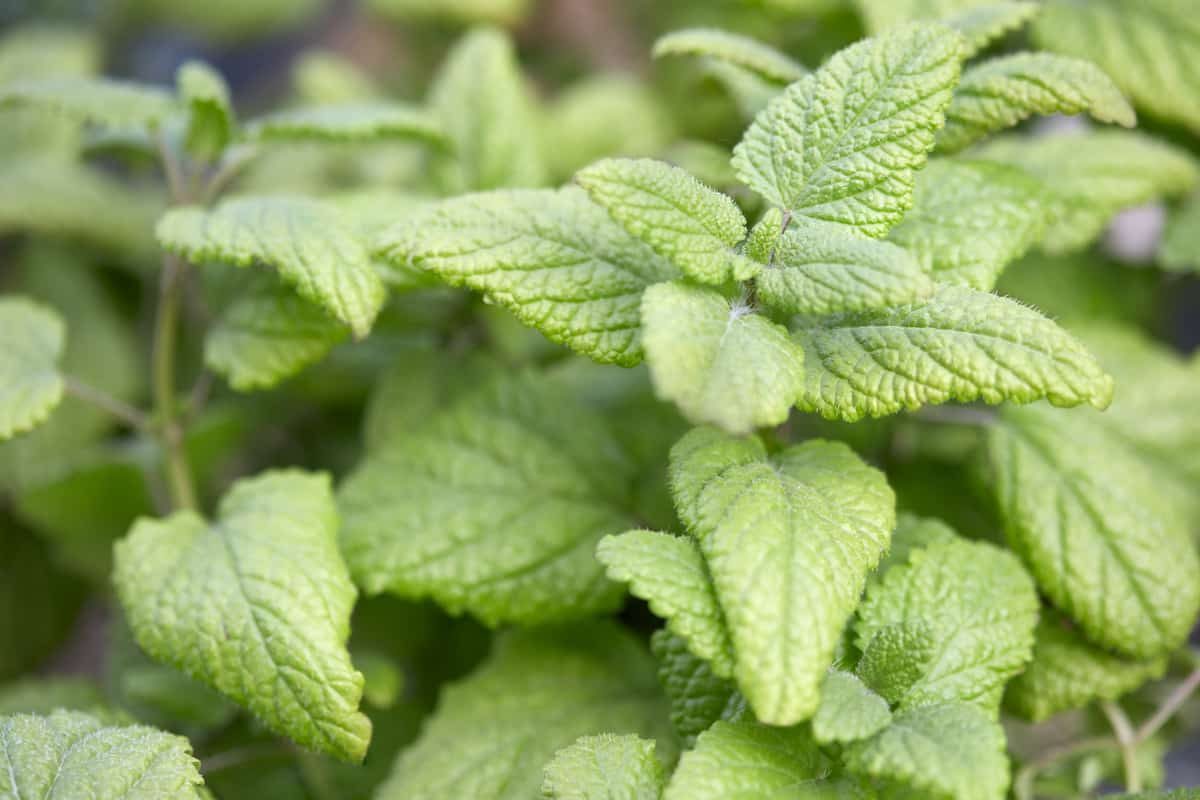
Lemon balm and lemongrass both taste of lemon without the sourness, and for the same chemical reason: the oil of each is led by citral, a pair of compounds called geranial and neral.12 Beyond that they have little in common. Lemon balm, Melissa officinalis, is a soft-leaved perennial herb of the mint family from the Mediterranean and Central Asia.34 Lemongrass, Cymbopogon citratus, is a tall tropical grass whose fibrous stalks are usually simmered and pulled out before serving.56 That difference in the plant decides how each one is cooked.
Side by side
| Lemon balm | Lemongrass | |
|---|---|---|
| Species | Melissa officinalis L.3 | Cymbopogon citratus (DC.) Stapf5 |
| Family | Lamiaceae, the mint family34 | Poaceae, the grass family, which also includes corn and bamboo578 |
| The plant | Perennial herb up to 3 feet, hardy to Zone 539 | Tufted perennial grass with stems up to 2 m (occasionally 3 m); hardy only to Zone 829 |
| Native range | Mediterranean to Central Asia3 | Disputed; known only from cultivation (see below)52 |
| Part used | Leaves, fresh or dried; essential oil41 | Lower stalk and bulb for flavor; leaves for tea; essential oil6 |
| Main aroma compounds | Citral (geranial and neral) and citronellal1 | Citral (geranial and neral); myrcene, limonene and geraniol among the others2 |
| Oil content | 0.06% to 0.8% of the leaf (EMA)1 | 0.25% to 0.50% of the harvested herbage (PROSEA)2 |
| Typical uses | Salads, soups, sauces, stuffings, liqueurs, wine, herbal teas, fruit drinks4 | Southeast Asian curry pastes, sauces and fish dishes, teas and other drinks625 |
| US food status | On FDA’s GRAS lists as a spice and as an essential oil1011 | Lemongrass oil on FDA’s GRAS list of essential oils11 |
| Flavor (editorial) | Soft lemon over a green, faintly minty background | Rich, grassy lemon, with a tea-like edge |
| Price | No dated, sourced comparison found | No dated, sourced comparison found |
The two oil figures are measured differently, one as a share of the leaf and one as a distillation yield from harvested herbage, so they don’t show which plant is richer in oil.
Two different plants
Lemon balm is a perennial of the temperate zone.3 Penn State Extension describes it as growing up to 3 feet, hardy to Zone 5, and spreading if left unattended.9 It is not a shrub.
Lemongrass is a perennial, tufted grass with many upright stems.2 Penn State calls it one of the few herbs in the grass family, Poaceae,9 the family that also includes corn and the bamboos.78 It is hardy only to Zone 8.9 Britannica places most of the flavor in the fibrous stalks and the slight bulb at the base.6
Where they come from. Kew gives lemon balm’s native range as the Mediterranean to Central Asia.3 Lemongrass’s origin is unresolved, and the sources disagree:
| Source | What it says about lemongrass |
|---|---|
| Kew, World Checklist native range | Southern India and Sri Lanka5 |
| Kew, species profile on the same page | Native to Indonesia, introduced and cultivated in most of the tropics5 |
| PROSEA | Known only from cultivation; exact origin unknown, Malesian origin most likely2 |
So “lemongrass comes from Southeast Asia” is one of several positions, not a settled fact.
Flavor and chemistry
Britannica describes lemongrass as tasting of rich lemon without the acidity,6 and PROSEA calls the oil’s smell very strong, fresh-grassy, lemon-like and herbaceous or tea-like.2 Lemon balm’s scent is softer, with a green, faintly minty background; that description is ours.
The chemistry behind both is citral. Figures vary by sample, so each belongs to its scope:
| Oil (scope) | Geranial | Neral | Source |
|---|---|---|---|
| Lemongrass, general range for C. citratus oil | 40–62% | 25–38% | PROSEA2 |
| Lemongrass, one analysis (Rajeswara et al. 1996, as tabulated by PROSEA) | 53.6% | 36.1% | PROSEA2 |
| Lemongrass, Ethiopian highlands | Total citral about 14% | PROSEA2 | |
| Lemon balm, one Algerian sample (Algiers, May 2018) | 45.06% | 31.72% | Abdellatif et al.12 |
The lemon balm figure is a single sample from a different study, so the table does not show that one oil carries more citral than the other. It shows that both are citral-led, and that some lemongrass oils are low in citral altogether. The Algerian lemon balm oil also held 6.42% citronellal,12 and the EMA puts β-caryophyllene and germacrene D at about 10% each of lemon balm oil.1
The differences that change a dish
Texture. This is the big one. Lemon balm’s leaves are tender and can be torn into salads.4 Lemongrass stalks are fibrous; Britannica says they are usually infused in oil or stock and removed, while the tender center of young shoots can be chopped finely and eaten.6
Heat. Lemongrass is built for simmering. It goes into Thai, Lao and Vietnamese curry pastes pounded with garlic and makrut lime leaf,6 and in Java its leaf sheaths go into spicy sauces and fish dishes.2 Lemon balm is usually added raw or late; long cooking leaves little of its scent, which is common kitchen experience rather than a measured finding.
Sweet uses. Both have them. Penn State’s lemon balm syrup, made by steeping six 4-inch sprigs in a boiling syrup of equal parts sugar and water for 30 minutes, goes into cocktails, seltzer, pound cake or fruit.9 Lemongrass is mostly savory, but not only: PROSEA notes it is used in Java to make a popular sherbet.2 So the idea that lemongrass is too astringent for sweet dishes is a matter of taste, not a rule.
Dried forms. Outside Southeast Asia many cooks rely on lemongrass powder and dried stalks.6 In America’s Test Kitchen’s tests, half as much dried lemongrass as fresh was the amount used in each recipe.13 No comparable test of dried lemon balm was found.
Can one stand in for the other?
Only partly. They share a lemon scent but not a texture or a job. Our lemon balm substitute and lemongrass substitute pages each give a starting point, from opposite directions:
| Swap | Starting amount | Treatment |
|---|---|---|
| Lemongrass in place of 1 tablespoon fresh lemon balm, in tea | A 2- to 3-inch piece of fresh stalk, sliced; steep and taste | Method |
| Lemongrass in place of 1 tablespoon fresh lemon balm, in a soup or sauce | A 2- to 3-inch piece, bruised; simmer, taste and remove | Method |
| Lemon balm in place of 1 stalk of lemongrass | About 2 tablespoons fresh leaves, added near the end | Method |
No published ratio exists for this pair, so all three are starting points. Lemon balm won’t stand in for lemongrass in a curry paste, where the stalk gives body as well as scent, and lemongrass won’t stand in for lemon balm torn raw into a salad; both are kitchen judgments.
Health and safety
The calming reputation. The EMA’s herbal committee accepts lemon balm leaf as a traditional herbal medicine for mild stress and to aid sleep, based on long-standing use, and says the evidence is insufficient to establish its efficacy.141 For lemongrass, Memorial Sloan Kettering reports that in clinical studies lemongrass tea did not lower anxiety or produce a calming effect, and that studies in humans are limited.15 So the common claim that lemon balm has anti-anxiety properties lemongrass lacks overstates the case for lemon balm: neither has been shown to treat anxiety.
Cautions. For lemon balm medicines, the EMA limits use to adults and children over 12, warns of possible drowsiness, and does not recommend use in pregnancy or breastfeeding.141 Memorial Sloan Kettering lists dizziness, drowsiness, dry mouth and increased urination as possible side effects of taking lemongrass by mouth.15 Kew notes that lemongrass oil can cause contact dermatitis.5 These cautions concern medicinal use and the oil, not ordinary cooking.
What isn’t known
- No study measures the two leaves’ citral content, or their lemon strength, side by side.
- No published substitution ratio exists for this pair.
- Lemongrass’s native range is disputed among the sources.
- No test of how lemon balm holds up to cooking or drying was found.
- No dated, sourced price comparison.
Related
- Lemon balm and lemongrass, the full profiles
- Lemon balm substitutes and lemongrass substitutes
- Lemon balm vs. lemon verbena, lemon verbena vs. lemongrass and lemon balm vs. mint
- Cooking with lemongrass and lemongrass uses
Footnotes
-
Assessment report on Melissa officinalis L., folium, European Medicines Agency. ema.europa.eu · Regulator ↩ ↩2 ↩3 ↩4 ↩5 ↩6 ↩7
-
L.P.A. Oyen, Cymbopogon citratus, Plant Resources of South-East Asia (PROSEA). uses.plantnet-project.org · Reference work ↩ ↩2 ↩3 ↩4 ↩5 ↩6 ↩7 ↩8 ↩9 ↩10 ↩11 ↩12 ↩13 ↩14
-
Melissa officinalis L., Plants of the World Online, Royal Botanic Gardens, Kew. powo.science.kew.org · Reference work ↩ ↩2 ↩3 ↩4 ↩5 ↩6 ↩7
-
Melissa Petruzzello, “Lemon balm”, Encyclopaedia Britannica. britannica.com · Reference work ↩ ↩2 ↩3 ↩4 ↩5
-
Cymbopogon citratus (DC.) Stapf, Plants of the World Online, Royal Botanic Gardens, Kew. powo.science.kew.org · Reference work ↩ ↩2 ↩3 ↩4 ↩5 ↩6 ↩7 ↩8
-
Tony Hill, “Lemongrass”, Encyclopaedia Britannica. britannica.com · Reference work ↩ ↩2 ↩3 ↩4 ↩5 ↩6 ↩7 ↩8
-
“Corn”, Encyclopaedia Britannica, 2026. britannica.com · Reference work ↩ ↩2
-
“Bamboo”, Encyclopaedia Britannica, 2026. britannica.com · Reference work ↩ ↩2
-
Mandy L. Smith and Susan Marquesen, “Lemon-Scented Herbs in the Garden and the Kitchen”, Penn State Extension, 2025. extension.psu.edu · Reference work ↩ ↩2 ↩3 ↩4 ↩5 ↩6
-
21 CFR 182.10, US Food and Drug Administration. ecfr.gov · Regulator ↩
-
21 CFR 182.20, US Food and Drug Administration. ecfr.gov · Regulator ↩ ↩2
-
Abdellatif et al., “Minerals, Essential Oils, and Biological Properties of Melissa officinalis L.”, Plants, 2021. pmc.ncbi.nlm.nih.gov · Peer-reviewed ↩ ↩2
-
“Dried vs. Fresh Lemongrass”, America’s Test Kitchen. americastestkitchen.com · Publication ↩
-
“Melissa leaf”, summary for the public, European Medicines Agency, 2014. ema.europa.eu · Regulator ↩ ↩2
-
“Lemongrass”, About Herbs, Memorial Sloan Kettering Cancer Center, 2022. mskcc.org · Reference work ↩ ↩2