Spice Comparisons · Comparison
Lemon Verbena vs. Lemongrass: A Shrub Leaf and a Grass Stalk, Both Built on Citral
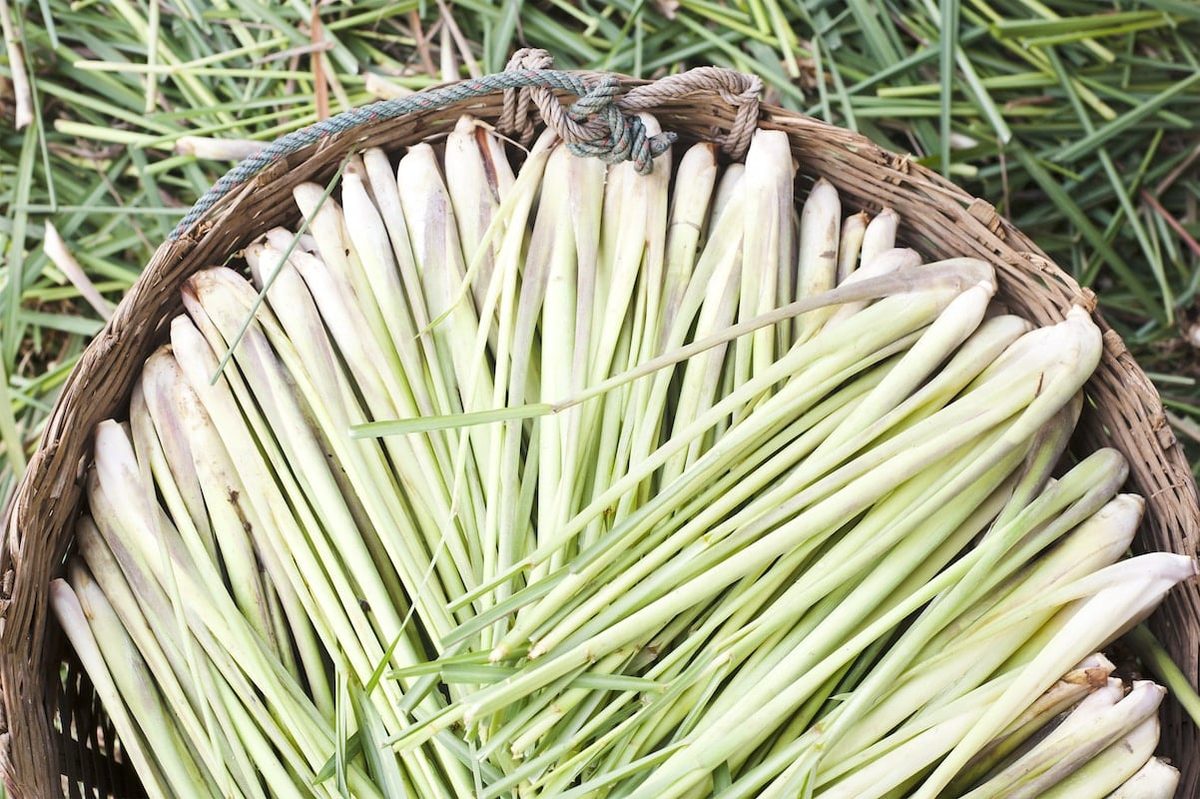
Lemon verbena and lemongrass smell alike for a chemical reason: the main compounds in both oils are geranial and neral, the two forms of citral.12 Botanically and in the kitchen they have little else in common. Lemon verbena is the leaf of a South American shrub in the verbena family, usually steeped and strained; lemongrass is a tropical grass whose fibrous stalks are pounded into pastes or simmered and removed.345 They can stand in for each other in teas and broths, much less well in a curry paste or a stir-fry.
Side by side
| Lemon verbena | Lemongrass | |
|---|---|---|
| Botanical name | Aloysia citrodora Paláu (syn. Lippia citrodora, Aloysia triphylla)3 | Cymbopogon citratus (DC.) Stapf4 |
| Family | Verbenaceae (verbena family)3 | Poaceae (grass family)46 |
| Native range | Southern Bolivia to northwestern Argentina (Kew)3 | Disputed: southern India and Sri Lanka, or Indonesia, both on Kew’s page; PROSEA says it is known only from cultivation42 |
| Plant | Shrub with rough, lance-shaped leaves in whorls of three36 | Tufted perennial grass with many upright stems2 |
| Part used | Leaves, fresh or dried1 | Fibrous stalks and the slight bulb at the base; leaves for tea54 |
| Main oil compounds | Geranial and neral (citral), often with limonene; varies widely by origin1 | Citral (geranial and neral), plus myrcene, limonene and geraniol2 |
| Flavor | The brightest and most intense lemon of the lemon herbs (Penn State)6 | A rich lemon without the acidity (Britannica)5 |
| Typical uses | Drinks and teas, liqueurs, puddings, jams, sorbet and ice cream16 | Southeast Asian curry pastes, stocks and soups, teas45 |
| Forms sold | Fresh sprigs, dried leaf and tea, essential oil | Fresh stalks, dried and powdered lemongrass, essential oil5 |
| US food status | Listed among natural flavoring substances, with a use limitation carried from an earlier entry (see Safety)7 | Lemongrass oil is GRAS8 |
| Price | No dated, sourced comparison found | No dated, sourced comparison found |
For each in depth, see lemon verbena and lemongrass.
How much citral? Not one number for either
Both oils are citral-led, but the figures come from different studies of different plants, and they vary a lot within each herb:
| Oil and scope | Geranial | Neral | Source |
|---|---|---|---|
| Lemon verbena, Sprea et al. 2023, their own samples | 18.7 to 21.1% | 15.3 to 16.2% | 1 |
| Lemon verbena, Portugal (as reviewed by Sprea et al.) | 26.8 to 38.3% | 20.8 to 29.6% | 1 |
| Lemongrass, PROSEA’s general range for C. citratus oil | 40 to 62% | 25 to 38% | 2 |
| Lemongrass oil from the Ethiopian highlands | total citral about 14% | 2 |
Some lemon verbena oils reviewed by Sprea and colleagues, from Morocco, had no geranial at all and were led by other compounds.1 So a higher citral range for lemongrass oil in one reference does not mean a stalk of lemongrass is “more lemony” than a sprig of lemon verbena. These are distilled oils, not the leaves and stalks a cook uses, and no study compares the two herbs directly.
Differences that change the dish
Leaf versus stalk. This is the big one. Lemongrass stalks are woody and tough, so Britannica says they are commonly macerated in oil and other spices and removed after infusion, or tied in a bundle and simmered in stock; more rarely, the outer layers are peeled back to reveal tender young shoots that can be chopped and added directly.5 Lemon verbena leaves are usually steeped in tea, cream or syrup and strained out. Penn State suggests grinding them fully with sugar because of their texture, and using that sugar in shortbread or pound cake.6
Perfume versus grass. Penn State ranks lemon verbena’s leaves as having the brightest and most intense lemon scent and flavor of the lemon herbs.6 PROSEA describes lemongrass oil as fresh-grassy, lemon-like and tea-like.2 In our judgment, lemon verbena tastes sweeter and more floral, lemongrass greener and more savory.
Where each belongs. Britannica calls lemongrass a staple of kitchens across Southeast Asia, where cooks pound it with garlic, makrut lime leaf and other herbs into thick curry pastes.5 Penn State notes the leaves are used in Asian stir-fries and meat dishes, and in teas.6 Lemon verbena’s sourced uses lean sweet and drinkable: refreshing drinks, liqueurs, puddings and jams, according to Sprea and colleagues,1 and teas, sorbet, ice cream and whipped cream, according to Penn State.6 Using either one outside its home ground is fine; using lemon verbena in a Thai curry paste is a different dish (editorial).
Drying. Penn State says lemon verbena leaves dry easily and keep their scent and flavor for two to three years; that figure is theirs.6 Dried lemongrass works only in dishes with liquid: in America’s Test Kitchen’s tests it was acceptable in a curry paste and a soup, but in a stir-fry it kept the texture of hay.9
How big is a lemon verbena plant?
Sources give different heights, and the difference reflects where the plant grows:
| Source | Height |
|---|---|
| EMA assessment report | 1 to 3 meters10 |
| Penn State Extension | Up to 15 feet in its native habitat; about 3 feet in Pennsylvania6 |
Safety and regulation
- Lemon verbena. The European Medicines Agency accepts the leaf as a traditional herbal medicine for mild stress, sleep and mild digestive complaints, based exclusively on long-standing use.11 Its monograph says use in children has not been established for lack of adequate data.11 In the US it does not appear on FDA’s GRAS lists for spices or essential oils; it is listed under 21 CFR 172.510 as “Lemon-verbena, Lippia citriodora”, with “Do.” (ditto) in the limitations column, meaning the same use limitation as an earlier entry in the table.7
- Lemongrass. FDA lists lemongrass oil among essential oils generally recognized as safe.8 Memorial Sloan Kettering says studies in humans are limited, and that in clinical studies lemongrass tea did not lower anxiety or have a calming effect.12 Kew notes that the oil can cause contact dermatitis.4
This page makes no claim that either herb treats or prevents any condition.
Can one stand in for the other?
In teas, syrups and broths, yes; in pastes, stir-fries and salads, only partly. The treatments below come from our lemon verbena substitutes and lemongrass substitutes pages. No published source gives a ratio for this swap in either direction.
| Swap | Starting amount | Treatment |
|---|---|---|
| Lemon verbena for lemongrass, in tea and drinks | About 1 tablespoon fresh leaves per stalk, steep and taste | Method |
| Lemongrass for lemon verbena, in infusions or savory dishes | About the same volume of thinly sliced fresh stalk as lemon verbena leaves, then taste; remove before serving | Method |
| Dried lemongrass for fresh | Half as much dried as fresh, in dishes with liquid only | Attributed: America’s Test Kitchen9 |
- Lemon verbena for lemongrass. Works where the herb is steeped: tea, a poaching liquid, a soup broth. It will taste sweeter and more perfumed (our judgment). In a pounded curry paste it can’t supply the stalk’s body, and in a raw salad its leaves are tough.
- Lemongrass for lemon verbena. Slice and bruise a fresh stalk for infusions. Expect a greener, grassier result. For a dessert where the leaves are eaten, such as lemon verbena sugar, lemon zest is the closer swap; see lemon verbena substitutes.
- A ratio that circulates says to use half as much lemon verbena as lemongrass, or twice as much lemongrass as lemon verbena. We found no source for it.
What isn’t known
- No sensory study compares the lemon strength of lemon verbena with lemongrass, and no published swap ratio exists in either direction.
- The citral figures above come from separate studies of oils from different places; no study analyzes both herbs side by side.12
- Lemongrass’s native range is unresolved, even within Kew’s own page.4
- No dated price comparison was found.
Related
- Lemon verbena and lemon verbena substitutes
- Lemongrass, lemongrass substitutes, lemongrass uses and cooking with lemongrass
- Lemon balm vs. lemon verbena and lemon balm vs. lemongrass
- Lemon balm, lemon myrtle, lemon thyme and kaffir lime leaves
Footnotes
-
Sprea et al., “Volatile Compounds and Biological Activity of the Essential Oil of Aloysia citrodora Paláu”, Molecules, 2023. mdpi.com · Peer-reviewed ↩ ↩2 ↩3 ↩4 ↩5 ↩6 ↩7 ↩8 ↩9
-
L.P.A. Oyen, Cymbopogon citratus, Plant Resources of South-East Asia (PROSEA), via Pl@ntUse. uses.plantnet-project.org · Reference work ↩ ↩2 ↩3 ↩4 ↩5 ↩6 ↩7 ↩8
-
Aloysia citrodora Paláu, Plants of the World Online, Royal Botanic Gardens, Kew. powo.science.kew.org · Reference work ↩ ↩2 ↩3 ↩4 ↩5
-
Cymbopogon citratus (DC.) Stapf, Plants of the World Online, Royal Botanic Gardens, Kew. powo.science.kew.org · Reference work ↩ ↩2 ↩3 ↩4 ↩5 ↩6 ↩7 ↩8
-
Tony Hill, “Lemongrass”, Encyclopaedia Britannica. britannica.com · Reference work ↩ ↩2 ↩3 ↩4 ↩5 ↩6 ↩7
-
Mandy L. Smith and Susan Marquesen, “Lemon-Scented Herbs in the Garden and the Kitchen”, Penn State Extension, 2025. extension.psu.edu · Reference work ↩ ↩2 ↩3 ↩4 ↩5 ↩6 ↩7 ↩8 ↩9 ↩10
-
21 CFR 172.510, Natural flavoring substances and natural substances used in conjunction with flavors. ecfr.gov · Regulator ↩ ↩2
-
21 CFR 182.20, Essential oils, oleoresins (solvent-free), and natural extractives. ecfr.gov · Regulator ↩ ↩2
-
“Dried vs. Fresh Lemongrass”, America’s Test Kitchen. americastestkitchen.com · Publication ↩ ↩2
-
Assessment report on Aloysia citrodora Paláu, folium, European Medicines Agency, 2019. ema.europa.eu · Regulator ↩
-
European Union herbal monograph on Aloysia citrodora Paláu, folium, European Medicines Agency, 2019. ema.europa.eu · Regulator ↩ ↩2
-
“Lemongrass”, About Herbs, Memorial Sloan Kettering Cancer Center, 2022. mskcc.org · Reference work ↩