Cooking · Cooking with
Cooking With Wasabi: Grating, Timing, Powder and Paste
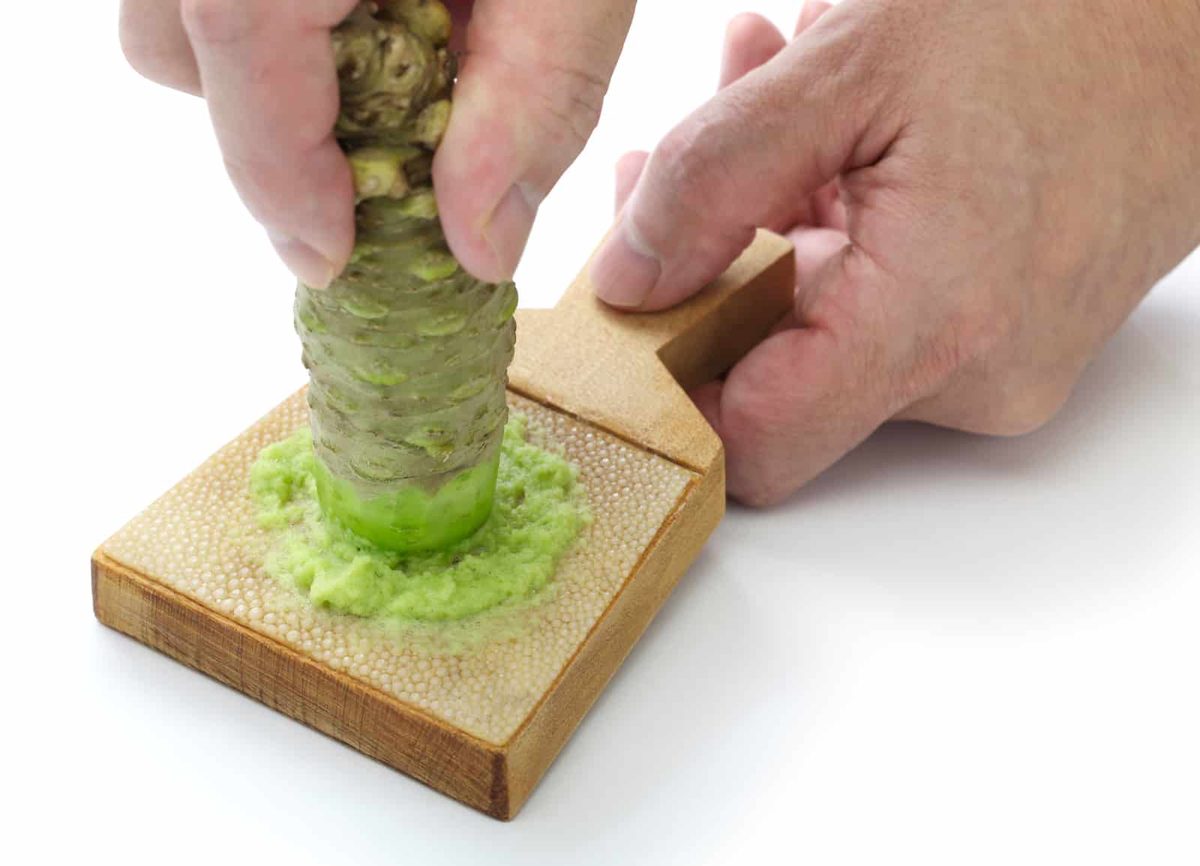
Wasabi is the grated rhizome of Eutrema japonicum (often still labeled Wasabia japonica), a plant of the mustard family.12 Most “wasabi” sold outside Japan is something else: Britannica notes that the paste in Western restaurants is commonly made from horseradish,2 and Chowhound reports that the vast majority of commercial wasabi is European horseradish colored green.3 Both get their heat from the same kind of compound, an isothiocyanate, so the cooking rules overlap. The big difference is timing.
Know which wasabi you have
| Form | What it usually is | How to use it |
|---|---|---|
| Fresh rhizome | Real wasabi | Grate just before serving |
| Tube paste | Mostly horseradish; one S&B tube lists 31% horseradish and 4.5% wasabi, plus sweetener, vinegar, salt and starches4 | Use straight from the tube |
| Powder | Often horseradish and mustard (S&B’s lists both, no wasabi);5 some brands sell 100% wasabi powder6 | Mix with cold water, then wait |
Read the label. Katzer says many, if not most, wasabi powders and pastes are imitations made from horseradish or mustard.7 Full comparisons: fresh wasabi vs. wasabi paste and wasabi powder vs. paste.
Fresh wasabi: grate it last
Wasabi’s heat is not sitting in the rhizome waiting. Britannica explains that isothiocyanates are released when the plant’s cells are ruptured by cutting or grating.8 In wasabi grown in New Zealand, allyl isothiocyanate made up 86 to 94 percent of the total.9 Once grated, fresh wasabi paste loses its pungency when exposed to air,8 which is why it is grated right before serving.
Preparing the rhizome. Marx Foods’ guide says to rinse it, trim the tip off one end, and strip away only as much peel as you plan to use.10
Grating. Use the finest grater you have. Britannica says wasabi is traditionally grated on a sharkskin or wooden grater,8 and Katzer says conservative cooks still use sharkskin.7 Marx Foods used a fine rasp (Microplane) in its guide but says a metal Japanese wasabi grater would be even better, with a traditional sharkskin grater the best option.10 Gather the paste into a small mound to cut its exposed surface.10
Timing. Sources agree the window is short but describe it differently:
| Source | What happens after grating |
|---|---|
| Marx Foods | Use within 5 to 10 minutes for the best flavor; after about 15 to 20 minutes it loses its nuance and becomes simply hot10 |
| Chowhound | The real thing loses its flavor after about 15 minutes3 |
A common claim that grated wasabi should rest about 10 minutes before serving has no source for fresh rhizome. The 10-minute wait applies to powder (below). Our suggestion: grate in small batches as you go, and grate a little more if the first batch has faded.
Storing the rhizome. Marx Foods says to refrigerate whole rhizomes wrapped in a damp, not wet, towel, re-dampening it as it dries, and says they can stay fresh for as long as three weeks if carefully stored.10 For grated wasabi, a New Zealand study found that storage at -10°C or colder for two months kept isothiocyanate levels steady.9
Powder: cold water, then wait
S&B’s directions call for 3/5 cup of cold water to 1 cup of powder,5 and Sushi Sonic’s 100% wasabi powder says to let the paste stand 10 minutes to reach full flavor.6 Mustard makes related compounds,8 and for homemade mustard Popular Science warns that water that is too hot deactivates the enzyme involved, myrosinase.11 No test for wasabi powder was found, but cool water is the safe choice. Katzer notes that dried wasabi needs a few minutes with water before its pungency shows.7
Tube paste
Tube paste needs no preparation. No published figure says how long an opened tube keeps its heat. America’s Test Kitchen found that grated horseradish grows milder with time and that vinegar slows the loss, so that homemade prepared horseradish holds its heat for up to two weeks;12 the S&B tube lists brewing vinegar.4 We found no source for the claim that tube paste keeps its punch far longer than fresh wasabi, though it is plausible given the vinegar. Store it as the label directs.
How it is used
Sushi and sashimi. The Embassy of Japan’s magazine says wasabi is paired mainly with sushi and sashimi and that it removes fishy smells and brings out the fresh flavor of the food.13 Katzer describes sashimi dipped in soy sauce and wasabi paste.7
Wasabi in soy sauce. A common claim says mixing wasabi into soy sauce is a breach of Japanese etiquette. We found no source for that. Katzer writes that wasabi paste is sometimes mixed with soy sauce, and that the mixture is a popular condiment with grilled steaks.7 Whether you mix is your choice.
Beyond Japanese food. Wasabi can stand in for horseradish in Western sauces. Tasting Table suggests 1/2 teaspoon of wasabi paste for each teaspoon of horseradish in cocktail sauce (Attributed).14 Stirring it into mayonnaise, sour cream, mashed potatoes or a vinaigrette is common practice. Our suggestion is to add it at the end and taste, since fresh wasabi loses pungency in open air.8 For a dish that came out too hot, see too much wasabi.
Related
- Wasabi
- Wasabi substitutes
- Wasabi vs. horseradish
- Fresh wasabi vs. wasabi paste
- Wasabi powder vs. paste
- Cooking with horseradish
Footnotes
-
Eutrema japonicum, Plants of the World Online, Royal Botanic Gardens, Kew. powo.science.kew.org · Reference work ↩
-
Melissa Petruzzello, “Wasabi”, Encyclopaedia Britannica. britannica.com · Reference work ↩ ↩2
-
Elias Nash, “Why Genuine Wasabi Is So Expensive In The US”, Chowhound, 2023. chowhound.com · Publication ↩ ↩2
-
S&B Wasabi Paste Tube, 43g, PS in foodservice product listing. psinfoodservice.com · Merchant ↩ ↩2
-
S&B Wasabi Powder, Gourmet Food World listing. gourmetfoodworld.com · Merchant ↩ ↩2
-
Sushi Sonic 100% Real Wasabi Powder, groceryeshop.us listing. groceryeshop.us · Merchant ↩ ↩2
-
Gernot Katzer, “Wasabi”, Gernot Katzer’s Spice Pages. gernot-katzers-spice-pages.com · Reference work ↩ ↩2 ↩3 ↩4 ↩5
-
“Isothiocyanate”, Encyclopaedia Britannica. britannica.com · Reference work ↩ ↩2 ↩3 ↩4 ↩5
-
Tamanna Sultana, “Factors affecting the yield of isothiocyanates, the flavour compounds, in wasabi”, PhD thesis, Lincoln University. researcharchive.lincoln.ac.nz · Peer-reviewed ↩ ↩2
-
Sarah Mickey, “How to Use Fresh Wasabi”, Marx Foods, 2011. marxfood.com · Publication ↩ ↩2 ↩3 ↩4 ↩5
-
Sandra Gutierrez G., “When the mustard shortage hits, make your own”, Popular Science, 2022. popsci.com · Publication ↩
-
“Keeping the Kick in Fresh Horseradish”, America’s Test Kitchen. americastestkitchen.com · Publication ↩
-
“Full of Zest: Shizuoka’s Wasabi Fields”, JCC E-Magazine, Embassy of Japan in Singapore, 2021. sg.emb-japan.go.jp · Regulator ↩
-
Deb Kavis, “5 Easy Substitutes For Horseradish In Cocktail Sauce”, Tasting Table, 2025. tastingtable.com · Publication ↩