Spice Comparisons · Comparison
Wasabi Powder vs. Paste: What’s in Each, and When to Use Which
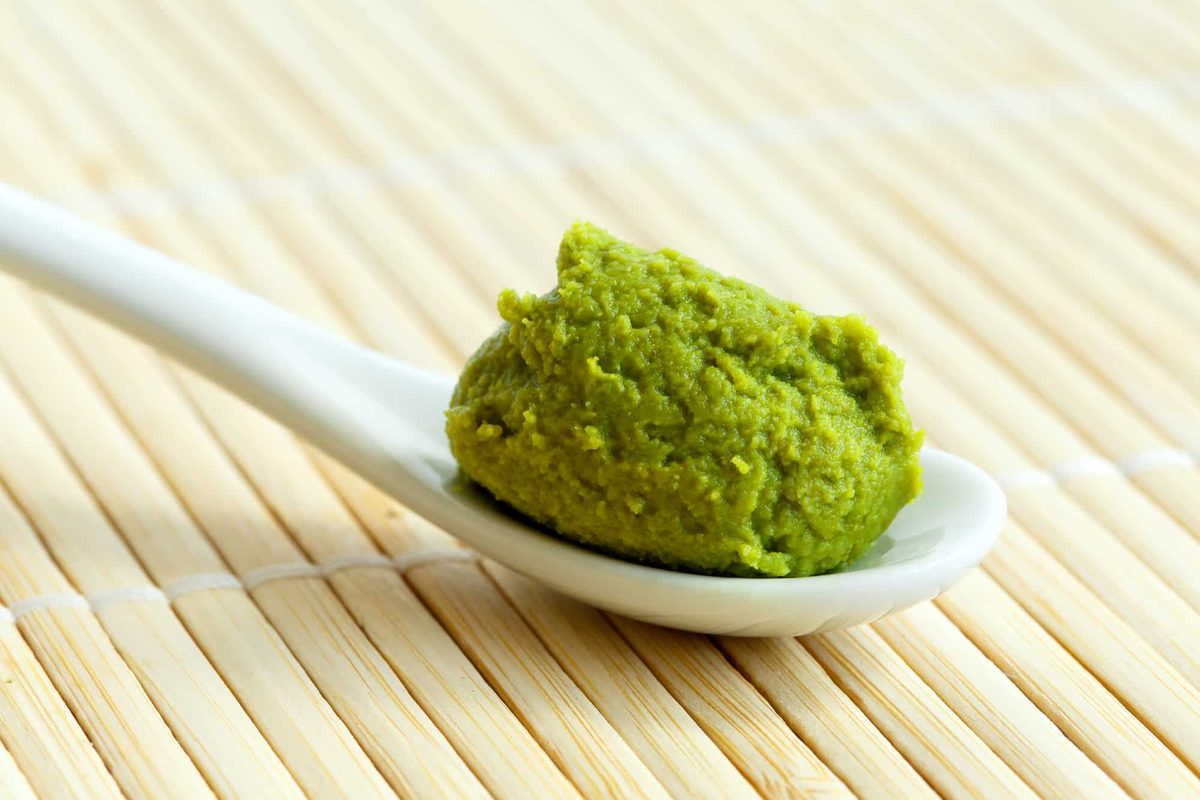
Real wasabi is the grated rhizome of Eutrema japonicum, a plant of the mustard family.12 Most wasabi powder and paste sold outside Japan contains little or none of it. Chowhound reports that the vast majority of commercial wasabi is European horseradish mixed with mustard and colored green, and cites an estimate that about 99% of the wasabi sold in North America is not real.3 Labels bear that out: one S&B powder lists horseradish and mustard but no wasabi, and one S&B tube lists 31% horseradish and 4.5% wasabi.45 So “powder vs. paste” is mostly a question of dry vs. ready-made, and of what each label actually lists. A small number of powders are pure wasabi.6
Side by side
| Wasabi powder (typical) | Wasabi paste in a tube (typical) | |
|---|---|---|
| Example label | S&B powder: horseradish, mustard, corn starch, ascorbic acid, artificial flavor, artificial color4 | S&B tube (43 g): 31% horseradish, sweetener (E420), brewing vinegar, salt, dextrin, 4.5% wasabi, potato starch, water, spices and herbs, turmeric, thickener (E415), acid (E330), color (E133)5 |
| Another example | Foodservice powder: horseradish, mustard flour, tapioca starch, ascorbic acid, colors E102 and E133; no wasabi7 | No second tube label checked |
| Real-wasabi version | Exists: Sushi Sonic lists “100% Real Wasabi (Wasabia japonica)”6 | Not checked for this page |
| Heat | None until mixed with water86 | Ready to use |
| Preparation | Mix with cool water and let stand (directions vary by brand, below) | None |
| What holds the heat | Nothing to hold until mixed | Contains vinegar and acid;5 vinegar slows the loss of heat in grated horseradish9 |
| Keeping | Ground spices generally about 1 year (ATK guideline)10 | No published figure for an opened tube found |
| Flavor (editorial) | Sharp and clean when freshly mixed | Rounder, slightly sweet and salty, from its sweetener and salt |
| Price | No dated, sourced comparison found | No dated, sourced comparison found |
All the brands named here appear only as examples of what labels say, not as quality ratings. For real wasabi against tube paste, see fresh wasabi vs. wasabi paste.
Where the heat comes from
Wasabi, horseradish and mustard all make their heat the same way: isothiocyanates are released when the plant’s cells are broken by cutting or grating.11 In a Lincoln University study of New Zealand-grown wasabi, allyl isothiocyanate made up 86% to 94% of the isothiocyanates measured.12 The same compound gives horseradish, another member of the mustard family,13 its distinctive flavor,11 and mustard makes it when its enzyme, myrosinase, acts on a compound in the crushed seed in the presence of water.14 That shared chemistry is why horseradish and mustard can imitate wasabi at all. The mix is not identical: the same study found 2-phenylethyl isothiocyanate only in European horseradish.12
Powder is inert until it gets wet. A German spice merchant describes ground horseradish as developing a pronounced pungency immediately in combination with water.8 For mustard, Popular Science reports that water that is too hot deactivates the enzyme, and that acid such as vinegar inhibits it completely.14 So mix wasabi powder with cool water, not hot, and add nothing acidic until it has developed. Sushi Sonic’s directions for its real-wasabi powder call for cool water and 10 minutes’ standing to reach full flavor.6
How long the heat lasts. A widely repeated figure says wasabi’s heat lasts about 15 minutes. That figure, from Chowhound, is for freshly grated real wasabi,3 and Britannica notes that fresh wasabi paste loses its pungency when exposed to air.11 We found no published figure for how long powder mixed with water stays hot. For horseradish, America’s Test Kitchen found that grated root grows milder with time, and that vinegar preserves its heat by slowing that process.9 The S&B tube lists brewing vinegar and an acid, E330,5 which fits a paste meant to sit on a shelf; we found no test of how long an opened tube keeps its heat.
How to mix powder into paste
Package directions differ, so follow your own:
| Product | Water | Powder | Source |
|---|---|---|---|
| S&B Wasabi Powder | 3/5 cup cold water | 1 cup | Label, as listed by a retailer4 |
| Foodservice wasabi powder | 200 ml | 100 g | Product listing7 |
| Sushi Sonic real-wasabi powder | Enough cool water for the consistency you want | 1 teaspoon | Label, as listed by a retailer; stand 10 minutes6 |
The first two are by volume and by weight, so they can’t be compared directly. For a small batch, the common practice is to stir a little cool water into a teaspoon or two of powder until it forms a stiff paste, cover it, and wait several minutes before serving.
Can one stand in for the other?
No source publishes a powder-to-paste ratio. These are starting points.
| Swap | Starting amount | Treatment |
|---|---|---|
| Powder made into paste, in place of tube paste | Mix to the same thickness and use the same amount, then taste | Method |
| Tube paste in place of dry powder, in wet dishes (dressings, sauces, mayonnaise) | About the amount of paste the powder would have made, then taste | Method |
| Tube paste in place of dry powder, in dry uses (coatings, seasoning blends) | Doesn’t work well: the paste adds moisture, sugar and salt5 | Method |
| Wasabi paste in place of horseradish, in cocktail sauce | 1/2 teaspoon wasabi paste per 1 teaspoon horseradish | Attributed to Tasting Table15 |
When to use which
These are kitchen judgments, apart from the cited points:
- Tube paste for convenience with sushi and sashimi, wasabi’s main pairing,16 and for stirring into dips, dressings and mayonnaise.
- Powder when you want to control the heat and mix it fresh, when you want wasabi flavor in a dry coating or seasoning, or when you use wasabi rarely: dry powder keeps better than an opened tube, in our judgment, though neither has a published shelf life.
- Real-wasabi powder if you want the actual plant without buying a fresh rhizome. Check that the ingredient list names wasabi (Wasabia japonica or Eutrema japonicum) and nothing else.61
What isn’t known
- No published figure for how long a powder-based paste or an opened tube keeps its heat.
- No measured comparison of heat between powders, tube pastes and fresh wasabi.
- How much real wasabi other brands’ powders and pastes contain was not surveyed; the labels here are examples.
- No published conversion between wasabi powder and tube paste.
Related
- Wasabi and horseradish
- Fresh wasabi vs. wasabi paste and wasabi vs. horseradish
- Wasabi substitutes and horseradish powder
- Too much wasabi? and cooking with wasabi
- Mustard powder and Japanese spices
Footnotes
-
Eutrema japonicum, Plants of the World Online, Royal Botanic Gardens, Kew. powo.science.kew.org · Reference work ↩ ↩2
-
Melissa Petruzzello, “Wasabi”, Encyclopaedia Britannica. britannica.com · Reference work ↩
-
Elias Nash, “Why Genuine Wasabi Is So Expensive In The US”, Chowhound, 2023. chowhound.com · Publication ↩ ↩2
-
S&B Wasabi Powder, label ingredients and directions as listed by Gourmet Food World. gourmetfoodworld.com · Merchant ↩ ↩2 ↩3
-
Wasabi Paste Tube, 43g, S&B, PS in foodservice product database. psinfoodservice.com · Merchant ↩ ↩2 ↩3 ↩4 ↩5
-
Sushi Sonic 100% Real Wasabi Powder, label ingredients and directions as listed by groceryeshop.us. groceryeshop.us · Merchant ↩ ↩2 ↩3 ↩4 ↩5 ↩6
-
Wasabipowder, PS in foodservice product database. psinfoodservice.com · Merchant ↩ ↩2
-
Horseradish ground, Gewürzshop Mayer. gewuerzshop-mayer.de · Merchant ↩ ↩2
-
“Keeping the Kick in Fresh Horseradish”, America’s Test Kitchen. americastestkitchen.com · Publication ↩ ↩2
-
Keeping Spices and Dried Herbs Fresher Longer, America’s Test Kitchen. americastestkitchen.com · Publication ↩
-
“Isothiocyanate”, Encyclopaedia Britannica. britannica.com · Reference work ↩ ↩2 ↩3
-
Tamanna Sultana, Factors affecting the yield of isothiocyanates in wasabi, PhD thesis, Lincoln University. researcharchive.lincoln.ac.nz · Peer-reviewed ↩ ↩2
-
Melissa Petruzzello, “Horseradish”, Encyclopaedia Britannica. britannica.com · Reference work ↩
-
Sandra Gutierrez G., “When the mustard shortage hits, make your own”, Popular Science, 2022. popsci.com · Publication ↩ ↩2
-
Deb Kavis, “5 Easy Substitutes For Horseradish In Cocktail Sauce”, Tasting Table, 2025. tastingtable.com · Publication ↩
-
“Full of Zest: Shizuoka’s Wasabi Fields”, JCC E-Magazine, Embassy of Japan in Singapore, 2021. sg.emb-japan.go.jp · Reference work ↩