Spice Substitutes · Substitutes
Wasabi Substitutes: Horseradish, Hot Mustard and a Homemade Paste
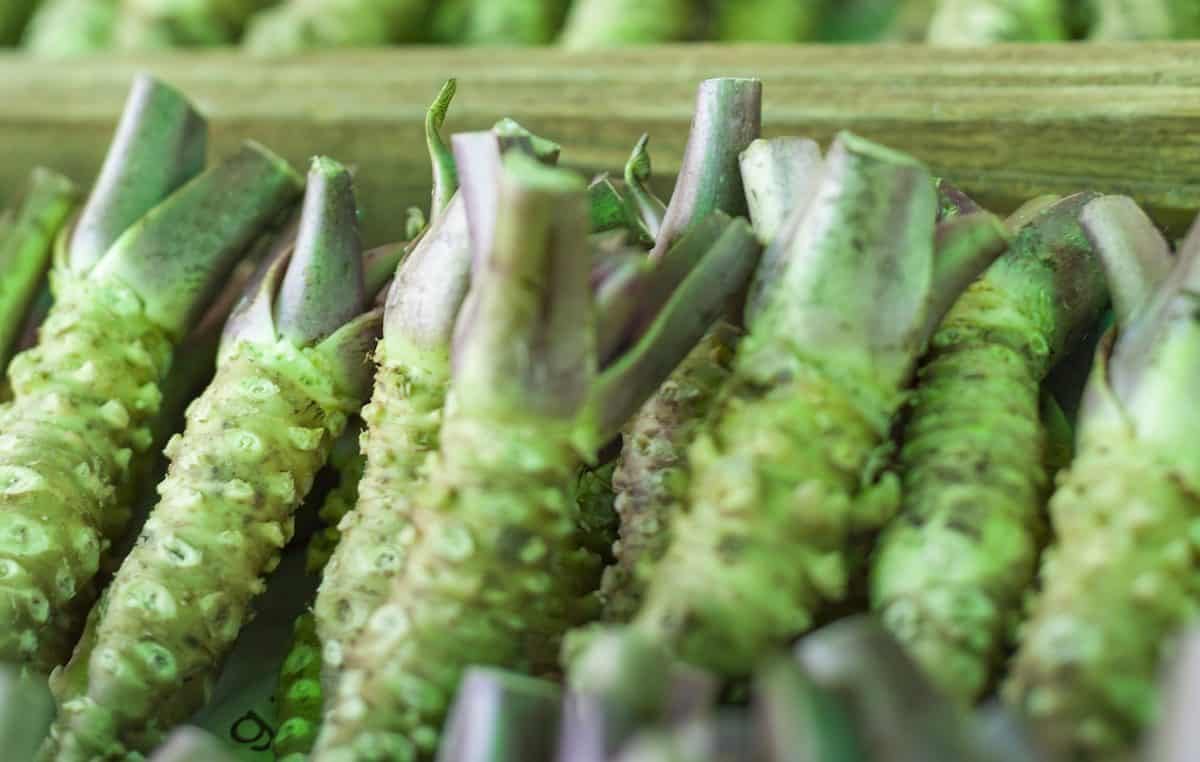
True wasabi is the grated rhizome of Eutrema japonicum, a plant of the mustard family (Brassicaceae).12 Its heat comes from isothiocyanates, mainly allyl isothiocyanate, which made up 86 to 94 percent of the isothiocyanates measured in wasabi in a New Zealand study.3 Horseradish and mustard make the same compound, which is why they are the substitutes. They are also what most “wasabi” is made of. Chowhound, citing the Washington Post, reports that about 99 percent of the wasabi sold in North America is not real wasabi.4 So the first question is which wasabi you are replacing.
Quick answer
| What you’re replacing | Best substitute | Starting amount, per 1 teaspoon wasabi | Treatment |
|---|---|---|---|
| Tube or restaurant-style paste, with sushi or sashimi | Prepared horseradish, drained | 1 teaspoon, more to taste | Method |
| Same, if you want the look | Homemade paste: horseradish, a little dry mustard, optional green coloring | 1 teaspoon | Method |
| Wasabi powder, mixed with water | Hot mustard powder, mixed with cold water | 1 teaspoon powder | Method |
| Wasabi stirred into a dressing, mayo or sauce | Prepared horseradish or hot mustard | 1 teaspoon, then taste | Method |
| Freshly grated wasabi rhizome | Freshly grated horseradish root | A little at a time | Method |
How the ratios on this page are labeled
- Computed: based on a measurable physical relationship, with the source named.
- Attributed: a named source publishes this ratio. We quote it as theirs.
- Disputed: named sources give different answers to the same swap. We show each one and do not average them.
- Method: we found no published ratio. We give a direction and a cautious starting point, and say so.
We found no credible source that publishes a ratio for replacing wasabi. The one related figure, from Tasting Table, goes the other way (wasabi in place of horseradish), and it is used below as a guide, not as a measured equivalence.
Why horseradish and mustard work
Isothiocyanates form when the plant’s cells are cut or grated.5 Britannica says allyl isothiocyanate gives horseradish its distinctive flavor, and that related compounds occur in mustard and radish.5 In mustard, an enzyme called myrosinase acts on a compound called sinigrin to produce allyl isothiocyanate once the seed is ground and mixed with water.6
The match is close but not exact. The same New Zealand study notes that 2-phenylethyl isothiocyanate is found only in European horseradish, not in wasabi.3 Tasting Table describes wasabi as similar to horseradish but more intense.7
All of these lose heat fast once prepared. Britannica says fresh wasabi paste loses its pungency when exposed to air,5 and Chowhound puts it at about 15 minutes after grating.4 America’s Test Kitchen says grated horseradish grows milder with time and that vinegar preserves its heat by slowing the reaction.8 Make any substitute just before serving.
If you are replacing tube or restaurant-style wasabi
This is the green paste served with sushi and sashimi. The Embassy of Japan in Singapore notes that some restaurants use a cheaper mixture of horseradish, mustard and food coloring.9 Britannica says the wasabi paste of Western restaurants is commonly made from horseradish.1 One foodservice wasabi powder in the PS in foodservice product database, for example, lists horseradish, mustard flour, tapioca starch, ascorbic acid and two synthetic colors (E102 and E133) as its ingredients, and no wasabi.10
1. Prepared horseradish
Britannica says horseradish is commonly used as a substitute for true wasabi.11 Prepared horseradish is grated root mixed with vinegar,11 so it is wetter and sharper than paste.
Ratio (Method): We found no published ratio. Going the other way, Tasting Table uses 1/2 teaspoon of wasabi paste in place of 1 teaspoon of horseradish in cocktail sauce.7 Read in reverse, that would mean up to 2 teaspoons of horseradish per teaspoon of wasabi paste. That is our arithmetic on one writer’s guidance, and since most wasabi paste is itself horseradish-based, start at 1 teaspoon per teaspoon, press out some of the vinegar, taste, and add more if needed.
2. A homemade imitation paste
Because commercial paste is usually horseradish, mustard and coloring,910 you can make the same thing.
Method: We found no published recipe from a source that meets our standard. As a starting point, mix about 1 teaspoon of drained prepared horseradish with a pinch of dry mustard and a drop of water, and add a little green food coloring if the color matters. Taste and adjust the mustard to set the heat.
If you are replacing wasabi powder
Wasabi powder is mixed with water to make a paste. The foodservice powder above calls for 200 ml of water per 100 g of powder.10 Chowhound says the vast majority of commercial wasabi is made from European horseradish,4 and the powder above is horseradish and mustard flour,10 so a hot mustard powder is a natural swap.
Tasting Table says the kick in Chinese hot mustard comes from brown mustard seeds crushed and mixed with water.7 Popular Science notes that it is hard to find any mustard powder other than yellow.6 Mix the powder with cold water: Popular Science says water that is too hot deactivates myrosinase completely.6
Ratio (Method): We found no published ratio. Use the same volume of hot mustard powder as wasabi powder, let the paste stand a few minutes, and taste before serving.
If wasabi is an ingredient in a sauce
For a wasabi mayonnaise, dressing or dip, the job is heat with a sinus-clearing edge rather than the green paste itself.
Ratio (Method): Use prepared horseradish or hot mustard, starting with the same amount as the wasabi called for. Tasting Table finds hot mustard thinner than prepared horseradish but with a similar punch,7 so it blends easily into a dressing. Prepared mustard brings its own acid and salt, so taste before adding more.
If you are replacing freshly grated wasabi
Fresh wasabi rhizome is grated just before it is served.5 Its specific growing requirements limit where it can be cultivated.1 The nearest home equivalent is fresh horseradish root, grated finely and used immediately.
Ratio (Method): We found no published ratio for fresh horseradish in place of fresh wasabi. Start with a small mound, about the size you would use of wasabi, and taste. If you are using bottled horseradish instead of fresh in a recipe, NDSU Extension gives 1 tablespoon of fresh horseradish as equal to 2 tablespoons of bottled.12
What isn’t known
- No credible source publishes a ratio for any wasabi substitute. Every amount on this page is a labeled starting point.
- No published study compares the pungency of real wasabi, commercial wasabi paste and prepared horseradish side by side.
- The claim that wasabi powders keep their heat longer than paste, but still fade over time, could not be traced to a measurement.
- Claims that spicy brown mustard uses less vinegar than yellow mustard, or that English mustard powder is milder than Chinese hot mustard powder, could not be traced.
Related
- Wasabi, fresh wasabi vs wasabi paste, wasabi powder vs paste, cooking with wasabi, too much wasabi
- Wasabi vs horseradish, horseradish, horseradish powder, cooking with horseradish
- Mustard powder, brown mustard seeds
- Horseradish substitutes, mustard powder substitutes
Footnotes
-
Petruzzello, Wasabi, Encyclopaedia Britannica. britannica.com · Reference work ↩ ↩2 ↩3
-
Eutrema japonicum, Plants of the World Online, Royal Botanic Gardens, Kew. powo.science.kew.org · Reference work ↩
-
Factors affecting the yield of isothiocyanates in wasabi, thesis, Lincoln University, New Zealand. researcharchive.lincoln.ac.nz · Reference work ↩ ↩2
-
Nash, Why Genuine Wasabi Is So Expensive In The US, Chowhound, 2023. chowhound.com · Publication ↩ ↩2 ↩3
-
Isothiocyanate, Encyclopaedia Britannica. britannica.com · Reference work ↩ ↩2 ↩3 ↩4
-
Gutierrez G., When the mustard shortage hits, make your own, Popular Science, 2022. popsci.com · Publication ↩ ↩2 ↩3
-
Kavis, 5 Easy Substitutes For Horseradish In Cocktail Sauce, Tasting Table, 2025. tastingtable.com · Publication ↩ ↩2 ↩3 ↩4
-
Keeping the Kick in Fresh Horseradish, America’s Test Kitchen. americastestkitchen.com · Publication ↩
-
Full of Zest: Shizuoka’s Wasabi Fields, Japan Creative Centre, Embassy of Japan in Singapore, 2021. sg.emb-japan.go.jp · Regulator ↩ ↩2
-
Wasabipowder, product specification, PS in foodservice. psinfoodservice.com · Merchant ↩ ↩2 ↩3 ↩4
-
Petruzzello, Horseradish, Encyclopaedia Britannica. britannica.com · Reference work ↩ ↩2
-
Garden-Robinson, Ingredient Substitutions (FN198), NDSU Extension, 2018. ksre.ksu.edu · Reference work ↩