Cooking · Cooking with
Cooking With Horseradish: Grating, Vinegar Timing, Heat and Storage
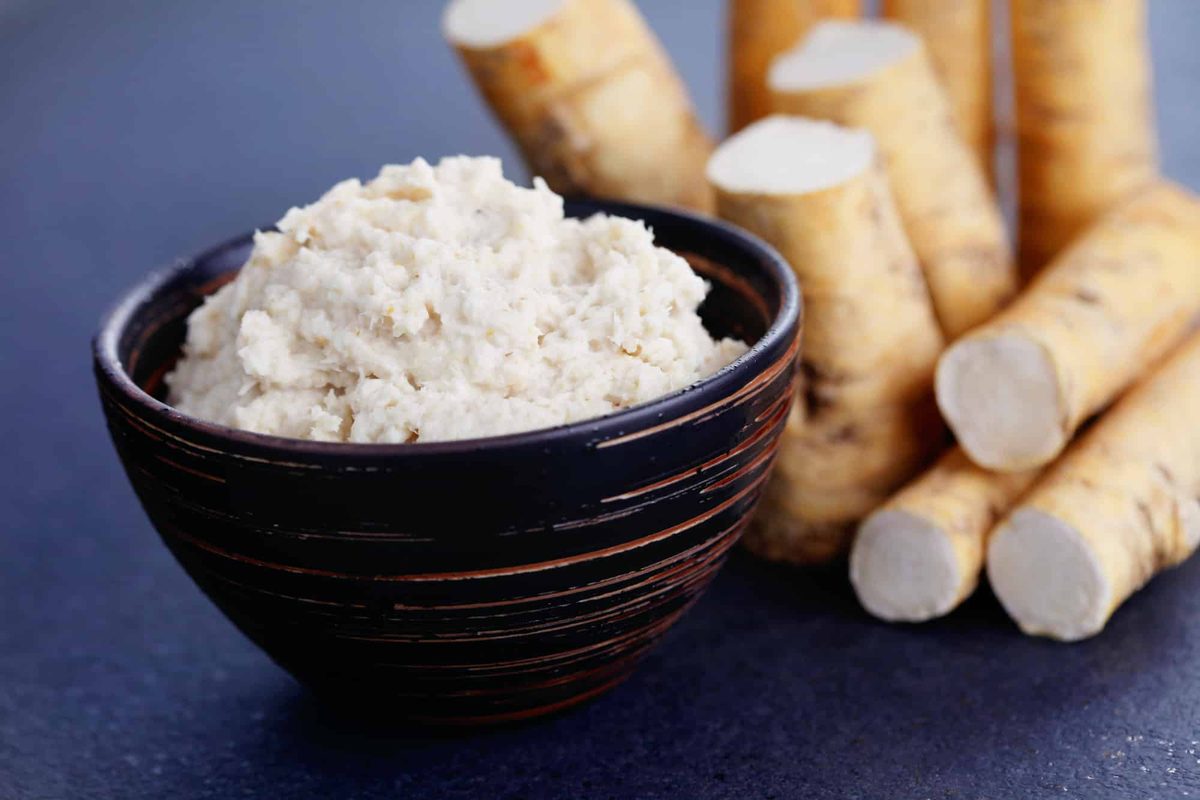
Horseradish has no heat until you cut it. Grating ruptures the root’s cells and releases allyl isothiocyanate, the volatile compound behind its bite,1 and from that moment the heat starts to escape into the air. Almost every rule for cooking with horseradish follows from that: grate it close to when you need it, use vinegar to hold the heat, and keep it away from the stove.
At a glance
| Question | Short answer |
|---|---|
| Where does the heat come from? | Allyl isothiocyanate, released when the cells are cut or grated1 |
| How fast does it fade? | Grated horseradish gets milder the longer it sits2 |
| What does vinegar do? | Slows the enzyme and preserves the heat;2 when you add it changes how hot the result is3 |
| Can you cook it? | Heat strips its pungency; add it at the end or serve it on the side4 |
| How long does homemade prepared horseradish keep its bite? | About two weeks (ATK, Tasting Table) to 1 to 2 months (Oregon State); see the table below |
| Fresh vs. bottled | NDSU treats 1 tablespoon fresh as equal to 2 tablespoons bottled5 |
Preparing the fresh root
Choose and clean it. Oregon State University Extension calls for fresh, firm, fully mature roots (in its drying instructions) and says to wash them well and peel off the brown outer skin.6 Tasting Table also trims any tough ends and the hard core at the center.7 A vegetable peeler or paring knife both work (kitchen judgment).
Grate it in a machine if you can. The fumes are the real hazard. Tasting Table’s Angeline Stratz advises preparing horseradish in a well-ventilated area, wearing gloves and goggles, and using a food processor, since a hand grater takes effort and leaves nothing between you and the fumes.7 Cut the peeled root into small pieces and pulse it, adding a bit of water if it needs help blending.7 Oregon State grates the peeled root in a food processor or puts small cubes through a food grinder, and can finish it in a blender with the vinegar.6 Open the processor lid away from your face (common practice).
Grate only what you need. Stratz suggests grating only as much as you can use within a few days, because fresh horseradish starts losing its flavor the moment it is cut.7 America’s Test Kitchen found the same: the longer grated horseradish sat, the milder it tasted.2
Vinegar: when you add it sets the heat
Vinegar is what turns grated root into prepared horseradish. ATK explains that it preserves the root’s heat by slowing down the enzyme that produces it.2 The timing changes the result. Tasting Table, citing Taste of Home, reports that adding vinegar immediately after grating lessens the burn, while waiting several minutes before adding it intensifies the heat.3
- For a hot condiment: grate, wait a few minutes, then stir in the vinegar.
- For a milder one: add the vinegar right away.
A widely repeated rule says to wait exactly three minutes. We found no source for a specific number of minutes; “several minutes” is as precise as the sources get.
A measured recipe. Oregon State’s refrigerator recipe uses 2 cups (3/4 pound) of freshly grated horseradish, 1 cup of 5% white vinegar, 1/2 teaspoon of canning salt and 1/4 teaspoon of powdered ascorbic acid, for about 2 half-pints, sealed and refrigerated.6 Tasting Table blends it with white vinegar, sugar and salt.7
Keep it off the heat
Horseradish’s pungency depends on an enzyme, myrosinase. In a 2024 study of commercial horseradish sauce, heat treatment inactivated the enzyme and caused what the authors called an undesired loss of pungency.4 In cooking terms:
- Stir horseradish into hot dishes at the very end, off the heat, or serve it on the side.
- Mashed potatoes, gravies and pan sauces get more flavor from horseradish folded in just before serving than from horseradish simmered in them (our judgment, consistent with the study above).
- Cold applications show it off best: cream sauces, cocktail sauce, dressings, deviled eggs and sandwiches (common practice).
What to make with it
Horseradish cream sauce. America’s Test Kitchen’s classic sauce for prime rib whips 1/2 cup of heavy cream until just thickened, folds in 1/2 cup of prepared horseradish, 1 teaspoon of salt and 1/8 teaspoon of pepper, and chills it at least 30 minutes; it makes about a cup.8 ATK says the one-to-one ratio of horseradish to cream is what gives the sauce its vibrant pungency.8 It is served with prime rib and other roasts.8
Plain prepared horseradish. Britannica notes that grated root is commonly mixed with vinegar to make horseradish sauce.9 Serve it with roast beef, sausages or smoked fish (common practice).
Cocktail sauce and Bloody Marys. Both take prepared horseradish for heat (common practice).
At the Passover seder. Horseradish is widely used as maror, the bitter herb, a custom that spread among Eastern European Jews because lettuce was hard to get before Passover.10 See the horseradish profile for more.
In place of wasabi. Britannica notes that horseradish is commonly used as a substitute for true wasabi.9 See wasabi vs. horseradish.
Fresh, bottled or powder?
NDSU Extension lists 1 tablespoon of fresh horseradish as equal to 2 tablespoons of bottled (Attributed).5 Bottled versions vary in how much vinegar, sugar or cream they contain; check the label (kitchen judgment). For the dried form, see horseradish powder.
How long the heat lasts
Sources disagree on how long homemade prepared horseradish, refrigerated, keeps its punch:
| Source | Product | Keeps its heat |
|---|---|---|
| America’s Test Kitchen2 | Grated root mixed with vinegar, airtight, refrigerated | Up to two weeks |
| Tasting Table (Stratz)7 | Prepared horseradish | Pungent for about two weeks; edible for one to three months |
| Oregon State University Extension6 | Refrigerator recipe above | Fades and loses pungency within 1 to 2 months |
None of these is a measured shelf-life study, and they are not averaged here. For the whole root, Oregon State says intact roots keep their flavor for up to 3 months stored in moist sand or sawdust in a dark root cellar.6
Freezing. A common tip says grated horseradish freezes well in ice cube trays with only a little loss of heat. We found no extension or test-kitchen source for it, so it remains untested here.
When the heat is too much
Horseradish burn fades fast. Tasting Table notes it subsides within minutes or even seconds.3 A common claim says water washes it away because allyl isothiocyanate is water-soluble; in fact PubChem lists it as only slightly soluble in water, about 2 grams per liter at 20°C.11 Tasting Table ties the short-lived burn to the evaporation of volatile compounds, not to anything water does.3 No source we found tested water as a remedy. For a dish that has too much, see too much wasabi, which covers horseradish-based wasabi too.
Not yet measured
- How many minutes of waiting before adding vinegar gives the most heat.
- How freezing affects grated horseradish.
- A refrigerated shelf life for opened commercial prepared horseradish.
Related
- Horseradish
- Horseradish powder
- Horseradish substitutes
- Wasabi vs. horseradish and cooking with wasabi
- Too much wasabi
- Mustard powder
Footnotes
-
Isothiocyanate, Encyclopaedia Britannica. britannica.com · Reference work ↩ ↩2
-
Keeping the Kick in Fresh Horseradish, America’s Test Kitchen. americastestkitchen.com · Publication ↩ ↩2 ↩3 ↩4 ↩5
-
Sylvia Tomczak, Why Horseradish Is So Potent For Such A Short Time, Tasting Table, 2022. tastingtable.com · Publication ↩ ↩2 ↩3 ↩4
-
Bianchi et al., Substitution of additives in horseradish sauce, Applied Food Research, 2024. doaj.org · Peer-reviewed ↩ ↩2
-
Julie Garden-Robinson, Ingredient Substitutions (FN198), NDSU Extension, 2018. ksre.ksu.edu · Reference work ↩ ↩2
-
Nellie Oehler, Preserving horseradish (SP 50-793), Oregon State University Extension Service, 2025. extension.oregonstate.edu · Reference work ↩ ↩2 ↩3 ↩4 ↩5
-
Angeline Stratz, How To Properly Prep Fresh Horseradish, Tasting Table, 2025. tastingtable.com · Publication ↩ ↩2 ↩3 ↩4 ↩5 ↩6
-
Classic Horseradish Cream Sauce, Cook’s Illustrated, America’s Test Kitchen, 2007. americastestkitchen.com · Publication ↩ ↩2 ↩3
-
Horseradish, Encyclopaedia Britannica. britannica.com · Reference work ↩ ↩2
-
Ari Z. Zivotofsky, What’s the Truth about Using Horseradish for Maror?, Jewish Action. jewishaction.com · Publication ↩
-
Allyl isothiocyanate (CID 5971), PubChem, National Library of Medicine. pubchem.ncbi.nlm.nih.gov · Reference work ↩