Spice Comparisons · Comparison
Fresh Wasabi vs. Wasabi Paste: The Grated Rhizome and the Horseradish Tube Compared
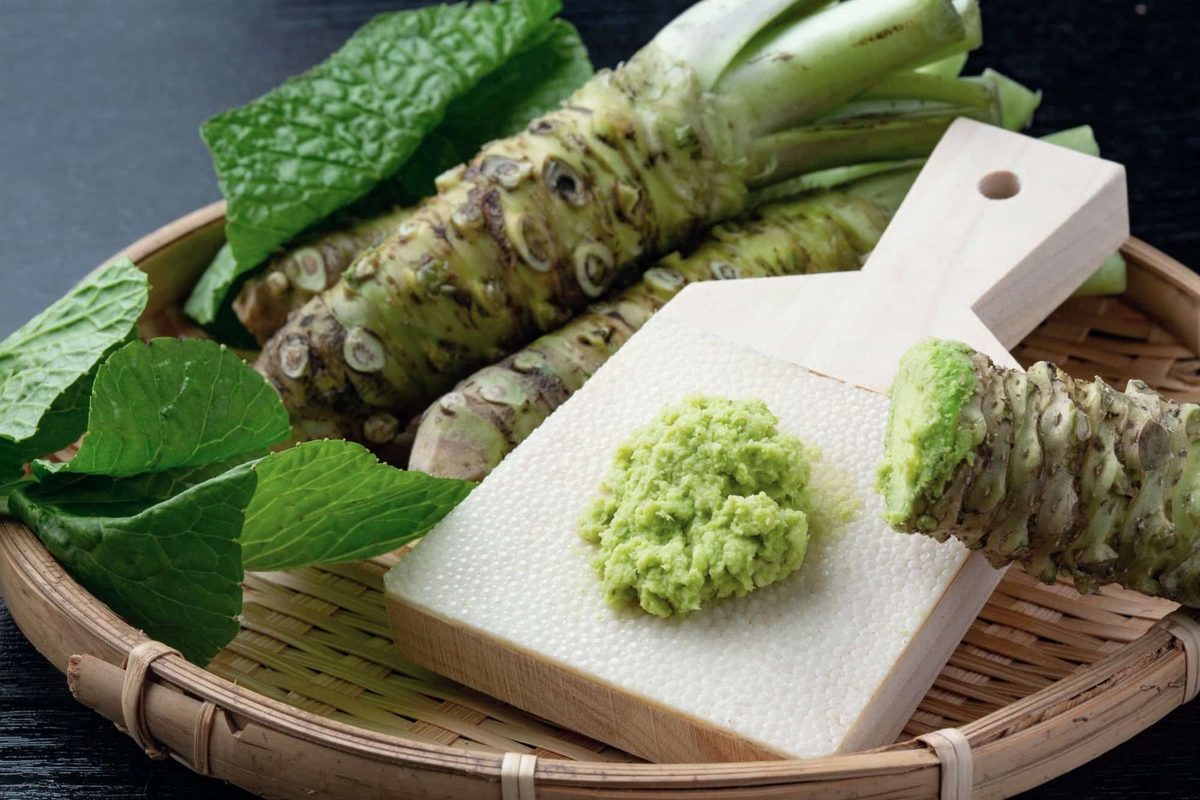
Fresh wasabi is the rhizome of Eutrema japonicum, a plant of the mustard family, grated just before it is eaten.123 Wasabi paste, whether from a tube or mixed from powder, is usually something else: European horseradish, mustard and green coloring.45 Some tubes contain a little real wasabi. One S&B tube lists 31% horseradish and 4.5% wasabi.6 Both get their heat from the same kind of compound, which is why the imitation works at all. The differences are in flavor balance, how fast the heat fades, texture and price.
Side by side
| Fresh wasabi | Wasabi paste (typical) | |
|---|---|---|
| What it is | Grated rhizome of Eutrema japonicum (syn. Wasabia japonica)12 | Usually European horseradish with mustard and green coloring;45 some tubes include a small share of wasabi6 |
| Plant family | Brassicaceae (mustard family)2 | Horseradish is also in the mustard family, Brassicaceae7 |
| Main heat compound | Allyl isothiocyanate: 86% to 94% of the isothiocyanates measured in New Zealand-grown wasabi8 | Allyl isothiocyanate gives horseradish its flavor;3 horseradish also carries 2-phenylethyl isothiocyanate, which wasabi lacks8 |
| Ingredients | The rhizome | Example tube (S&B, 43 g): 31% horseradish, sweetener (E420), brewing vinegar, salt, dextrin, 4.5% wasabi, potato starch, water, spices and herbs, turmeric, thickener (E415), acid (E330), color (E133)6 |
| How long the heat lasts | Loses its pungency once exposed to air;3 about 15 minutes after grating, according to Chowhound4 | No figure published for tube paste. Grated horseradish turns milder with time; vinegar helps it keep its heat9 |
| Price (US) | As much as $100 a pound (Chowhound, 2023)4 | Horseradish, the main ingredient: about $3 to $5 a pound (same source)4 |
| Where it’s grown | Japan, where Shizuoka Prefecture led water wasabi production in 2022;10 grown outside Japan mainly in China, Taiwan, Australia and New Zealand (Chowhound)4 | Horseradish roots are harvested after one growing season7 |
| Flavor (attributed) | “Delicate and slightly sweet,” with a faint heat that fades fast (Chowhound)4 | “Much harsher” (Chowhound);4 see the disagreement below |
What’s actually in the tube
Most of what is sold as wasabi outside Japan is horseradish. Britannica says the wasabi paste of Western restaurants is commonly made from horseradish.2 Chowhound reports that the vast majority of commercial wasabi is made from European horseradish, mixed with mustard and citric acid and colored green, and cites The Washington Post for an estimate that about 99% of the wasabi sold in North America is not real wasabi.4 The Embassy of Japan’s magazine says some restaurants in Japan also use a cheaper mixture of horseradish, mustard and food coloring.5
Labels show the range. The S&B tube above lists horseradish first and wasabi sixth, at 4.5%.6 A foodservice wasabi powder in the same product database lists horseradish, mustard flour, tapioca starch, ascorbic acid and two synthetic colors, E102 and E133, and no wasabi at all.11 The front of a tube says little; the ingredient list says what’s inside.
The paste is thicker and smoother than fresh-grated wasabi, and the S&B ingredient list shows why: potato starch, dextrin and a thickener (E415) alongside the horseradish.6 Freshly grated rhizome is moister and slightly coarse; that description is ours.
Same heat, different mix
Wasabi, horseradish and mustard make their heat the same way. Isothiocyanates are released when the plant’s cells are broken by cutting or grating.3 In a Lincoln University (New Zealand) doctoral study of seven isothiocyanates in New Zealand-grown wasabi, allyl isothiocyanate made up 86% to 94% of the total.8 Allyl isothiocyanate is also what gives horseradish its distinctive flavor, and related compounds occur in mustard.3 The same study found the overall mix differs: 2-phenylethyl isothiocyanate turned up only in European horseradish.8 That is a measured chemical difference. How it changes the taste has not been tested in any source we found.
Which one is hotter? The sources disagree
A common claim says fresh wasabi is milder than paste. The two sources we found that describe the difference point in opposite directions, and neither measured it.
| Source | What it says |
|---|---|
| Chowhound (Elias Nash, 2023) | Fresh wasabi paste is “delicate and slightly sweet, with a faint heat that dissipates quickly”; the fake wasabi most places serve is “much harsher in comparison”4 |
| Tasting Table (Deb Kavis, 2025) | Wasabi is similar to horseradish but “brings a greater intensity”; the article doesn’t say whether it means real wasabi or a commercial paste12 |
No measurement of pungency across fresh wasabi, tube paste and prepared horseradish was found. Heat in any of them also depends on how recently it was grated or mixed (see below), so a single answer may not exist.
Why fresh wasabi is grated at the last minute
Britannica notes that fresh wasabi paste loses its pungency when exposed to air, which is why the rhizome is grated just before serving, traditionally on a sharkskin or wooden grater.3 Chowhound puts the loss of flavor at about 15 minutes after grating.4 The heat doesn’t vanish the moment the wasabi is grated, but it fades fast.
Horseradish-based paste is not immune either. America’s Test Kitchen found that grated horseradish grows milder as time passes, and that vinegar preserves its heat by slowing the reaction;9 homemade prepared horseradish keeps its heat for up to two weeks in the refrigerator, by ATK’s account.9 The S&B tube lists brewing vinegar and an acid (E330).6 We found no published figure for how long an opened tube keeps its heat.
Storing the rhizome. The Lincoln University study found that keeping rhizomes frozen at −10°C or colder for two months preserved their original levels of heat compounds.8
Why fresh wasabi costs so much
Chowhound puts genuine wasabi at up to $100 a pound in the US, against $3 to $5 for horseradish, about one-twentieth the price.4 The reasons are in the growing. Britannica notes that wasabi’s specific growing requirements limit its cultivation.2 Chowhound says the plant needs a cool environment with its roots in clear running water and takes two years to harvest, against 140 to 160 days for horseradish.4 The Embassy of Japan’s magazine says a rhizome can take up to three years to reach harvest size.5 Those figures describe different growers and need not agree.
Wasabi is not confined to Nagano Prefecture, as is sometimes said. Shizuoka Prefecture says it had the highest production volume of water wasabi rhizomes in Japan in 2022.10 Outside Japan, Chowhound lists China, Taiwan, Australia and New Zealand as the main places it has been grown successfully.4
Can one stand in for the other?
Yes, and paste usually does. We found no published ratio for either direction (see wasabi substitutes), so these are starting points.
| Swap | Starting amount | Treatment |
|---|---|---|
| Tube paste in place of freshly grated wasabi, with sushi or sashimi | A smaller dab than you would use of fresh, then taste | Method |
| Freshly grated wasabi in place of tube paste | About the same size dab, grated just before serving, then taste | Method |
| Wasabi powder mixed into paste | Follow the package: the foodservice powder above calls for 200 ml of water per 100 g of powder | Attributed (to that product) |
| Fresh horseradish root in place of fresh wasabi | A little at a time, grated just before serving | Method |
How these were worked out. The “smaller dab” follows Chowhound’s description of commercial paste as much harsher than fresh;4 Tasting Table’s view that wasabi is more intense than horseradish points the other way,12 so taste before adding more. The powder instruction belongs to one product only.11
When to use which
The Embassy of Japan’s magazine describes wasabi as mainly paired with sushi and sashimi and says it removes fishy smells and brings out the fresh flavor of seafood.5 In our judgment, fresh wasabi is worth its price where its sweetness and short-lived heat can be noticed: good sashimi, nigiri and simple raw fish. Tube paste makes sense for everyday sushi, dressings, dips and anything where wasabi is one flavor among several. For cooking ideas, see cooking with wasabi.
What isn’t known
- No measured comparison of pungency between fresh wasabi and commercial paste was found.
- No published figure for how long an opened tube of paste keeps its heat.
- No source tested how 2-phenylethyl isothiocyanate changes the taste of horseradish-based paste.
- How much wasabi other brands’ pastes contain was not surveyed; the S&B tube is one example.
Related
- Wasabi and horseradish, the full profiles
- Wasabi substitutes and horseradish substitutes
- Wasabi powder vs. paste and wasabi vs. horseradish
- Too much wasabi? and cooking with wasabi
- Mustard powder and Japanese spices
Footnotes
-
Eutrema japonicum, Plants of the World Online, Royal Botanic Gardens, Kew. powo.science.kew.org · Reference work ↩ ↩2
-
Melissa Petruzzello, “Wasabi”, Encyclopaedia Britannica. britannica.com · Reference work ↩ ↩2 ↩3 ↩4 ↩5
-
“Isothiocyanate”, Encyclopaedia Britannica. britannica.com · Reference work ↩ ↩2 ↩3 ↩4 ↩5 ↩6
-
Elias Nash, “Why Genuine Wasabi Is So Expensive In The US”, Chowhound, 2023. chowhound.com · Publication ↩ ↩2 ↩3 ↩4 ↩5 ↩6 ↩7 ↩8 ↩9 ↩10 ↩11 ↩12 ↩13 ↩14 ↩15
-
“Full of Zest: Shizuoka’s Wasabi Fields”, JCC E-Magazine, Embassy of Japan in Singapore, 2021. sg.emb-japan.go.jp · Regulator ↩ ↩2 ↩3 ↩4 ↩5
-
Wasabi Paste Tube, 43g, S&B, PS in foodservice product database. psinfoodservice.com · Merchant ↩ ↩2 ↩3 ↩4 ↩5 ↩6
-
Melissa Petruzzello, “Horseradish”, Encyclopaedia Britannica. britannica.com · Reference work ↩ ↩2
-
Tamanna Sultana, Factors affecting the yield of isothiocyanates in wasabi, PhD thesis, Lincoln University. researcharchive.lincoln.ac.nz · Reference work ↩ ↩2 ↩3 ↩4 ↩5
-
“Keeping the Kick in Fresh Horseradish”, America’s Test Kitchen. americastestkitchen.com · Publication ↩ ↩2 ↩3
-
“Izu Wasabi”, Shizuoka Prefecture. fujinokuni.shokunomiyako-shizuoka.pref.shizuoka.jp · Regulator ↩ ↩2
-
Wasabipowder, PS in foodservice product database. psinfoodservice.com · Merchant ↩ ↩2
-
Deb Kavis, “5 Easy Substitutes For Horseradish In Cocktail Sauce”, Tasting Table, 2025. tastingtable.com · Publication ↩ ↩2