Spices · Fix
Too Much Wasabi? How to Cool It Down, Fastest Fix First
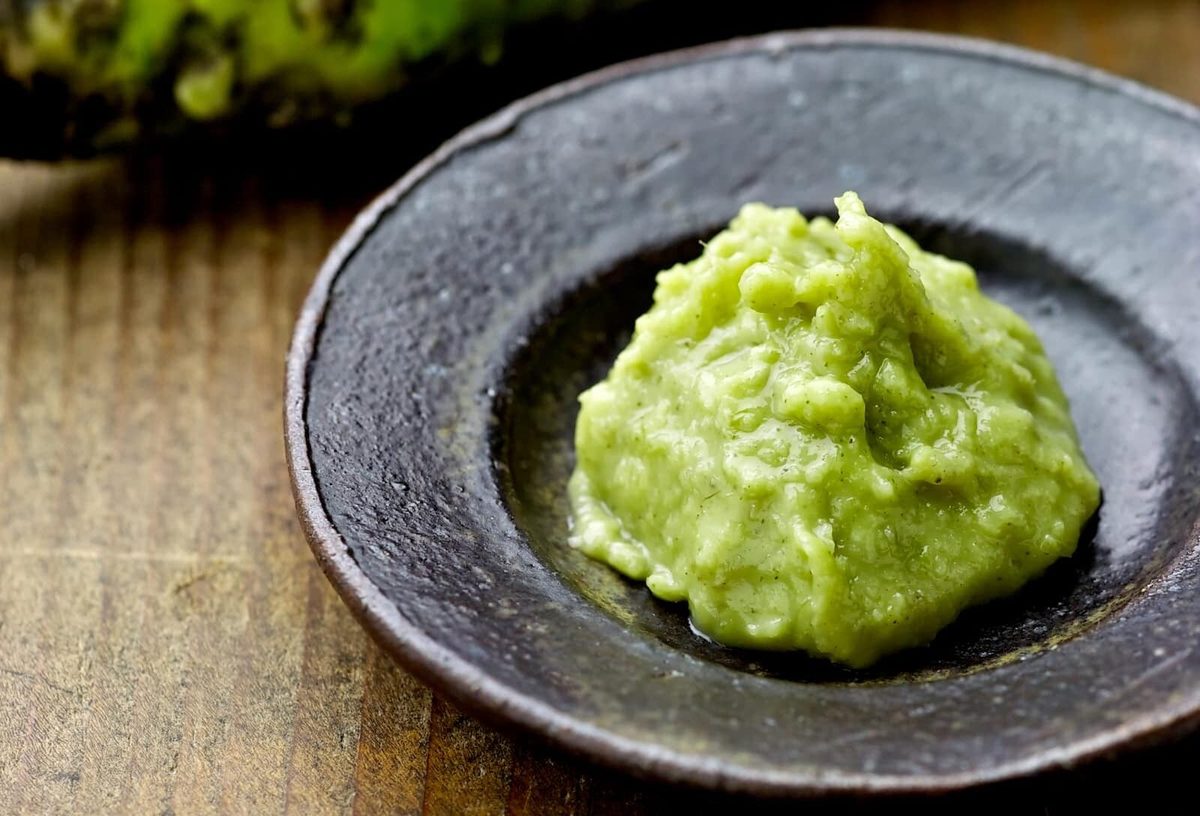
Too much wasabi is a heat problem, but not the same kind of heat as chili. Its burn comes from a compound that escapes into the air, which gives you one fix chili never offers: time. Within each section below, the fastest fix comes first.
Quick answer
| What’s wrong | Fastest fix | If that’s not enough |
|---|---|---|
| A dressing, dip or sauce is too hot | Add more of the base (mayonnaise, sour cream, soy sauce, dressing) | Leave it uncovered for a while, then taste again |
| A blob of paste on sushi or a plate | Scrape most of it off | Mix what’s left into more soy sauce |
| A cooked dish is too hot | Dilute with more of everything else | Simmer briefly before serving, then taste |
| Your mouth and nose are burning now | Wait: the burn passes quickly | Take a smaller bite next time |
What makes wasabi hot
The heat in both wasabi and horseradish comes from isothiocyanates, compounds released when the plant’s cells are broken by cutting or grating.1 In horseradish, allyl isothiocyanate is the one that gives the distinctive flavor.1 It dominates in wasabi too: in a New Zealand doctoral study of wasabi, allyl isothiocyanate made up 86 to 94 percent of the total isothiocyanates measured.2
Allyl isothiocyanate is volatile.3 That is why horseradish’s burn is intense but brief: Tasting Table notes it subsides within minutes or even seconds, and that long exposure to air lets the volatile compounds evaporate.3 Britannica notes the same of fresh wasabi paste: it loses its pungency when exposed to air.1
Is your “wasabi” actually wasabi? Probably not, if you bought it outside Japan. Chowhound reports that the vast majority of commercial wasabi is made from European horseradish, often with mustard and green coloring, and cites The Washington Post for an estimate that about 99 percent of the wasabi sold in North America is not real wasabi.4 Because both get their heat from the same kind of compound, the fixes below work on either. More on the differences in wasabi vs. horseradish and fresh wasabi vs. wasabi paste.
Too hot: sheer volume
Remove what you can. On sushi or a plate, scrape off as much paste as you can with a knife or chopstick.
Dilute. Add more of everything except wasabi. In a wasabi mayonnaise, dressing or dip, that means more of the base; in a dish, more of the main ingredients. Doubling the rest halves the concentration. This is the one fix that reliably lowers the heat in every bite.
Give it time, uncovered. Since the hot compound is volatile and fresh wasabi paste loses pungency in air,13 a sauce or dip that’s too hot may calm down if you leave it uncovered for a while before serving. America’s Test Kitchen found the same with freshly grated horseradish: the more time passed, the milder it tasted.5 No source gives a time for a finished sauce, so taste every 10 to 15 minutes. Keep perishable dips in the refrigerator while you wait.
Cook it, if the dish allows. In a 2024 study, heat-treating a horseradish sauce inactivated the enzyme that releases allyl isothiocyanate and caused what the authors called an undesired loss of pungency.6 That was a commercial sauce, not a home stir-fry, and we found no test of home cooking. Still, if the dish can simmer a little longer, it’s worth trying; taste as you go.
Something creamy. Sour cream, mayonnaise, cream cheese or butter turn a too-hot wasabi into a milder sauce, the same way horseradish is mixed into sour cream. Count this as dilution with a rich, mild base. A widely repeated claim says fat “neutralizes” wasabi; we found no source showing that, so we won’t claim it.
Fixes that don’t hold up
Vinegar to stop the heat. Vinegar does affect the reaction, but in the opposite direction from what most people hope. America’s Test Kitchen explains that the vinegar in prepared horseradish preserves its heat by slowing the enzyme down.5 Tasting Table, citing Taste of Home, says adding vinegar immediately after grating lessens the burn, while waiting several minutes first intensifies it.3 Either way, vinegar acts at the moment of grating; it can’t take back heat that has already formed, and it may help the paste hold its heat longer.
Rinsing your mouth with vinegar. We found no source supporting this.
Water “washes it away.” It’s often said that wasabi’s heat compounds dissolve in water, so water clears the burn in a way it can’t for chili. Allyl isothiocyanate is only slightly soluble in water: about 2 grams per liter at 20°C, per the U.S. Hazardous Substances Data Bank as compiled by PubChem.7 We found no test of water, soda or sparkling water against wasabi burn. Drinking something won’t hurt, but the burn fades on its own within minutes.3
Breathing through your nose. Some guides say this clears wasabi vapor. We found no source that tested it.
Preventing it next time
Start with less than you think. No source gives a measured serving amount. Our suggestion: start with a small dab, mix it into soy sauce or the sauce base, taste, then add more.
Add wasabi late. Heat treatment stripped pungency from horseradish sauce in the study above,6 so if you want wasabi’s heat in a cooked dish, our suggestion is to stir it in at the end and taste before adding more.
Grate fresh wasabi just before serving. It loses pungency in air;1 Chowhound puts its flavor loss at about 15 minutes after grating.4 Grating ahead gives a milder result. For prepared horseradish, ATK says a mixture stored airtight in the refrigerator keeps its heat for up to two weeks.5
Related
- Cooking with wasabi
- Wasabi powder vs. paste
- Wasabi substitutes
- Cooking with horseradish
- Too much pepper
Footnotes
-
Isothiocyanate, Encyclopaedia Britannica. britannica.com · Reference work ↩ ↩2 ↩3 ↩4 ↩5
-
Tamanna Sultana, Factors affecting the yield of isothiocyanates, the flavour compounds, in wasabi, PhD thesis, Lincoln University. researcharchive.lincoln.ac.nz · Reference work ↩
-
Why Horseradish Is So Potent For Such A Short Time, Sylvia Tomczak, Tasting Table, 2022. tastingtable.com · Publication ↩ ↩2 ↩3 ↩4 ↩5
-
Why Genuine Wasabi Is So Expensive In The US, Elias Nash, Chowhound, 2023. chowhound.com · Publication ↩ ↩2
-
Keeping the Kick in Fresh Horseradish, America’s Test Kitchen. americastestkitchen.com · Publication ↩ ↩2 ↩3
-
Bianchi F et al., Substitution of additives in horseradish sauce: technological strategies and efficacy, Applied Food Research, 2024. doaj.org · Peer-reviewed ↩ ↩2
-
Allyl isothiocyanate (CID 5971), PubChem, National Library of Medicine. pubchem.ncbi.nlm.nih.gov · Reference work ↩