Spice Substitutes · Substitutes
Epazote Substitutes for Beans and Mexican Cooking
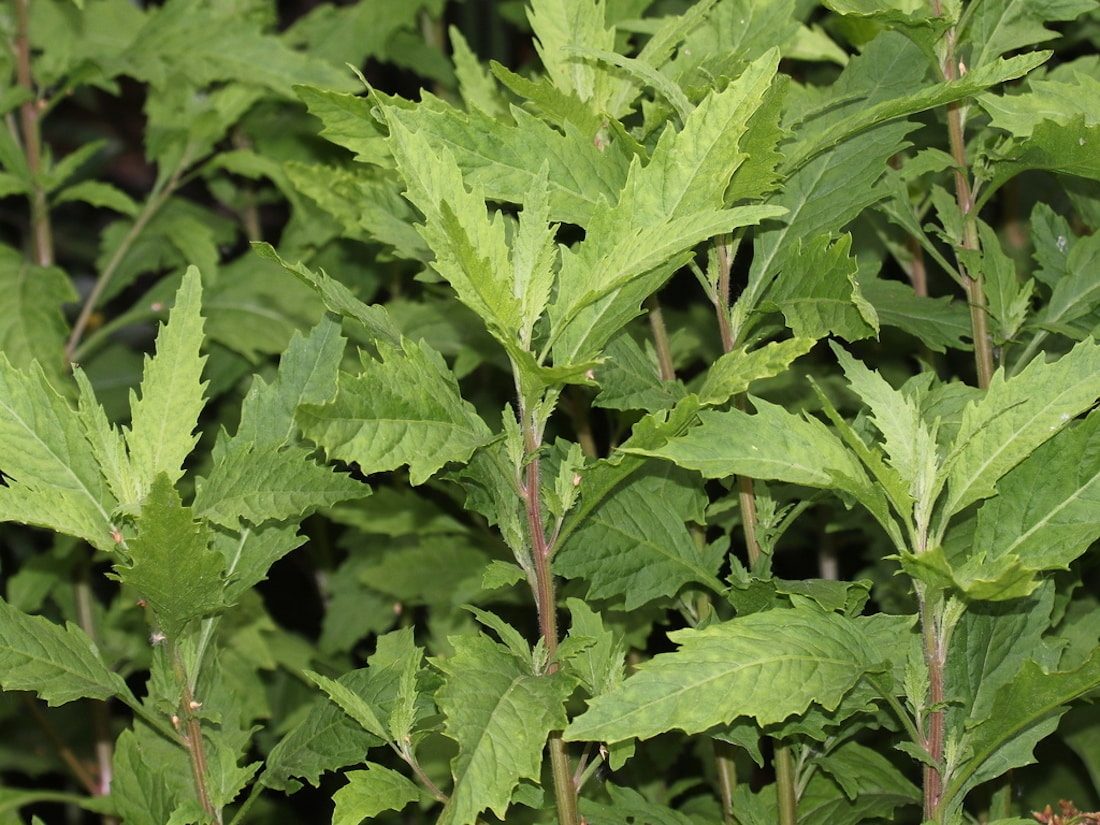
Epazote is the leaf of Dysphania ambrosioides, a strong-smelling plant of the Amaranthaceae native to the Americas.1 Gernot Katzer calls its fragrance strong but difficult to describe,2 and Tasting Table compares the flavor to anise or licorice.3 Its essential oil is rich in ascaridole, with p-cymene and α-terpinene as the other key compounds.4 Katzer notes that ascaridole is only rarely found in plants used as spices,5 which helps explain why epazote is so hard to imitate. Pati Jinich writes that it has no substitute that she knows of.6
What you can do is keep the dish working. Here is how, ranked by what the epazote was there to do.
Quick answer
| What epazote is doing | Best substitute | Starting amount, per 1 part fresh epazote | Treatment |
|---|---|---|---|
| Simmered in a pot of beans | Dried epazote | 1/3 to 2/3 part | Disputed |
| Same, with no epazote at all | Summer savory | 1/2 part, then taste | Method |
| Fresh in quesadillas, soups or sauces | Mexican oregano | 1/2 part, then taste | Method |
| Same, where its anise side matters | Tarragon | 1/2 part, then taste | Method |
| Any job, if nothing above is on hand | Leave it out | None | Method |
How the ratios on this page are labeled
Every ratio carries one of four labels.
- Computed: based on a measurable physical relationship, with the source named.
- Attributed: a named source publishes this ratio. We quote it as theirs.
- Disputed: named sources give different answers to the same swap. We show each one and do not average them.
- Method: we found no published ratio. We give a direction and a cautious starting point, and say so.
Only the dried-for-fresh swap has published figures, and they disagree. For every other herb we found no published ratio.
How much epazote a dish uses
Very little. Tasting Table suggests starting with a single leaf.3 Rick Bayless’s pressure-cooker black beans call for 1 or 2 sprigs of epazote.7 Jinich says only a very small amount is needed.6 Keep any substitute at that scale.
If epazote is simmered in beans
This is its best-known job. Katzer says the most common epazote-flavored food is Mexican refried beans,2 and Tasting Table calls beans its best-known application.3 Cooks often add it to make beans less gassy; the U.S. Botanic Garden’s education sheet says it can stop gas from forming,8 but no clinical study testing that claim was found, and no substitute below is known to have the same effect.
1. Dried epazote
Dried epazote is easier to find than fresh. Katzer notes that fresh epazote may be hard to find and that the dried herb is considered inferior, though in his view not as bad as most sources say.2 Tasting Table says the dried form is less aromatic,3 and Jinich says it has a much milder flavor.6
Ratio (Disputed): Sources disagree on how much dried epazote replaces fresh.
| Source | Dried in place of fresh |
|---|---|
| Pati Jinich, replying to a reader on her epazote page | Use 1/3 less dried than fresh6 |
| Penn State Extension, general rule for herbs | 1 tablespoon fresh = 1 teaspoon dried9 |
| LSU AgCenter, general rule for herbs | 1 tablespoon finely cut fresh = 1 teaspoon crumbled dried10 |
Jinich’s figure is specific to epazote; the extension figures are general rules for herbs and do not mention it. Jinich’s comes to about two thirds as much dried as fresh, the extension rule to about a third. We do not average them. Because epazote is strong and easily overdone, start at the extension rule’s smaller amount, taste the beans after 15 minutes of simmering, and add more toward Jinich’s amount if they need it. That is a starting point, not a measured equivalence.
2. Summer savory
German calls summer savory Bohnenkraut, “bean herb”, and Duden defines it as a seasoning used especially for bean dishes.11 Britannica describes savory’s flavor as delicate, sweet and spicy.12 It is milder than epazote and tastes different: reviews of summer savory oil report carvacrol at 11 to 67 percent and p-cymene at 3.5 to 19.6 percent.13 p-Cymene is one of epazote’s key compounds too,4 but savory has no ascaridole, so the overlap is partial.
Ratio (Method): We found no published ratio. Start with about half the epazote amount, since a little savory goes a long way, and taste near the end of cooking.
3. Katzer’s mix
When fresh epazote is unavailable, Katzer suggests a mixture of savory, oregano and boldo leaves.2 Boldo is the interesting part of that mix: Katzer says boldo leaf oil is characterized by its ascaridole content,5 the compound that defines epazote. He also calls boldo leaves rather strong and advises using slightly less.5 As with epazote, concentrated oils high in ascaridole are the documented hazard. TRAMIL reports that a single oral dose of 5 ml of epazote oil has been lethal in adults.14 Use the dried leaf in cooking amounts only, never the oil.
Ratio (Method): Katzer gives no proportions. Use a pinch each of savory and oregano, plus a small piece of boldo leaf if you have it, in place of 1 sprig of epazote.
If epazote is a fresh herb in other dishes
Tasting Table lists quesadillas, pozole, moles, bean-filled sopes and corn salad,3 and Katzer adds soups, salads and meat dishes made with the fresh herb.2
1. Mexican oregano
Mexican oregano, Lippia graveolens, is an important spice in Mexico and Central America, according to PROSEA, which describes its flavor as stronger, sharper and more pungent than that of true oregano.15 Its oil is led by thymol (40 to 60 percent) and carvacrol (3 to 25 percent).15 It shares no main compound with epazote, but it belongs to the same cuisine and gives a dish a bold herbal note. Tasting Table names oregano as one of two herbs that can be used as a substitute, while adding that epazote’s distinct flavor is hard to replicate.3
Ratio (Method): No published ratio was found. Start with about half the epazote amount, fresh or dried, and taste.
2. Tarragon
Tasting Table’s other suggested substitute is tarragon.3 PROSEA describes tarragon’s scent as sweet and anise-like,16 which matches the anise side of epazote that Tasting Table describes,3 but not the rest of its flavor.
Ratio (Method): No published ratio was found. Start with about half the epazote amount and add it near the end.
If nothing above is on hand
Leave the epazote out. A pot of beans with onion, garlic, chile and salt is a complete dish without it, and in our judgment that is better than forcing in an herb that pulls the flavor somewhere else.
What isn’t known
- No published ratio exists for savory, Mexican oregano, tarragon or Katzer’s mix in place of epazote.
- Dried-for-fresh figures disagree; only one, Jinich’s, is specific to epazote, and it was given in a reply to a reader rather than in a recipe.
- No clinical study was found showing that epazote reduces gas from beans, or that any substitute does.
- Cilantro, fennel and lemon verbena are sometimes suggested as epazote substitutes. No source reviewed here supports them, and none shares epazote’s main compounds.
Related
- Epazote
- Mexican oregano, Mexican oregano vs. oregano and Mexican oregano substitutes
- Summer savory, oregano and tarragon
- Tortilla soup spices
Footnotes
-
Dysphania ambrosioides (L.) Mosyakin & Clemants, Plants of the World Online, Royal Botanic Gardens, Kew. powo.science.kew.org · Reference work ↩
-
Gernot Katzer, Epazote (Chenopodium ambrosioides), Gernot Katzer’s Spice Pages. gernot-katzers-spice-pages.com · Reference work ↩ ↩2 ↩3 ↩4 ↩5
-
Nikita Ephanov, Epazote: The Mexican Herb You Should Be Adding To Beans, Tasting Table, 2022. tastingtable.com · Publication ↩ ↩2 ↩3 ↩4 ↩5 ↩6 ↩7 ↩8
-
Heredia Severino et al., Essential Oils and Extracts from Epazote (Dysphania ambrosioides), Plants, 2025. dspace.umh.es · Peer-reviewed ↩ ↩2
-
Gernot Katzer, Boldo (Peumus boldus), Gernot Katzer’s Spice Pages. gernot-katzers-spice-pages.com · Reference work ↩ ↩2 ↩3
-
Pati Jinich, Epazote, patijinich.com, 2009. patijinich.com · Publication ↩ ↩2 ↩3 ↩4
-
Rick Bayless, Black Beans Cooked with Epazote in a Pressure Cooker, rickbayless.com. rickbayless.com · Publication ↩
-
Epazote Science Page, United States Botanic Garden. usbg.gov · Reference work ↩
-
Preserving Herbs by Drying, Penn State Extension. extension.psu.edu · Reference work ↩
-
Flavorful Herbs, LSU AgCenter. lsuagcenter.com · Reference work ↩
-
Savory, Encyclopaedia Britannica. britannica.com · Reference work ↩
-
Fierascu et al., Phytochemical Profile and Biological Activities of Satureja hortensis L., Molecules, 2018. mdpi.com · Peer-reviewed ↩
-
Dysphania ambrosioides, TRAMILibrary monograph, TRAMIL. tramil.net · Reference work ↩
-
H.C. Ong and M. Brink, Lippia graveolens, Plant Resources of South-East Asia (PROSEA). uses.plantnet-project.org · Reference work ↩ ↩2
-
C.C. de Guzman and R.A. Reglos, Artemisia dracunculus, Plant Resources of South-East Asia (PROSEA). uses.plantnet-project.org · Reference work ↩