Cooking · Dish guide
Tortilla Soup Spices: Dried Chiles, Epazote and a Tomato Base, From a 1913 Cookbook to Today
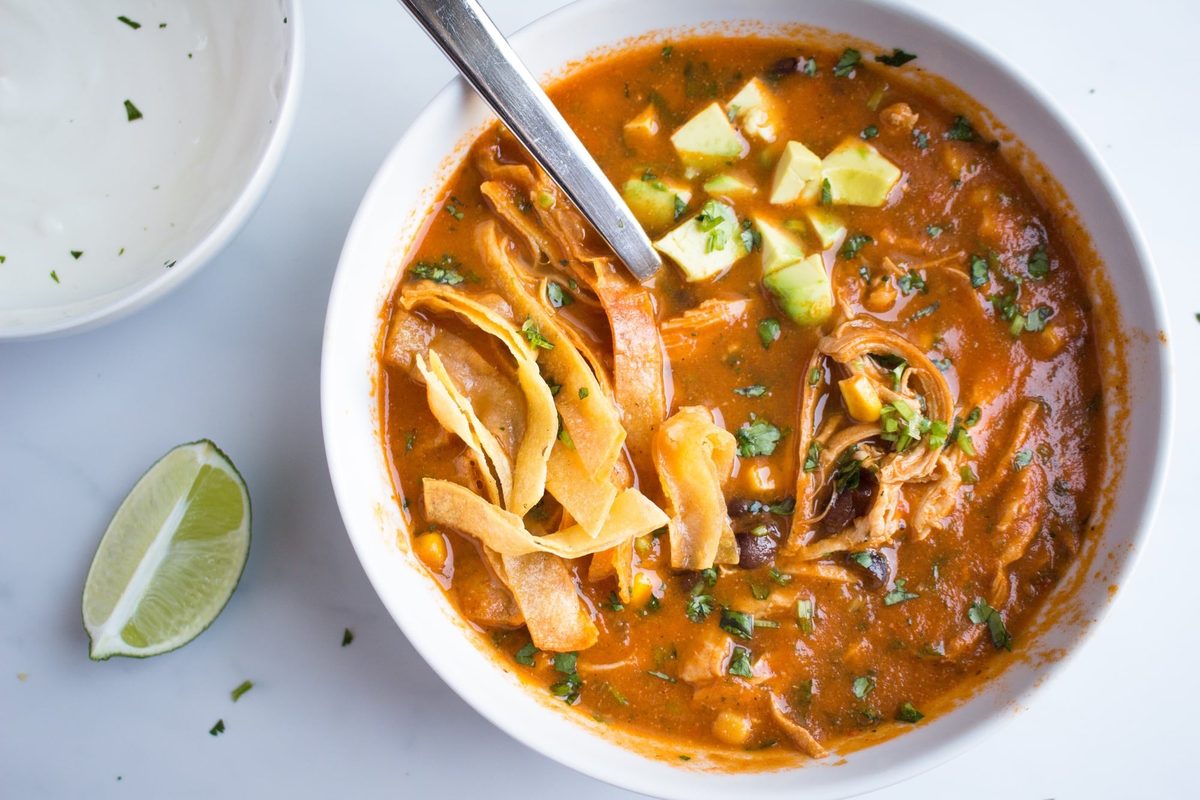
Tortilla soup (sopa de tortilla) is a Mexican soup of fried tortillas in a tomato broth, and its seasoning is short and specific: a dried chile, garlic, onion, tomato and a sprig of epazote. That combination is old. La cocinera poblana, a Mexican household cookbook printed in 1913, fries the tortillas in lard with crushed garlic, fries tomato and onion, adds broth, and finishes with “una rama de epazote y unos pedazos de chile ancho” (a sprig of epazote and some pieces of ancho chile).1 Two modern recipes below keep the same structure and switch the ancho for a pasilla. The rest of the flavor comes from what goes in the bowl: cheese, avocado, crema and lime.
At a glance
| Seasoning | Job | In the recipes below |
|---|---|---|
| Dried chile (pasilla or ancho) | Color, depth, mild heat | All three123 |
| Garlic | Pungent base | All three123 |
| Onion | Sweet, savory base | All three123 |
| Tomato | Body and acidity | All three123 |
| Epazote | The signature herb; strong, resinous | All three (optional in two)123 |
| Lime | Sharpness at the table | Two of three23 |
| Avocado, cheese, crema | Richness to balance the chile | Two of three23 |
| Chipotle | Smoky heat | None of the three; a common variation |
| Cilantro | Fresh garnish | None of the three; a common variation |
Three recipes side by side
| La cocinera poblana, 19131 | Joe T. Garcia’s, Fort Worth (James Beard Foundation)2 | Rick Bayless3 | |
|---|---|---|---|
| Chile | Pieces of ancho, on top | 1 dried pasilla, soaked and puréed | 2 large dried pasilla negro chiles (one for the base, one fried as garnish) |
| Garlic | 3 cloves, crushed, fried in the lard | 2 cloves, crushed, puréed | 2 cloves |
| Onion and tomato | Chopped onion and tomatoes, fried | 1/2 onion, 4 ripe tomatoes, puréed | 1 medium onion; 1/2 can diced tomatoes, preferably fire-roasted |
| Fat | Lard | Lard or vegetable oil | Pork lard or oil |
| Epazote | A sprig | 2 small sprigs fresh, or 1/2 tsp dried (optional) | A couple of sprigs, if available |
| In the bowl | Fried tortillas | Tortilla chips, chicken, avocado, queso Chihuahua, lime | Fried tortilla strips, chicken, crema, melting cheese, avocado, lime |
These are the publishers’ recipes, not a house standard. Joe T. Garcia’s recipe appears in the James Beard Foundation’s archive from James Beard’s All-American Eats.2
The core seasonings and what each one does
Dried chile: pasilla or ancho
The chile is the main spice, and the choice is between two dried chiles. Both modern recipes use pasilla;23 the 1913 version uses ancho.1
- Pasilla (also called chile negro) is one of the most common Mexican chiles, according to Katzer; its fresh form, the chilaca, is dark green, almost black.4 The Chile Pepper Institute calls it a staple in Mexican cooking, particularly for sauces.5 Joe T. Garcia’s soaks one pasilla in hot water and purées it with the tomatoes, onion and garlic.2 Bayless fries a second pasilla as a garnish.3
- Ancho is a dried poblano.6 The Chile Pepper Institute describes sweet, smoky flavors with hints of dried fruit.6
Heat in any chile comes from capsaicinoids, chiefly capsaicin and dihydrocapsaicin.7 See pasilla powder, ancho powder and pasilla powder substitutes.
Chipotle in adobo: a variation, not the base
None of the three recipes here uses chipotle. It is a popular modern addition all the same. The Real Academia Española defines chipotle as a hot, brick-red chile used smoke-dried,8 and Mick Vann, writing in The Austin Chronicle, identifies it as a large jalapeño.9 Canned chipotles in adobo bring smoke, heat and the tang of the sauce; blending one into the tomato base is a common shortcut (kitchen practice, not from these recipes). In our view it makes a smokier, hotter soup than one built on pasilla. See chipotle powder and chipotle powder substitutes.
Garlic, onion and tomato: the base
Every recipe uses all three.123 In the 1913 recipe, three crushed garlic cloves are fried in the lard before the tortillas,1 and Joe T. Garcia’s purées the garlic with the tomatoes, onion and chile, then fries the purée in lard until it thickens.2 Britannica describes garlic’s powerful, onionlike aroma and pungent taste.10 Bayless prefers fire-roasted canned tomatoes.3 See garlic powder vs. garlic.
Epazote: the signature herb
Epazote (Dysphania ambrosioides, formerly Chenopodium ambrosioides) is native to the Americas.11 Its fragrance is strong but hard to describe, Katzer writes;12 Tasting Table likens it to anise or licorice.13 Katzer notes that it is used fresh in soups, salads and meat dishes.12
All three recipes use it, two of them as optional.123 Joe T. Garcia’s adds it after the long simmer and cooks it 15 minutes more, and allows 1/2 teaspoon of dried in place of two small fresh sprigs.2 Tasting Table also advises adding it near the end of cooking and notes that the dried form is less aromatic.13 The US Botanic Garden cautions that large doses can be poisonous to animals and humans;14 the recipes here use a sprig or two per pot.123 See epazote substitutes.
Lime, avocado, cheese and crema: at the table
Much of tortilla soup’s balance is added in the bowl. Joe T. Garcia’s sets chips, chicken and avocado in each bowl, then tops the soup with queso Chihuahua and a squeeze of lime.2 Bayless lists crunchy tortillas, crema and cheese, avocado and chile as the garnishes, and notes that sour cream will curdle here, so he calls for Mexican crema or crème fraîche.3
Cilantro: optional
None of the three recipes calls for cilantro. Britannica notes that the leaves are widely used in Latin American dishes,15 and the LSU AgCenter groups cilantro with the delicate herbs best added at the end.16 If you like it, scatter it over the bowl at serving. See cooking with cilantro and cilantro vs. oregano.
Black pepper
None of the three recipes uses black pepper; Joe T. Garcia’s and Bayless season with salt alone.23 A grind at the table is a matter of taste. See black pepper.
Related
- Good Mexican spices for chicken
- Mexican oregano
- Spices for chicken soup
- Best spices for chili
- The master list of herbs and spices
Footnotes
-
“Sopa de Tortilla 1913”, from La cocinera poblana (1913), La Cocina Histórica, UTSA Libraries Special Collections. lacocina.utsa.edu · Reference work ↩ ↩2 ↩3 ↩4 ↩5 ↩6 ↩7 ↩8 ↩9 ↩10 ↩11 ↩12
-
“Sopa de Tortilla”, Joe T. Garcia’s Mexican Restaurant, James Beard Foundation recipe archive. archive.jamesbeard.org · Publication ↩ ↩2 ↩3 ↩4 ↩5 ↩6 ↩7 ↩8 ↩9 ↩10 ↩11 ↩12 ↩13 ↩14 ↩15 ↩16 ↩17 ↩18
-
Rick Bayless, “Tortilla Soup”, RickBayless.com. rickbayless.com · Publication ↩ ↩2 ↩3 ↩4 ↩5 ↩6 ↩7 ↩8 ↩9 ↩10 ↩11 ↩12 ↩13 ↩14 ↩15 ↩16
-
Gernot Katzer, “Paprika and Mexican chiles”, Gernot Katzer’s Spice Pages. gernot-katzers-spice-pages.com · Reference work ↩
-
“Pasilla”, Chile Pepper Institute, New Mexico State University. cpi.nmsu.edu · Reference work ↩
-
“Ancho”, Chile Pepper Institute, New Mexico State University. cpi.nmsu.edu · Reference work ↩ ↩2
-
Bosland and Walker, “Measuring Chile Pepper Heat”, New Mexico State University, 2010. pubs.nmsu.edu · Reference work ↩
-
“chipotle”, Diccionario de la lengua española, Real Academia Española. dle.rae.es · Reference work ↩
-
Mick Vann, “Chipotle Chiles”, The Austin Chronicle, 2012. austinchronicle.com · Publication ↩
-
“Garlic”, Encyclopaedia Britannica, 2026. britannica.com · Reference work ↩
-
“Dysphania ambrosioides”, Plants of the World Online, Royal Botanic Gardens, Kew. powo.science.kew.org · Reference work ↩
-
Gernot Katzer, “Epazote”, Gernot Katzer’s Spice Pages. gernot-katzers-spice-pages.com · Reference work ↩ ↩2
-
Nikita Ephanov, “Epazote: The Mexican Herb You Should Be Adding To Beans”, Tasting Table, 2022. tastingtable.com · Publication ↩ ↩2
-
“Epazote Science Page”, United States Botanic Garden. usbg.gov · Reference work ↩
-
“Coriander”, Encyclopaedia Britannica. britannica.com · Reference work ↩
-
“Flavorful Herbs”, LSU AgCenter. lsuagcenter.com · Reference work ↩