Herbs · Profile
Oregano: Flavor, Chemistry, Species and How to Use It
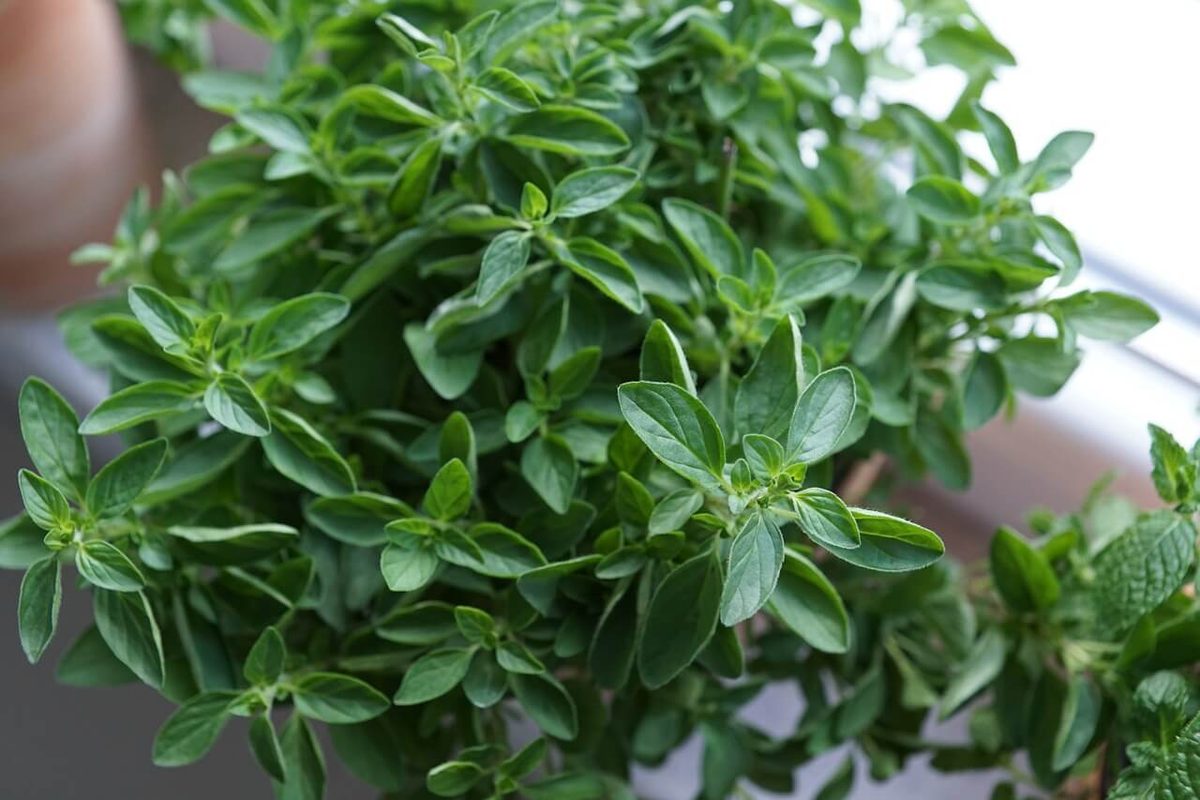
Oregano is the dried or fresh leaf of Origanum vulgare and its close relatives, perennial herbs of the mint family. It is also a flavor category: the oregano on a spice shelf may come from several Origanum species, and Mexican oregano comes from a different plant family altogether. This page covers the plants behind the name, the compounds that give oregano its bite, how it is used, how to judge quality, and why oregano is the most adulterated herb in Europe’s largest survey of herb and spice fraud.
At a glance
| Botanical name | Origanum vulgare L. (common oregano); other Origanum species and Lippia are also sold as oregano123 |
| Plant family | Lamiaceae (mint family); Mexican oregano is Verbenaceae14 |
| Part used | Leaves and flowering tops, mostly dried3 |
| Native range | Macaronesia to China (O. vulgare, per Kew)1 |
| Key aroma compounds | Carvacrol and thymol, in amounts that vary widely by plant42 |
| Forms sold | Whole, crushed or rubbed, and ground dried leaf; fresh sprigs; essential oil3 |
| International standard | Codex CXS 342-2021, dried oregano3 |
| Production figures | No published figure found |
Measured values
22 figures, sourced| Measure | Value | Scope | Source |
|---|---|---|---|
| Carvacrol plus thymol (combined) | 78–85 % of essential oil | Typical oregano oil per the review (page: "almost 78–85%") | mdpi.com |
| Carvacrol | 58.7–77.4 % of essential oil | Spanish O. vulgare samples (Carrasco et al., as tabulated in the review) | mdpi.com |
| Thymol | 0.2–5.8 % of essential oil | Spanish O. vulgare samples (Carrasco et al., as tabulated in the review) | mdpi.com |
| Moisture, maximum Limit | 12 % | Codex CXS 342-2021, dried oregano, all styles | fao.org |
| Volatile oil, minimum Limit | 2.5 ml/100 g, dry basis | Codex CXS 342-2021, dried oregano, Extra grade (whole and crushed) | fao.org |
| Volatile oil, minimum Limit | 2.0 ml/100 g, dry basis | Codex CXS 342-2021, dried oregano, Class I (whole and crushed) | fao.org |
| Volatile oil, minimum Limit | 1.5 ml/100 g, dry basis | Codex CXS 342-2021, dried oregano, Class II (whole and crushed) | fao.org |
| Volatile oil, minimum Limit | 1.3 ml/100 g, dry basis | Codex CXS 342-2021, dried oregano, ground | fao.org |
| Total ash, maximum Limit | 9 %, dry basis | Codex CXS 342-2021, dried oregano, Extra grade | fao.org |
| Total ash, maximum Limit | 10 %, dry basis | Codex CXS 342-2021, dried oregano, Class I and Class II | fao.org |
| Total ash, maximum Limit | 12 %, dry basis | Codex CXS 342-2021, dried oregano, ground | fao.org |
| Acid-insoluble ash, maximum Limit | 1.2 %, dry basis | Codex CXS 342-2021, dried oregano, Extra grade | fao.org |
| Acid-insoluble ash, maximum Limit | 2 %, dry basis | Codex CXS 342-2021, dried oregano, Class I and Class II | fao.org |
| Acid-insoluble ash, maximum Limit | 2.5 %, dry basis | Codex CXS 342-2021, dried oregano, ground | fao.org |
| Extraneous matter, maximum Limit | 0.5 % | Codex CXS 342-2021, dried oregano, Extra grade | fao.org |
| Extraneous matter, maximum Limit | 2 % | Codex CXS 342-2021, dried oregano, Class I and Class IIGround: N/A; Codex notes this does not mean zero. | fao.org |
| Foreign matter, maximum Limit | 0.1 % | Codex CXS 342-2021, dried oregano, every whole grade | fao.org |
| Pyrrolizidine alkaloids, maximum Limit | 1,000 µg/kg | EU Regulation 2023/915, dried oregano, marjoram, borage and lovage and mixtures made only of them | eur-lex.europa.eu |
| Vitamin K Nutrient | 622 µg per 100 g | USDA FoodData Central, oregano, dried (FDC ID 171328, SR Legacy) | fdc.nal.usda.gov |
| Iron Nutrient | 36.8 mg per 100 g | USDA FoodData Central, oregano, dried (FDC ID 171328, SR Legacy) | fdc.nal.usda.gov |
| Calcium Nutrient | 1,600 mg per 100 g | USDA FoodData Central, oregano, dried (FDC ID 171328, SR Legacy) | fdc.nal.usda.gov |
| Fiber Nutrient | 42.5 g per 100 g | USDA FoodData Central, oregano, dried (FDC ID 171328, SR Legacy) | fdc.nal.usda.gov |
Each figure is quoted as its source states it, with the samples or standard it applies to. Where sources differ, both are shown; nothing is averaged. All measured values
What oregano is
The plants sold as oregano
Common oregano, Origanum vulgare, is a perennial of the temperate biome in the mint family, Lamiaceae.1 Britannica says it is usually grown as a small evergreen subshrub in mild climates.4 Kew accepts six subspecies, including subsp. hirtum, subsp. glandulosum and subsp. vulgare.1
The name stretches well beyond that one species. A 2020 review of oregano chemistry notes that “oregano” is used for several other Origanum species, such as O. onites and O. majorana, and even for plants in other genera: Thymus, Satureja, Lippia and Coridothymus.2 The Codex standard for dried oregano reflects this. It covers any Origanum species except marjoram (Origanum majorana), plus Lippia species traded as Mexican oregano.3
- Mexican oregano. Britannica gives it as Lippia graveolens and notes that it belongs to a different family, the Verbenaceae.4 Kew now treats Lippia graveolens as a synonym of Lippia origanoides, a shrub native from the southwestern United States (Texas, New Mexico) through Mexico and Central America to Argentina and Uruguay.5 See Mexican oregano and Mexican oregano vs. oregano.
- Marjoram. Origanum majorana is in the same genus, native to southern Türkiye and Cyprus.6 Britannica lists “wild marjoram” and “European marjoram” as other names for oregano.4 See marjoram and marjoram vs. oregano.
Name
Britannica traces “oregano” to the Greek oros, “mountain,” and ganos, “brightness” or “joy.”4
Flavor and aroma
Good dried oregano smells warm, resinous and a little camphor-like, and tastes pungent and slightly bitter, with a sharpness that can numb the tongue a little in strong lots; that description is ours. Britannica describes Greek and Italian culinary oreganos as having a strong aroma and a warm, pungent taste.4 Even so, the University of Delaware’s extension service classes oregano as a medium-strength herb, not a dominant one like sage or rosemary.7
The compounds
Britannica names thymol and carvacrol as constituents of oregano’s essential oil.4 A 2020 review in the International Journal of Molecular Sciences calls them the two primary phenols, together making up almost 78–85% of the oil.2 The share swings widely with the plant:
| Scope | Carvacrol | Thymol | Source |
|---|---|---|---|
| Spanish O. vulgare samples (Carrasco et al., as tabulated in the review) | 58.7–77.4% | 0.2–5.8% | Lombrea et al. 20202 |
| Carvacrol plus thymol, typical oregano oil per the review | 78–85% combined | Lombrea et al. 20202 |
The review explains why one figure cannot cover all oregano. The southern subspecies (hirtum, glandulosum, gracile) carry more essential oil, dominated by carvacrol, thymol, p-cymene and γ-terpinene, while lower-oil plants are marked instead by sabinene, linalool, borneol and sesquiterpenes; northern subspecies are poorer in essential oil overall.2 The review also links falling oil content at higher altitude to fewer peltate glands on the leaf, and notes that Greek oregano has denser, larger peltate trichomes than common oregano.2 All of these are figures for essential oil; we found no measured carvacrol content for dried culinary oregano leaf.
Origin and history
Kew gives the native range of O. vulgare as Macaronesia to China, spanning most of Europe, North Africa, the Caucasus, Central Asia, the Himalaya and parts of China, and records it as introduced in many US states and Canadian provinces, from California to Québec.1 Britannica puts the culinary oreganos in the hills of the Mediterranean countries and western Asia.4
Britannica records that the Greek physician Hippocrates documented oregano’s use as an antiseptic, and that oregano became widely known in the United States after World War II, when returning soldiers who had developed a taste for Italian food made it popular.4 The nickname “pizza herb” often attached to that story could not be traced to a source.
How oregano is used
Britannica calls oregano a key ingredient in Mediterranean and Middle Eastern cooking, used with meat, vegetables, sauces and soups, and essential in Italian pizza and pasta sauces, Greek salads and gyros.4
- Italy and Italian-American cooking. Pizza and tomato sauces are the defining uses.4 See good spices for pizza and Italian seasoning.
- Greece. Greek salad and gyros.4 By common practice, dried oregano also goes into lemon and olive oil dressings for grilled meat and fish. See Greek seasoning.
- Mexico and the US Southwest. Mexican oregano is the usual choice in Mexican cooking, by common practice. In the US, the federal purchasing specification for chili powder lists oregano with ground chili pepper, cumin, salt and garlic powder.8 See chili powder.
- Middle East. See also za’atar, a related family of herb blends.
Technique
America’s Test Kitchen puts oregano among the hearty herbs to add early in cooking.9 The University of Delaware notes that dried herbs are stronger than fresh, suggests crushing dried herbs to release their oils in quick and medium-length dishes, and gives a rough equivalence of 3/4 to 1 teaspoon dried crumbled herb for 2 to 3 teaspoons fresh.7 Its starting amount for medium-strength herbs is 1 to 2 teaspoons for six servings.7 For more, see fresh oregano vs. dried, oregano uses and cooking with oregano. If a dish has gone over, see too much oregano.
Buying and quality
The Codex standard for dried oregano (CXS 342-2021) sets three grades for whole and crushed oregano and one for ground, plus a 12% moisture maximum for all styles.3 Key chemical limits, on a dry basis:
| Requirement | Extra | Class I | Class II | Ground |
|---|---|---|---|---|
| Volatile oil, minimum (ml/100 g) | 2.5 | 2.0 | 1.5 | 1.3 |
| Total ash, maximum (%) | 9 | 10 | 10 | 12 |
| Acid-insoluble ash, maximum (%) | 1.2 | 2 | 2 | 2.5 |
| Extraneous matter, maximum (%) | 0.5 | 2 | 2 | N/A (Codex notes this does not mean zero) |
Foreign matter is capped at 0.1% for every whole grade, and no live insects are allowed in any style.3 For a shopper, a dull, dusty jar with little smell when rubbed is the warning sign; that is kitchen judgment, not part of the standard.
Adulteration
Oregano fared worst in the European Commission’s 2019–2021 coordinated control plan on herb and spice fraud, which tested 1,885 samples of six herbs and spices from 21 EU countries plus Norway and Switzerland.10 Across all six products, 17% of samples were suspicious. For oregano the figure was 48%, in most cases because of olive leaves.1011 The Joint Research Centre’s report calls the oregano supply chain the most vulnerable of those tested.11 Buying whole or crushed leaf rather than fine powder makes foreign leaf easier to spot; that is a practical suggestion, not a tested method.
Storage
We found no published shelf-life figure for dried oregano from a regulator or standards body. As with other dried herbs, the flavor is in a volatile oil, so smell is the test: crush a pinch, and if the aroma is faint, it has faded. For fresh sprigs, see can you freeze oregano? and how to dry oregano.
Nutrition
A teaspoon of dried oregano leaves weighs 1.0 g.12 At that weight it supplies about 6 µg of vitamin K (5% of the FDA Daily Value), 0.37 mg of iron (2%), 16 mg of calcium (1%) and 0.4 g of fiber.1213 These are computed from USDA’s per-100 g values of 622 µg vitamin K, 36.8 mg iron, 1,600 mg calcium and 42.5 g fiber, against Daily Values of 120 µg, 18 mg and 1,300 mg.1213 At normal seasoning amounts, oregano is not a meaningful source of any nutrient.
Safety
- Pyrrolizidine alkaloids. The EU sets a maximum of 1,000 µg/kg for these plant toxins in dried oregano, marjoram, borage and lovage, and in mixtures made only of them; for other dried herbs the limit is 400 µg/kg.14
- Health claims. Britannica notes that thymol and carvacrol are known for antibacterial properties.4 That is a property of the isolated compounds, not evidence that eating oregano treats infection. The NIH’s National Center for Complementary and Integrative Health has no fact sheet on oregano.15 Claims that oregano or its oil treats colds, infections such as MRSA, or cancer rest on laboratory work at most; this page makes no such claims.
Substitutes and comparisons
Marjoram is the closest stand-in but milder and sweeter; thyme shares oregano’s phenolic character; Mexican oregano works in most dishes but leans citrusy. These are kitchen judgments, not tested swaps. See oregano substitutes and Mexican oregano substitutes, and these comparisons:
- Marjoram vs. oregano
- Oregano vs. thyme
- Basil vs. oregano
- Oregano vs. mint
- Oregano vs. parsley
- Cilantro vs. oregano
Footnotes
-
Origanum vulgare L., Plants of the World Online, Royal Botanic Gardens, Kew. powo.science.kew.org · Reference work ↩ ↩2 ↩3 ↩4 ↩5 ↩6
-
Lombrea et al., “A Recent Insight Regarding the Phytochemistry and Bioactivity of Origanum vulgare L. Essential Oil”, International Journal of Molecular Sciences, 2020. mdpi.com · Peer-reviewed ↩ ↩2 ↩3 ↩4 ↩5 ↩6 ↩7 ↩8
-
Standard for Dried Oregano, CXS 342-2021, Codex Alimentarius. fao.org · Standard ↩ ↩2 ↩3 ↩4 ↩5 ↩6 ↩7
-
Anoushka Pant, “Oregano”, Encyclopaedia Britannica, 2026. britannica.com · Reference work ↩ ↩2 ↩3 ↩4 ↩5 ↩6 ↩7 ↩8 ↩9 ↩10 ↩11 ↩12 ↩13 ↩14
-
Lippia origanoides Kunth, Plants of the World Online, Royal Botanic Gardens, Kew. powo.science.kew.org · Reference work ↩
-
Origanum majorana L., Plants of the World Online, Royal Botanic Gardens, Kew. powo.science.kew.org · Reference work ↩
-
“Using Herbs and Spices”, University of Delaware Cooperative Extension, 2025. udel.edu · Reference work ↩ ↩2 ↩3
-
Commercial Item Description A-A-20001C, Spices and Spice Blends, USDA Agricultural Marketing Service, 2023. ams.usda.gov · Regulator ↩
-
Liz Bomze, “Our Guide to Fresh Herbs”, America’s Test Kitchen, 2019. americastestkitchen.com · Publication ↩
-
Herbs and spices (2019-2021), EU Agri-Food Fraud Network, European Commission. food.ec.europa.eu · Regulator ↩ ↩2
-
Maquet et al., “Results of an EU wide coordinated control plan to establish the prevalence of fraudulent practices in the marketing of herbs and spices”, Joint Research Centre, 2021. publications.jrc.ec.europa.eu · Regulator ↩ ↩2
-
Spices, oregano, dried (FDC 171328), USDA FoodData Central. fdc.nal.usda.gov · Regulator ↩ ↩2 ↩3
-
Daily Value on the Nutrition and Supplement Facts Labels, U.S. Food and Drug Administration. fda.gov · Regulator ↩ ↩2
-
Commission Regulation (EU) 2023/915, Annex I, point 2.4. eur-lex.europa.eu · Regulator ↩
-
Herbs at a Glance, National Center for Complementary and Integrative Health. nccih.nih.gov · Regulator ↩