Herbs · Profile
Mexican Oregano: A Different Plant With a Familiar Flavor
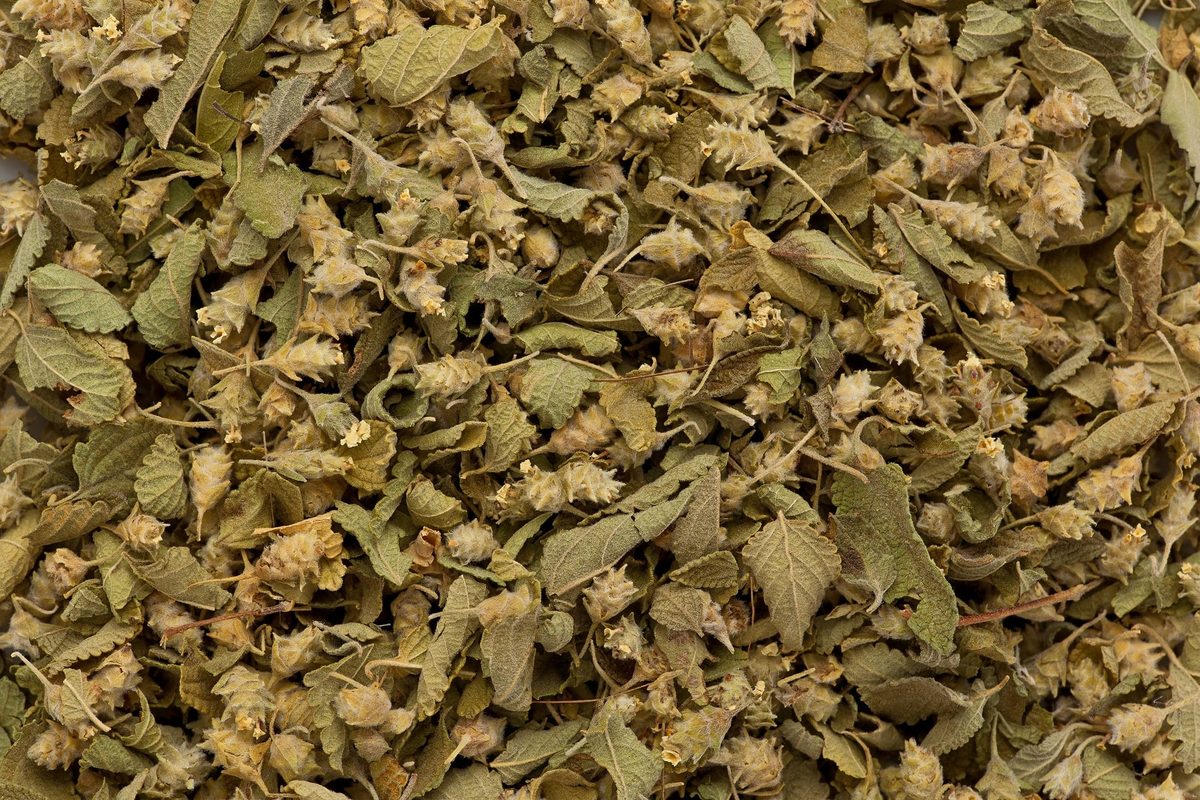
Mexican oregano is not oregano in the botanical sense. It is the dried leaf of Lippia graveolens, a shrub of the verbena family, Verbenaceae, while Mediterranean oregano is Origanum vulgare of the mint family.12 The two taste alike because both are rich in the same two phenols, thymol and carvacrol, but in different proportions, and PROSEA describes the Mexican herb as stronger, sharper and more pungent.34 PROSEA calls it an important spice in Mexico and Central America, and it turns up in the chile sauces of New Mexico.35
At a glance
| Botanical name | Lippia graveolens Kunth; Kew treats it as a synonym of Lippia origanoides Kunth16 |
| Plant family | Verbenaceae (verbena family)12 |
| Part used | Dried leaves; essential oil3 |
| Native range | Southern United States to Nicaragua (PROSEA); tropical and subtropical America (Kew)63 |
| Key aroma compounds | Thymol 40% to 60% and carvacrol 3% to 25% of the oil (PROSEA)3 |
| Oil content | About 3% to 4%3 |
| Forms sold | Dried whole or crumbled leaf, ground leaf, essential oil |
Measured values
3 figures, sourced| Measure | Value | Scope | Source |
|---|---|---|---|
| Essential oil | 3 to 4 % (about) | Lippia graveolens, PROSEA | uses.plantnet-project.org |
| Essential oil: thymol | 40 to 60 % of the oil | Lippia graveolens, PROSEA | uses.plantnet-project.org |
| Essential oil: carvacrol | 3 to 25 % of the oil | Lippia graveolens, PROSEA | uses.plantnet-project.org |
Each figure is quoted as its source states it, with the samples or standard it applies to. Where sources differ, both are shown; nothing is averaged. All measured values
What it is
The plant is a shrub native to tropical and subtropical America; PROSEA puts its range from the southern United States to Nicaragua.63 The name Lippia graveolens was published by Kunth; Kew now files it as a synonym of the broader species Lippia origanoides, so you will see both names in the literature.16
Its family connection is to lemon verbena, Aloysia citrodora, which Kew also places in Verbenaceae.7 The word “oregano” has never been a botanical label: a 2020 review notes that it is used for plants of several genera, Lippia among them.4
Wild stands are an issue. PROSEA reports that natural populations in Mexico are overharvested, and that in the southern United States the plant is grown as an annual.3 A 2021 review describes L. graveolens as a traditional crop “primarily cultivated for essential oil recovery.”8
Flavor and aroma
Mexican oregano tastes recognizably of oregano, but louder: more resinous and peppery, with a citrusy edge that Mediterranean oregano lacks. That is our description. PROSEA puts it more simply: stronger, sharper and more pungent than Origanum.3
The compounds, side by side
| Mexican oregano (Lippia graveolens) | Mediterranean oregano (Origanum vulgare) | |
|---|---|---|
| Main phenols | Thymol 40% to 60%, carvacrol 3% to 25% (PROSEA)3 | Carvacrol and thymol together about 78% to 85% of the oil (review)4 |
| Example samples | Not yet measured in a source we opened | Spanish samples: carvacrol 58.7% to 77.4% (tabulated in the review)4 |
| Other compounds named | β-caryophyllene and p-cymene in the oil; flavonoids such as pinocembrin and galangin in extracts8 | Varies by subspecies and altitude4 |
The short version: in the figures we found, Mexican oregano leans on thymol, while Mediterranean oregano usually leans on carvacrol. These are ranges from different studies and different samples, not a controlled comparison.
How it is used
PROSEA calls it an important spice in Mexico and Central America.3 In US extension recipes it turns up in chile cooking:
- New Mexico red chile sauce. NMSU Extension’s red chile sauce lists crushed dried Mexican oregano as optional and adds it near the end: “Add oregano and simmer another 5–7 minutes.”5 See best spices for chili for more chili recipes that use it.
- White chicken chili. A University of Tennessee Extension recipe card calls for 2 teaspoons of Mexican oregano.9
- Industry. PROSEA notes that the essential oil has largely replaced the herb itself in the food industry.3
By common practice it goes into pozole, menudo, bean dishes, salsas and adobos, often with cumin and dried chiles, and many cooks rub the dried leaves between their palms over the pot to release the oil. Those are kitchen traditions; we did not find a source we could open that documents specific dishes.
Buying and quality
Buy whole or coarsely crumbled leaves, which are easier to judge than powder: they should be green rather than brown and smell sharp and resinous when rubbed. That is kitchen judgment. Check the label for the word Mexican or the name Lippia, since the two herbs are not interchangeable in flavor.
Oregano in general is a target for fraud. In an EU-wide control plan, 48% of samples sold as oregano were suspected of adulteration, mostly with olive leaves.10 That survey concerned oregano on the EU market; it did not report Mexican oregano separately.
Production
PROSEA cites an estimate that Mexico produced about 3,000 tonnes of oregano a year in the early 1990s, of which about 2,000 tonnes went to the United States.3 That figure is more than 30 years old and is an estimate quoted in a reference work, not a current statistic; we found no recent government figure we could open.
Storage
We found no published shelf-life figure from a regulator or extension service for dried Mexican oregano. Keep it in an airtight jar away from heat and light, and judge it by smell; that is common practice. For general guidance see how to dry oregano and can you freeze oregano.
Health and safety
The 2021 review lists antioxidant, anti-inflammatory, antifungal and other activities for compounds from L. graveolens.8 Those are laboratory findings about extracts and isolated compounds, not evidence that eating the herb treats or prevents any disease. We found no NIH fact sheet or human trial for Mexican oregano, and widely repeated claims that it helps prevent Alzheimer’s disease, obesity or osteoporosis could not be traced to human evidence.
USDA’s FoodData Central has no separate entry for Mexican oregano, so vitamin and mineral claims for it cannot be checked; figures for “oregano” belong to Origanum.
Substitutes and comparisons
Mediterranean oregano is the usual stand-in; it is milder, so some cooks use a little more, but no tested ratio exists (Method). See Mexican oregano substitutes and Mexican oregano vs. oregano.
Related: oregano substitutes, marjoram, epazote, chili powder, fresh vs. dried oregano and too much oregano.
Footnotes
-
Lippia graveolens Kunth, Plants of the World Online, Royal Botanic Gardens, Kew. powo.science.kew.org · Reference work ↩ ↩2 ↩3 ↩4
-
“Oregano”, Encyclopaedia Britannica. britannica.com · Reference work ↩ ↩2
-
H.C. Ong and M. Brink, “Lippia graveolens (PROSEA)”, Plant Resources of South-East Asia, via Pl@ntUse. uses.plantnet-project.org · Reference work ↩ ↩2 ↩3 ↩4 ↩5 ↩6 ↩7 ↩8 ↩9 ↩10 ↩11 ↩12 ↩13
-
Lombrea et al., “A Recent Insight Regarding the Phytochemistry and Bioactivity of Origanum vulgare L. Essential Oil”, International Journal of Molecular Sciences, 2020. mdpi.com · Peer-reviewed ↩ ↩2 ↩3 ↩4 ↩5
-
Benson and Garcia-Anaya, “Preserving Red Chile”, NMSU Cooperative Extension Service. bernalilloextension.nmsu.edu · Reference work ↩ ↩2
-
Lippia origanoides Kunth, Plants of the World Online, Royal Botanic Gardens, Kew. powo.science.kew.org · Reference work ↩ ↩2 ↩3 ↩4
-
Aloysia citrodora Paláu, Plants of the World Online, Royal Botanic Gardens, Kew. powo.science.kew.org · Reference work ↩
-
“Mexican Oregano (Lippia graveolens Kunth) as Source of Bioactive Compounds: A Review”, Molecules, 2021 (abstract via DOAJ). doaj.org · Peer-reviewed ↩ ↩2 ↩3
-
“White Chicken Chili”, University of Tennessee Extension, Bedford County. bedford.tennessee.edu · Reference work ↩
-
“Herbs and spices (2019-2021): EU coordinated action”, European Commission. food.ec.europa.eu · Regulator ↩