Seasonings · Profile
Furikake: Japan’s Rice Seasoning, What’s in It and Where It Came From
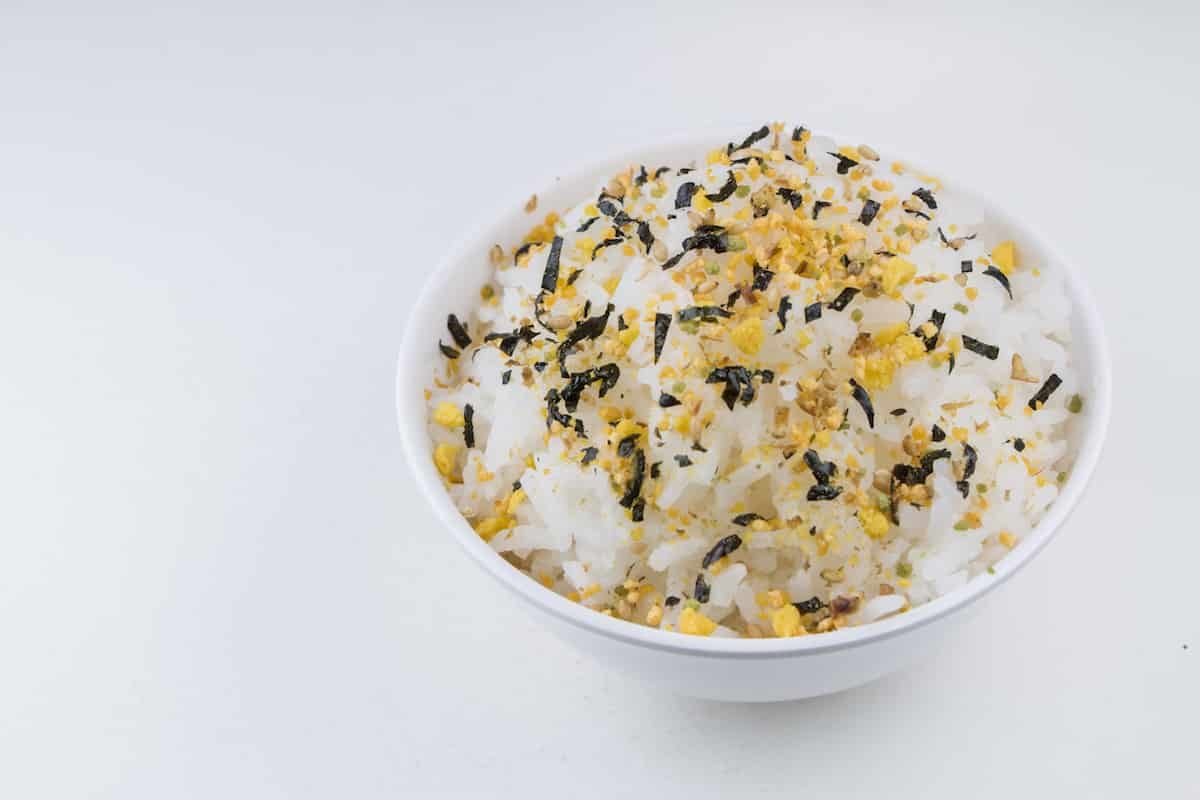
Furikake is a dry Japanese seasoning sprinkled over rice. The name means “sprinkle,” and the most common versions combine bonito flakes, toasted sesame seeds, nori seaweed, sugar and salt.1 Namiko Hirasawa Chen of Just One Cookbook calls it the salt and pepper of the Japanese kitchen.1 It comes in many flavors, from simple sesame salt to egg-and-seaweed noritama, and its modern form dates to a Kumamoto pharmacist’s effort, early in the Taisho era, to get more calcium into Japanese diets.234
At a glance
| What it is | A dry, flaky seasoning for rice1 |
| Name | Literally “sprinkle”1 |
| Common base | Bonito flakes, toasted sesame, nori, sugar, salt1 |
| Other additions | Salmon flakes, dried baby shrimp, shiso, egg, wasabi, vegetables1 |
| Simplest form | Gomashio, sesame salt2 |
| Oldest recognized product | 御飯の友 (Gohan no Tomo), Futaba, Kumamoto, early Taisho era4 |
| Official standard | None found; the USDA spice-blend specification does not include it5 |
| Allergens | Often fish, sesame and soy, all major US allergens6 |
What is in it
Furikake is a category, not a single recipe. Makiko Itoh of JustBento counts gomashio, sesame salt, as the most basic furikake.2 Chen describes the common commercial style as bonito flakes, toasted sesame, nori, sugar and salt, and lists salmon flakes, dried baby shrimp, shiso, egg, wasabi and vegetables as other additions.1 Two homemade versions side by side:
| Version | Ingredients | Source |
|---|---|---|
| Gomashio (sesame salt) | Toasted sesame seeds and salt | 2 |
| Noritama, Makiko Itoh (makes about 2 cups) | Bonito flakes (1½ cups fine, or 4 to 5 large handfuls), 3 to 4 large sheets nori, 1 tbsp sesame seeds, 2 hard-boiled eggs, 3 to 4 tbsp dark soy sauce, 1 tbsp mirin, a pinch of sea salt | 3 |
| Namiko Hirasawa Chen (makes 1 cup) | About 1/3 oz katsuobushi (bonito flakes), optional kombu, 1 tbsp aonori, 3 tbsp toasted white and 1 tbsp toasted black sesame, ½ sheet nori, 1 tsp each soy sauce, mirin and sugar, ½ tsp kosher salt, ½ tsp toasted sesame oil | 1 |
Itoh calls noritama one of the most popular commercial furikake flavors; the name joins nori with tama, short for tamago, egg.3 In her version the bonito flakes give most of the flavor and the egg yolk is there mainly for color.3 She describes her noritama as lower in salt, so it can be piled on rice.3
Where furikake came from
According to the Kumamoto Nichinichi Shimbun, early in the Taisho era (大正初期) a pharmacist named 吉丸末吉 (Yoshimaru Suekichi), founder of the company now called Futaba, set out to make up for calcium deficiency among Japanese people by grinding fish, bones and all, into a powder to eat on rice.4 The product, 御飯の友 (Gohan no Tomo, “friend of rice”), is still made in Kumamoto City, and the All Japan Furikake Association has recognized it as the originator of furikake.4
Chen gives a longer view: records of a salty powdered condiment go back to the 12th century, and the current form was invented in the early 20th century as a nutritional supplement.1 Accounts that a national manufacturer spread furikake across Japan after World War II to fight malnutrition could not be traced to a source, and this page does not repeat them.
Flavor and the compounds behind it
Furikake tastes salty, a little sweet, toasty from sesame, smoky and savory from bonito, and oceanic from nori. That description is ours. Of the main ingredients, the only one with its aroma chemistry in the sources checked is sesame, whose flavor under mild toasting is dominated by pyrazines.7 No published analysis of furikake as a whole was found.
How furikake is used
Chen recommends it on plain rice, rice porridge and udon, and for seasoning onigiri (rice balls), soba noodle salad, grilled salmon and rice crackers; she also suggests avocado, eggs, popcorn and pasta.1 Itoh sprinkles noritama on rice and soup.3
Buying and quality
No standard for furikake was found; the USDA’s specification for spice blends does not include it.5 Read the label for salt and sugar levels and for the allergens listed below.
Storage
| Version | Storage advice | Source |
|---|---|---|
| Chen’s homemade furikake | 1 to 2 months at room temperature with a food-safe silica gel packet; otherwise refrigerate up to 2 weeks or freeze up to 1 month | 1 |
| Itoh’s homemade noritama | Airtight in the refrigerator for about a week | 3 |
Chen notes that without a desiccant the nori and katsuobushi start to go stale.1 These are the authors’ guidance for their recipes, not measured shelf lives.
Safety
Allergens. The FDA lists fish, soybeans and sesame among the nine major food allergens.6 Bonito is a fish, and sesame and soy sauce are common furikake ingredients.13 Check the label.
Iodine. The NIH Office of Dietary Supplements calls seaweed, including nori, one of the best food sources of iodine, and notes that iodine content varies greatly among seaweed species.8 Its table gives 116 mcg (77% of the Daily Value) for 2 tablespoons (5 g) of dried, flaked nori.8 That figure is for nori alone, and no iodine measurement for furikake was found. The adult upper limit is 1,100 mcg a day, and the ODS notes that excessive iodine intake has been linked to thyroiditis and thyroid papillary cancer.8
Health claims
Claims that furikake helps prevent osteoporosis, thyroid disease or high cholesterol could not be traced to any regulator or systematic review, and this page makes none.
Substitutes and comparisons
- Furikake substitutes
- Gomasio vs furikake
- Gomasio, the simplest furikake
- Other Japanese seasonings: shichimi togarashi
- The seeds: sesame seeds, black sesame seeds
- Another seed-based topping: everything bagel seasoning
Footnotes
-
Namiko Hirasawa Chen, “Homemade Furikake (Rice Seasoning)”, Just One Cookbook. justonecookbook.com · Publication ↩ ↩2 ↩3 ↩4 ↩5 ↩6 ↩7 ↩8 ↩9 ↩10 ↩11 ↩12 ↩13
-
Makiko Itoh, “Homemade furikake no. 6: Gomashio, sesame salt”, JustBento. justbento.com · Publication ↩ ↩2 ↩3 ↩4
-
Makiko Itoh, “Homemade furikake no. 3: Noritama”, JustBento. justbento.com · Publication ↩ ↩2 ↩3 ↩4 ↩5 ↩6 ↩7 ↩8
-
“元祖に認定「御飯の友」”, Kumamoto Nichinichi Shimbun, 17 December 2017. kumanichi.com · Publication ↩ ↩2 ↩3 ↩4
-
Commercial Item Description A-A-20001C, Spices and Spice Blends, USDA Agricultural Marketing Service, 2023. ams.usda.gov · Regulator ↩ ↩2
-
“Food Allergies”, U.S. Food and Drug Administration. fda.gov · Regulator ↩ ↩2
-
Gernot Katzer, “Sesame (Sesamum indicum)”, Gernot Katzer’s Spice Pages. gernot-katzers-spice-pages.com · Reference work ↩
-
“Iodine: Fact Sheet for Health Professionals”, NIH Office of Dietary Supplements. ods.od.nih.gov · Regulator ↩ ↩2 ↩3