Seasonings · Profile
Gomasio (Gomashio): Japanese Sesame Salt, Its Ratios and How to Make It
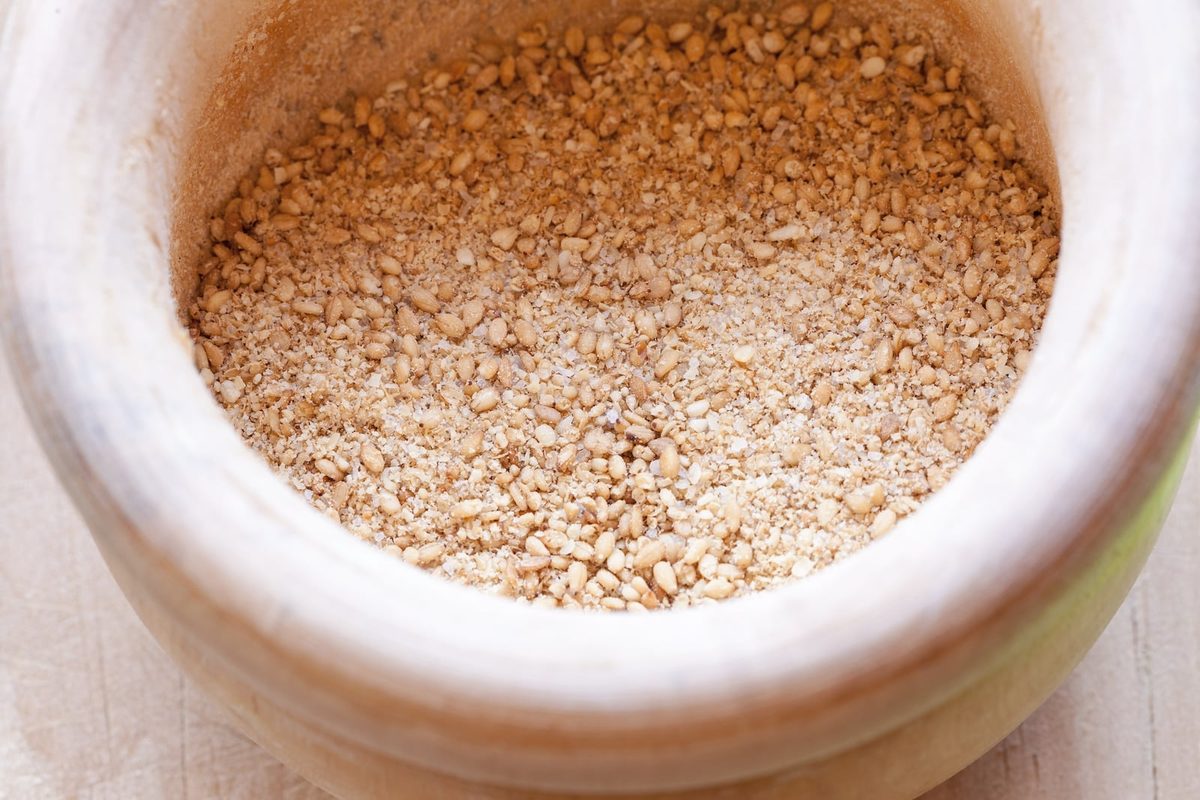
Gomasio, or gomashio (ごま塩, “sesame salt”), is toasted sesame seed mixed with salt.1 It is one of the simplest Japanese table seasonings, sprinkled over plain rice and essential on the red-bean rice sekihan.1 It also has a place in the macrobiotic diet.2 This page covers what goes into it, the very different ratios recipes use, how to make it, and how to use and store it.
At a glance
| What it is | Toasted sesame seeds and salt13 |
| Name | Gomashio (ごま塩), “sesame salt”; also spelled gomasio1 |
| Typical ratio | 8:1 sesame to salt by weight for commercial gomashio, per JustBento; recipes range to 18:1 (see below)14 |
| Seeds | Milk Street prefers unhulled5 |
| Classic uses | Plain rice, sekihan, rice dishes, stir-fries and grilled foods15 |
| Keeps | About a month, airtight, cool and dry (JustBento); a few weeks refrigerated (Milk Street)15 |
| Allergen | Contains sesame, a major food allergen in the US6 |
Measured values
2 figures, sourced| Measure | Value | Scope | Source |
|---|---|---|---|
| Salt content Conventional range | about 10 % salt | Katzer's description of gomashio; method not statedStated proportion, not a lab measurement | gernot-katzers-spice-pages.com |
| Sesame to salt ratio Conventional range | 8:1 by weight | commercial gomashio, per JustBentoStated proportion, not a lab measurement; recipes range to 18:1 | justbento.com |
Each figure is quoted as its source states it, with the samples or standard it applies to. Where sources differ, both are shown; nothing is averaged. All measured values
What gomasio is
JustBento’s Makiko Itoh calls gomashio the most basic furikake, the family of dry Japanese rice toppings.1 Katzer describes it as a simple mixture of toasted sesame seeds with about 10% salt.3 There is no single recipe: the seed-to-salt ratio, whether the seeds are ground, and whether the salt is toasted all vary from cook to cook.
For sesame itself, see black sesame seeds and black vs. white sesame seeds. Milk Street prefers unhulled seeds, which it describes as larger, plumper and nuttier.5 See also hulled vs. unhulled sesame seeds.
The ratio: sources disagree
Named recipes and references give quite different proportions. They are shown side by side here, not averaged.
| Source | Sesame : salt | Basis | Notes |
|---|---|---|---|
| JustBento (Makiko Itoh), describing commercial gomashio | 8 : 1 | Weight | “Usually” this ratio1 |
| JustBento, her own recipe | 10 : 1 | Weight | 100 g sesame to 10 g salt1 |
| Katzer’s Spice Pages | About 10% salt | Not stated | 3 |
| Gourmandelle (Ruxandra Niță), macrobiotic recipe | 18 : 1 | Tablespoons (volume) | Calls 18:1 the traditional macrobiotic ratio; offers 10:1 for a saltier result4 |
Gourmandelle attributes the 18:1 ratio to George Ohsawa in one passage,4 but no primary macrobiotic source for that number was found, and the 5:1 lower bound that also circulates online could not be traced at all.
At 8:1 or 10:1 by weight, salt makes up roughly a tenth of the mix (our arithmetic). Weight and volume ratios are not interchangeable, so compare like with like.
Method starting point: begin at 10:1 by weight, taste on rice, and add seed or salt from there.
How to make it
The two published methods differ in an interesting way.
- JustBento’s method dissolves the salt in water, then toasts the raw seeds in that brine over medium-low heat until they start to pop, so each whole seed is coated in its own layer of salt. Itoh considered grinding the salt finely in a suribachi instead and chose the brine. She advises against grinding the seeds, because that releases oils that go rancid quickly.1 An oven version toasts the seeds at 150 °C for about 5 minutes first.1
- Gourmandelle’s macrobiotic method toasts the salt in a dry pan, toasts the seeds until they start to crack, then grinds them together lightly in a mortar, or a suribachi (a Japanese mortar) if you have one.4
A spice grinder can stand in for a mortar if you pulse briefly; that is kitchen judgment. Whatever the method, the mix must be completely dry before it goes into a jar.1
How gomasio is used
- On rice. Milk Street calls it a multipurpose Japanese seasoning for rice, stir-fries and grilled foods.5
- Sekihan. JustBento says gomashio is essential for osekihan, the azuki bean and rice dish.1
- Everyday use, by common practice: on rice balls, steamed or roasted vegetables, eggs, tofu, salads and avocado toast, and as a finishing salt wherever a nutty crunch helps.
Gomasio and macrobiotics
The macrobiotic diet traces to Ishizuka Sagen (1850–1910), a Japanese army doctor of the Meiji period who blamed Japan’s adoption of Western food for a decline in health and urged a return to traditional foods such as unpolished rice, sea vegetables and beans.2 George Ohsawa (1893–1966, also known as Sakurazawa Yukikazu) published his first work on yin–yang theory in 1931 and later named the regimen macrobiotics.2 The SAGE encyclopedia entry describes the diet as emphasizing whole grains, especially brown rice, with vegetables, fermented foods and a limited amount of animal products, and lists sesame salt (gomashio) among the sodium-rich foods in Ohsawa’s diet, with soy sauce, miso and pickles.2
The same entry records that Ohsawa claimed macrobiotics could cure all diseases in 10 days and advised severely restricting water intake.2 Those claims are reported here as history; they are not supported, and nothing on this page recommends them.
Claims that Ishizuka was Ohsawa’s personal mentor, that the diet is pescatarian, and that parts of it date to the 17th century could not be confirmed from the sources reviewed.
Salt and health
A widely repeated claim presents gomasio as a low-sodium alternative to table salt. It does contain less salt than the same weight of plain salt, in proportion to its ratio; whether it lowers your sodium intake depends entirely on how much you sprinkle. That is arithmetic, not a measured finding, and no study of gomasio and blood pressure was found. Ohsawa himself counted it among sodium-rich foods.2 No claim is made here that gomasio treats or prevents high blood pressure or any other condition.
Claims that gomasio supplies significant magnesium, zinc, iron or B vitamins per serving, or that seaweed versions correct iodine deficiency, could not be supported. For what sesame itself contains, see black sesame seeds.
Safety
Gomasio is mostly sesame. The FASTER Act made sesame the ninth major food allergen in the US, effective 1 January 2023.6 The FDA has reported that some manufacturers began adding sesame to products that did not previously contain it, and advises checking the label every time you buy a product.7
Storage
JustBento says gomashio keeps for about a month in an airtight container in a cool, dry place such as a pantry or refrigerator, provided it was completely dry when packed.1 Milk Street says to refrigerate it airtight for a few weeks.5 Ground versions are more likely to go stale: Itoh warns that ground seeds release oils that turn rancid quickly.1 Smell before using; a stale or bitter smell means it is past its best.
Substitutes and comparisons
- Gomasio substitutes
- Gomasio vs. furikake and furikake seasoning
- Sesame seeds and black sesame seeds
- Shichimi togarashi
- Table salt and sea salt
Footnotes
-
Makiko Itoh, “Homemade furikake no. 6: Gomashio, sesame salt”, JustBento, 2008 (updated 2019). justbento.com · Publication ↩ ↩2 ↩3 ↩4 ↩5 ↩6 ↩7 ↩8 ↩9 ↩10 ↩11 ↩12 ↩13 ↩14 ↩15 ↩16
-
Nancy Stalker, “Macrobiotics”, The SAGE Encyclopedia of Food Issues, SAGE Publications, 2015. sk.sagepub.com · Reference work ↩ ↩2 ↩3 ↩4 ↩5 ↩6
-
Gernot Katzer, “Sesame”, Gernot Katzer’s Spice Pages. gernot-katzers-spice-pages.com · Reference work ↩ ↩2 ↩3
-
Ruxandra Niță, “How to Make Gomasio (Macrobiotic Sesame Salt)”, Gourmandelle, 2015 (updated 2026). gourmandelle.com · Publication ↩ ↩2 ↩3 ↩4
-
“Sesame Salt (Gomasio)”, Christopher Kimball’s Milk Street. prod.177milkstreet.com · Publication ↩ ↩2 ↩3 ↩4 ↩5 ↩6
-
Food Allergies, U.S. Food and Drug Administration. fda.gov · Regulator ↩ ↩2
-
Robert M. Califf, “An Update on Sesame Allergen Labeling on Food Packages”, FDA Voices, 2023. fda.gov · Regulator ↩