Spice Substitutes · Substitutes
Furikake Substitutes: Gomashio, Nori and Sesame, and When Shichimi Works
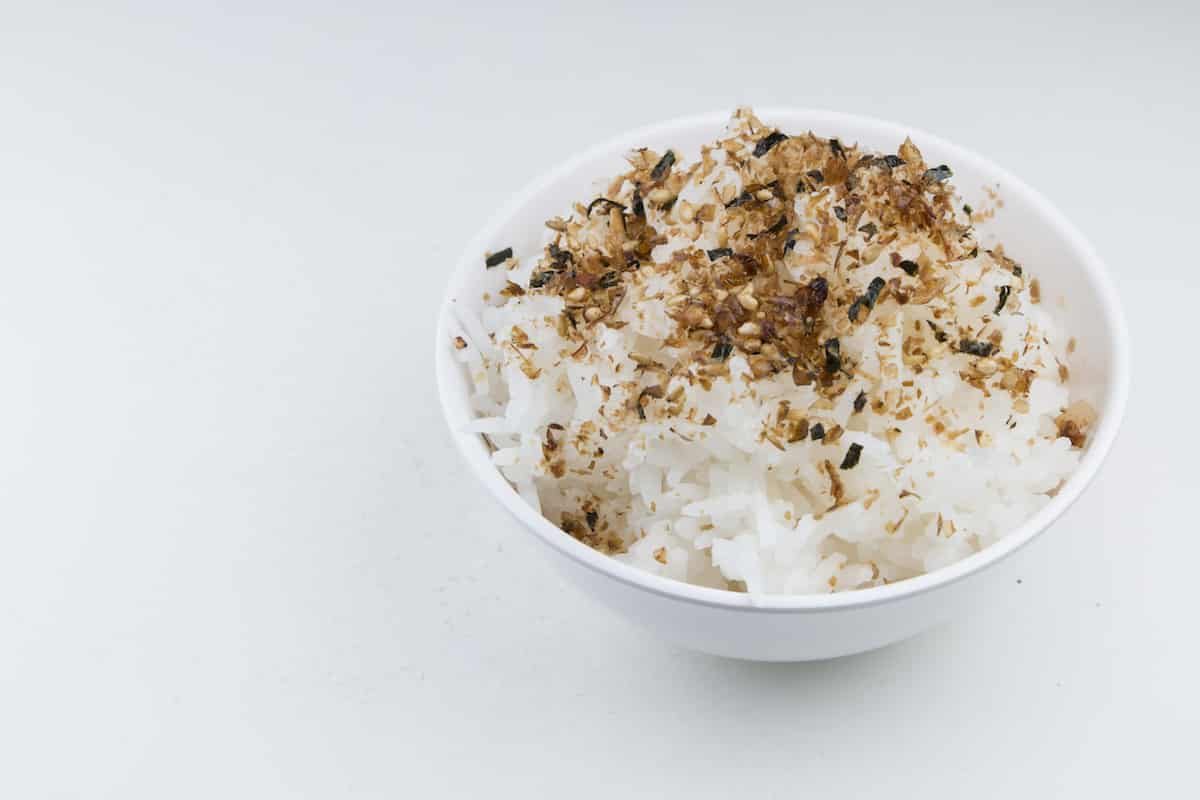
Furikake is a dry Japanese seasoning sprinkled over rice; the name means “sprinkle.”1 Namiko Hirasawa Chen of Just One Cookbook describes the common commercial kind as bonito flakes, toasted sesame seeds, nori seaweed, sugar and salt, with salmon flakes, dried baby shrimp, shiso, egg, wasabi or vegetables in some versions.1 It is a family of seasonings rather than one recipe, so a substitute only has to cover the jobs furikake is doing on your plate: salt, toasty sesame crunch, and the savory, sea-like flavor of nori and bonito.
Quick answer
| What furikake is doing | Best substitute | Starting amount, per 1 part furikake | Treatment |
|---|---|---|---|
| The whole package on rice or onigiri | Homemade furikake | Chen’s or Itoh’s formula, sprinkled to taste | Attributed (formula), Method (amount) |
| Salt and toasty sesame | Gomashio (sesame salt) | About 1/2 part, then taste | Method |
| Sea flavor and savoriness | Crumbled nori with toasted sesame and a pinch of salt | About 1 part of the mix | Method |
| A finishing sprinkle on noodles or rice bowls, where heat is welcome | Shichimi togarashi | About 1/4 part | Method |
How the ratios on this page are labeled
Every ratio carries one of four labels.
- Computed: based on a measurable physical relationship, with the source named.
- Attributed: a named source publishes this ratio. We quote it as theirs.
- Disputed: named sources give different answers to the same swap. We show each one and do not average them.
- Method: we found no published ratio. We give a direction and a cautious starting point, and say so.
We found no published ratio for replacing furikake with anything, and no sodium figure for a furikake product. Every amount here is a starting point to adjust by taste.
If you want the whole package
1. Make your own
Formula (Attributed): Two published home recipes show the range:
| Version | Ingredients | Source |
|---|---|---|
| Namiko Hirasawa Chen (makes 1 cup) | About 1/3 oz katsuobushi (bonito flakes), optional kombu, 1 tbsp aonori, 3 tbsp toasted white and 1 tbsp toasted black sesame, 1/2 sheet nori, 1 tsp each soy sauce, mirin and sugar, 1/2 tsp kosher salt, 1/2 tsp toasted sesame oil | 1 |
| Makiko Itoh’s noritama (makes about 2 cups) | Bonito flakes (1 1/2 cups fine, or 4 to 5 large handfuls), 3 to 4 large sheets nori, 1 tbsp sesame seeds, 2 hard-boiled eggs, 3 to 4 tbsp dark soy sauce, 1 tbsp mirin, a pinch of sea salt | 2 |
In Itoh’s noritama the bonito flakes give most of the flavor and the egg yolk is there mainly for color, so it can be left out.2 She describes her version as lower in salt, so it can be piled on rice.2 Chen keeps hers 1 to 2 months at room temperature with a food-safe silica gel packet; without one, the nori and katsuobushi go stale, so she refrigerates it for up to 2 weeks.1
Amount (Method): Neither author gives a substitution figure. Sprinkle to taste, as you would the commercial kind. A lower-salt homemade batch like Itoh’s can go on more heavily than a salty store-bought one.2
If furikake is bringing salt and toasty sesame
Gomashio (sesame salt)
Makiko Itoh calls gomashio, sesame salt, “the most basic furikake.”3 It covers furikake’s salt and sesame, but has none of the nori, bonito or sugar.31 Its toasty flavor comes from roasting: Gernot Katzer’s Spice Pages notes that pyrazines dominate the flavor of sesame toasted under mild conditions.4 Milk Street describes gomashio as a multipurpose seasoning for rice, stir-fries and grilled foods.5
How salty gomashio is depends on the recipe:
| Source | Sesame to salt | Basis |
|---|---|---|
| JustBento (Itoh), commercial gomashio | Usually 8:1 | By weight3 |
| JustBento (Itoh), her own recipe | 10:1 (100 g sesame, 10 g salt) | By weight3 |
| Gernot Katzer’s Spice Pages | About 10% salt | Not stated4 |
| Gourmandelle, “traditional macrobiotic” | 18:1, or 10:1 for a saltier condiment | By volume6 |
These are recipes for gomashio, not substitution ratios, and they do not need reconciling: each author’s mix is simply saltier or milder.
Ratio (Method): Start with about half as much gomashio as the furikake called for, taste, and add more. A commercial 8:1 mix is mostly sesame by weight, but its salt is not diluted by the bonito, nori and sugar that fill out furikake. That is our reasoning, not a measured comparison; no sodium figure for a furikake was found. If you are making it fresh, Itoh toasts the seeds until they start to pop and advises against grinding them, because ground sesame releases oils that turn rancid quickly.3
If furikake is bringing sea flavor and savoriness
Nori and toasted sesame, with a pinch of salt
Nori and sesame are the two ingredients both published furikake formulas share, along with some salt.12 Itoh identifies nori as the seaweed used to wrap sushi rolls and onigiri.2 Crumbling a sheet over rice with toasted sesame gives you furikake’s sea flavor and crunch. If you have bonito flakes, add them: Itoh says bonito gives most of the flavor in her noritama.2 Chen’s list of additions suggests other directions, including salmon flakes, shiso and egg.1
Ratio (Method): No published ratio was found. As a starting point, crumble half a sheet of nori into 3 to 4 tablespoons of toasted sesame seeds with a small pinch of salt. Chen’s recipe pairs half a sheet of nori, plus a tablespoon of aonori, with 4 tablespoons of sesame.1 Use the mix 1:1 for furikake and taste. A teaspoon each of sugar and soy sauce, as in Chen’s version, moves it closer to the commercial style.1
Nori is rich in iodine. The NIH Office of Dietary Supplements lists 116 mcg, 77% of the Daily Value, for 2 tablespoons (5 g) of dried, flaked nori, and notes that iodine content varies greatly among seaweed species.7 A sprinkle is a fraction of that amount.
If you want a finishing sprinkle and heat is welcome
Shichimi togarashi
Shichimi togarashi is a Japanese table blend built on chile. Nippon.com names chile, sansho and sesame as its standard ingredients, with the rest varying by maker.8 Some versions share furikake’s sesame and seaweed: Kyoto’s Shichimiya Honpo lists chile, white and black sesame, sansho, aonori (green laver), green shiso and hemp seed.9 Just One Cookbook names ramen, udon, soba, gyudon, tonjiru, yakitori and hot pots among its uses.10
It is a different seasoning from furikake. Chile leads it, and Nippon.com describes sansho’s heat as tongue-numbing.8 Shichimi brings no bonito, sugar or the salt that runs through the furikake formulas.19 It works where furikake would be a final sprinkle on noodles or a rice bowl, and less well on plain rice or in onigiri, where furikake’s salt and savoriness are the point.
Ratio (Method): No published ratio was found. Because chile leads, start with about a quarter as much shichimi as furikake, add a pinch of salt and some crumbled nori if you have it, and taste.
What the name means. Shichimi is 七味, “seven flavors,” and the same characters can be read nanami.11 Just One Cookbook lists Japanese seven-spice and nanami togarashi as other names for shichimi togarashi.10 The Daring Gourmet translates togarashi as “peppers,” meaning chile.12 Sources disagree on whether bottles labeled nanami differ: Tomo of japanese-products.blog says the export blends’ ingredients vary by country, while The Daring Gourmet says nanami uses less orange peel.1112 Citrus peel is not unique to the nanami label: Tokyo’s Yagenbori includes dried mandarin peel in its shichimi,13 and S&B’s U.S. nanami lists chili pepper, orange peel, black and white sesame, Japanese pepper, ginger and seaweed.14 Either bottle substitutes for furikake the same way.
Shichimi is sometimes compared with Chinese five-spice powder. Britannica lists five-spice as fennel seeds, cassia, cloves, star anise and Sichuan pepper,15 so the ingredient lists do not overlap apart from the peppers: sansho in shichimi, Sichuan pepper in five-spice.815
Allergens
The FDA lists fish, soybeans and sesame among the nine major food allergens.16 Bonito is a fish, and sesame and soy sauce run through most furikake recipes;12 gomashio and shichimi both contain sesame.39 Check labels if you are cooking for someone with an allergy.
What isn’t known
- No published ratio exists for replacing furikake with any other seasoning. All amounts above are Method starting points.
- No sodium figure for a furikake product was found, so the salt of gomashio or shichimi cannot be matched by arithmetic.
- Furikake varies widely by flavor and brand, from simple sesame salt to egg-and-seaweed noritama,32 so the best substitute depends on which kind your recipe had in mind.
Related
- Furikake and gomasio vs. furikake
- Gomasio and gomasio substitutes
- Shichimi togarashi, shichimi togarashi substitutes, nanami togarashi, sansho pepper
- Sesame seeds, black sesame seeds vs. white, shiso
Footnotes
-
Namiko Hirasawa Chen, Homemade Furikake (Rice Seasoning), Just One Cookbook. justonecookbook.com · Publication ↩ ↩2 ↩3 ↩4 ↩5 ↩6 ↩7 ↩8 ↩9 ↩10 ↩11
-
Makiko Itoh, Homemade furikake no. 3: Noritama, JustBento. justbento.com · Publication ↩ ↩2 ↩3 ↩4 ↩5 ↩6 ↩7 ↩8 ↩9
-
Makiko Itoh, Homemade furikake no. 6: Gomashio, sesame salt, JustBento. justbento.com · Publication ↩ ↩2 ↩3 ↩4 ↩5 ↩6 ↩7
-
Sesame (Sesamum indicum), Gernot Katzer’s Spice Pages. gernot-katzers-spice-pages.com · Reference work ↩ ↩2
-
Sesame Salt (Gomasio), Christopher Kimball’s Milk Street. prod.177milkstreet.com · Publication ↩
-
Ruxandra Niță, How to Make Gomasio (Macrobiotic Sesame Salt), Gourmandelle. gourmandelle.com · Publication ↩
-
Iodine: Fact Sheet for Health Professionals, NIH Office of Dietary Supplements. ods.od.nih.gov · Regulator ↩
-
七味唐辛子の七つ全部言える? (Japan Data), Nippon.com. nippon.com · Publication ↩ ↩2 ↩3
-
京名物七味唐がらし, product page, Shichimiya Honpo, Kyoto. shichimiya.co.jp · Merchant ↩ ↩2 ↩3
-
Namiko Hirasawa Chen, Shichimi Togarashi, Just One Cookbook. justonecookbook.com · Publication ↩ ↩2
-
Tomo, Nanami Togarashi vs. Shichimi: What’s the Difference?, japanese-products.blog. japanese-products.blog · Publication ↩ ↩2
-
Kimberly Killebrew, Shichimi Togarashi (Japanese 7 Spice Blend), The Daring Gourmet. daringgourmet.com · Publication ↩ ↩2
-
七味について (About shichimi), Yagenbori, Tokyo. yagenbori.jp · Merchant ↩
-
S&B Nanami Togarashi, ingredient list, via H-E-B. heb.com · Merchant ↩
-
Tony Hill, “Five-spice powder”, Encyclopaedia Britannica. britannica.com · Reference work ↩ ↩2
-
“Food Allergies”, U.S. Food and Drug Administration. fda.gov · Regulator ↩