Spices · Comparison
Gomasio vs. Furikake: Sesame Salt and the Rice Seasonings Built Around It
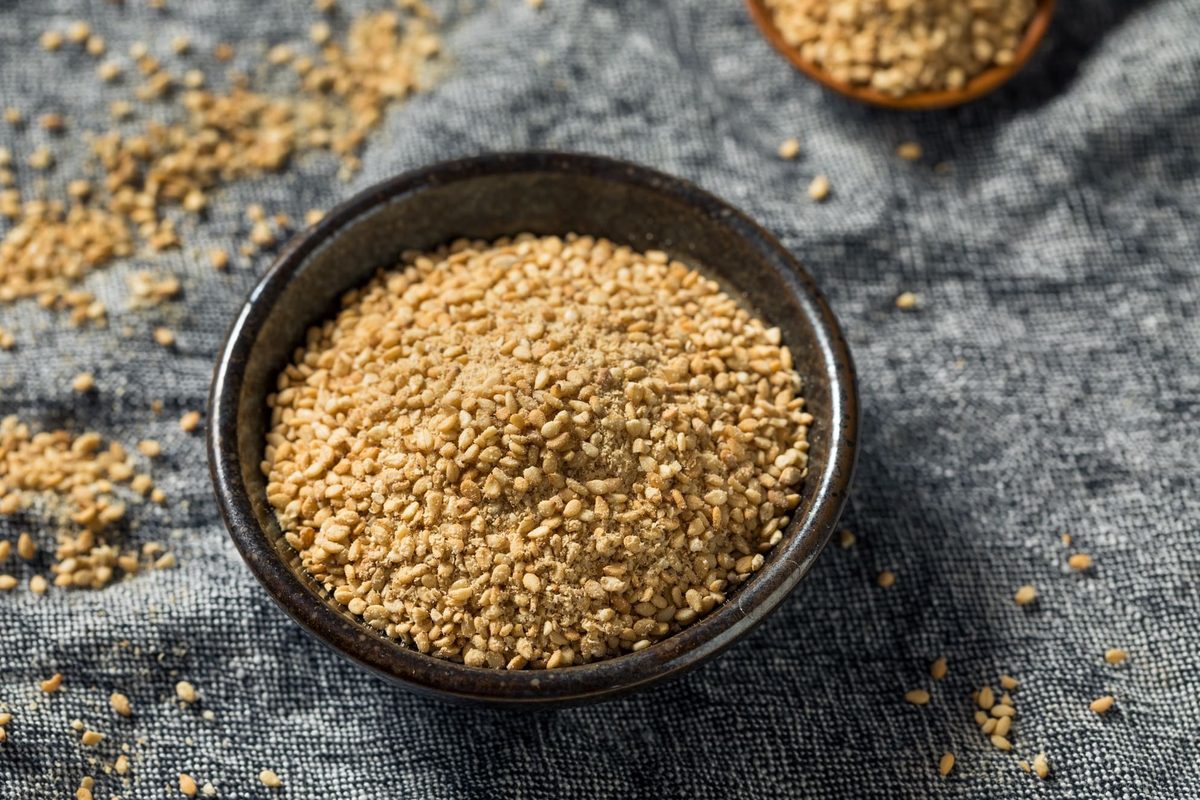
Gomasio, or gomashio (ごま塩, “sesame salt”), is toasted sesame seed and salt, and nothing else.12 Furikake is the wider family of dry Japanese rice seasonings it belongs to: Makiko Itoh of JustBento calls gomashio “the most basic furikake.”1 The furikake most people buy goes much further, with bonito flakes, nori, sugar and salt around the sesame.3 So the real difference is fish, seaweed and sugar, and what they do to the flavor and to who can eat it.
Side by side
| Gomasio | Furikake (common commercial style) | |
|---|---|---|
| What it is | Toasted sesame seeds and salt12 | A dry, flaky Japanese seasoning; the name means “sprinkle”3 |
| Core ingredients | Sesame and salt2 | Bonito flakes, toasted sesame seeds, nori seaweed, sugar and salt3 |
| Other versions | Recipes differ in ratio, grinding and how the salt is applied14 | Salmon flakes, dried baby shrimp, shiso, egg, wasabi or vegetables in some versions3 |
| Salt level | Usually 8:1 sesame to salt by weight in commercial gomashio, per Itoh; recipes range to 18:1 by volume (see below)14 | No sodium figure for a furikake product was found |
| Contains fish | No2 | Usually; bonito is in the common style3 |
| Origin | No dated origin found | Modern form traced to a Kumamoto pharmacist early in the Taisho era;5 Chen dates the current form to the early 20th century3 |
| Allergens | Sesame6 | Often fish, sesame and soy63 |
| Flavor (editorial) | Nutty, toasty, plainly salty | Salty, a little sweet, smoky and savory from bonito, oceanic from nori |
| Classic uses | Plain rice and the red-bean rice sekihan; Milk Street adds stir-fries and grilled foods17 | Plain rice, rice porridge, udon and onigiri3 |
| Homemade storage | About a month airtight, cool and dry (Itoh); a few weeks refrigerated (Milk Street)17 | 1 to 2 months with a silica gel packet, otherwise up to 2 weeks refrigerated (Chen); about a week refrigerated for Itoh’s noritama38 |
| Official standard | None found | None found; the USDA spice-blend specification does not include it9 |
| Price | No dated, sourced comparison found | No dated, sourced comparison found |
The flavor row is our description. For full profiles, see gomasio and furikake.
The differences that change a dish
What carries the flavor
In gomasio it is toasted sesame. Gernot Katzer reports that pyrazines dominate the flavor of sesame toasted under mild conditions (160 °C), and that some aroma compounds form only during toasting,2 which is why both published gomasio methods toast the seeds.14 Milk Street prefers unhulled seeds, which it describes as larger, plumper and nuttier;7 see hulled vs. unhulled sesame seeds.
In furikake the sesame shares the stage. In Itoh’s homemade noritama, the bonito flakes give most of the flavor and the egg yolk is there mainly for color.8 No published analysis of furikake’s flavor compounds was found, so the “savory” in the table above is our description, not a measurement.
Salt
Salt is half of gomasio’s job. The ratio is not fixed, and named sources disagree; the figures are shown, not averaged:
| Source | Sesame : salt | Basis |
|---|---|---|
| JustBento (Itoh), commercial gomashio | Usually 8 : 1 | Weight1 |
| JustBento, Itoh’s own recipe | 10 : 1 | Weight1 |
| Katzer’s Spice Pages | About 10% salt | Not stated2 |
| Gourmandelle, “traditional macrobiotic” | 18 : 1, or 10 : 1 for a saltier result | Volume4 |
Furikake’s salt varies by recipe and brand, and Itoh describes her noritama as lower in salt so it can be piled on rice.8 No sodium figure for a commercial furikake was found, so the two cannot be compared by number.
Gomasio is sometimes presented as a low-sodium alternative to salt. The SAGE encyclopedia entry on macrobiotics lists sesame salt among the sodium-rich foods of George Ohsawa’s diet, alongside soy sauce, miso and pickles.10 How much sodium either seasoning adds depends on how much you sprinkle.
Fish, seaweed and who can eat it
Gomasio is sesame and salt, so it contains no animal products.2 The common furikake style contains bonito, a fish.3 A plant-based furikake is not a contradiction, though: gomashio itself counts as one.1 Read the label.
The FDA lists fish, soybeans and sesame among the nine major food allergens.6 Gomasio carries one of them; a furikake with bonito and soy sauce can carry all three.38
Nori adds iodine. The NIH Office of Dietary Supplements gives 116 mcg, 77% of the Daily Value, for 2 tablespoons (5 g) of dried, flaked nori, and notes that iodine varies greatly among seaweed species.11 That figure is for nori alone, and no iodine measurement for furikake was found.
Where they come from
Furikake. According to the Kumamoto Nichinichi Shimbun, early in the Taisho era a pharmacist named Yoshimaru Suekichi set out to make up for calcium deficiency among Japanese people by grinding fish, bones and all, into a powder for rice.5 The product, Gohan no Tomo (“friend of rice”), is still made in Kumamoto, and the All Japan Furikake Association recognizes it as the originator of furikake.5 Namiko Hirasawa Chen notes records of a salty powdered condiment going back to the 12th century.3
Gomasio. No dated origin was found. Its best-documented place outside the everyday Japanese table is in macrobiotics: the SAGE entry traces the diet to Ishizuka Sagen (1850 to 1910), a Meiji-era army doctor, and to George Ohsawa (1893 to 1966), who later named the regimen.10 The same entry records Ohsawa’s claim that macrobiotics could cure all diseases in 10 days;10 that is history, not a supported claim.
Can one stand in for the other?
Both go on rice, so either will season a bowl. What changes is the flavor, and neither swap has a published ratio, so both are Method starting points, taken from our substitute pages.
- Gomasio in place of furikake. You keep the salt and toasted sesame and lose the bonito, nori and sugar. Our furikake substitutes page suggests starting with about half as much gomasio as furikake and tasting, because gomasio’s salt is not diluted by the other ingredients. Ratio (Method). In our judgment, crumbled nori over the rice brings back some of the sea flavor.
- Furikake in place of gomasio. It works on plain rice and onigiri, the same places gomasio goes,31 but the result is sweeter and tastes of fish and seaweed. Our gomasio substitutes page suggests the same amount, then tasting. Ratio (Method). It is not a fit for anyone avoiding fish.
- Making either. Gomasio takes minutes: Itoh dissolves the salt in water and toasts the seeds in that brine until they start to pop, and advises against grinding the seeds, because ground sesame releases oils that turn rancid quickly.1 Furikake recipes are longer; see the formulas on the furikake page.
What isn’t known
- No sodium figure for any commercial furikake was found, so salt cannot be compared by number.
- No dated origin for gomasio was found. Claims that it is centuries old could not be traced.
- No published ratio exists for swapping one for the other in either direction.
- No dated, sourced price comparison was found.
Related
- Gomasio and gomasio substitutes
- Furikake and furikake substitutes
- Sesame seeds, black sesame seeds, black vs. white sesame seeds
- Shichimi togarashi, another Japanese table seasoning with sesame
- Dukkah and dukkah substitutes
Footnotes
-
Makiko Itoh, “Homemade furikake no. 6: Gomashio, sesame salt”, JustBento. justbento.com · Publication ↩ ↩2 ↩3 ↩4 ↩5 ↩6 ↩7 ↩8 ↩9 ↩10 ↩11 ↩12 ↩13
-
Gernot Katzer, “Sesame (Sesamum indicum)”, Gernot Katzer’s Spice Pages. gernot-katzers-spice-pages.com · Reference work ↩ ↩2 ↩3 ↩4 ↩5 ↩6 ↩7
-
Namiko Hirasawa Chen, “Homemade Furikake (Rice Seasoning)”, Just One Cookbook. justonecookbook.com · Publication ↩ ↩2 ↩3 ↩4 ↩5 ↩6 ↩7 ↩8 ↩9 ↩10 ↩11 ↩12 ↩13
-
Ruxandra Niță, “How to Make Gomasio (Macrobiotic Sesame Salt)”, Gourmandelle. gourmandelle.com · Publication ↩ ↩2 ↩3 ↩4
-
“元祖に認定「御飯の友」”, Kumamoto Nichinichi Shimbun, 17 December 2017. kumanichi.com · Publication ↩ ↩2 ↩3
-
“Food Allergies”, U.S. Food and Drug Administration. fda.gov · Regulator ↩ ↩2 ↩3
-
“Sesame Salt (Gomasio)”, Christopher Kimball’s Milk Street. prod.177milkstreet.com · Publication ↩ ↩2 ↩3
-
Makiko Itoh, “Homemade furikake no. 3: Noritama”, JustBento. justbento.com · Publication ↩ ↩2 ↩3 ↩4
-
Commercial Item Description A-A-20001C, Spices and Spice Blends, USDA Agricultural Marketing Service, 2023. ams.usda.gov · Regulator ↩
-
Nancy Stalker, “Macrobiotics”, The SAGE Encyclopedia of Food Issues, SAGE Publications, 2015. sk.sagepub.com · Reference work ↩ ↩2 ↩3
-
“Iodine: Fact Sheet for Health Professionals”, NIH Office of Dietary Supplements. ods.od.nih.gov · Regulator ↩