Spice Substitutes · Substitutes
Garlic Chives Substitutes, Ranked by the Job They Are Doing
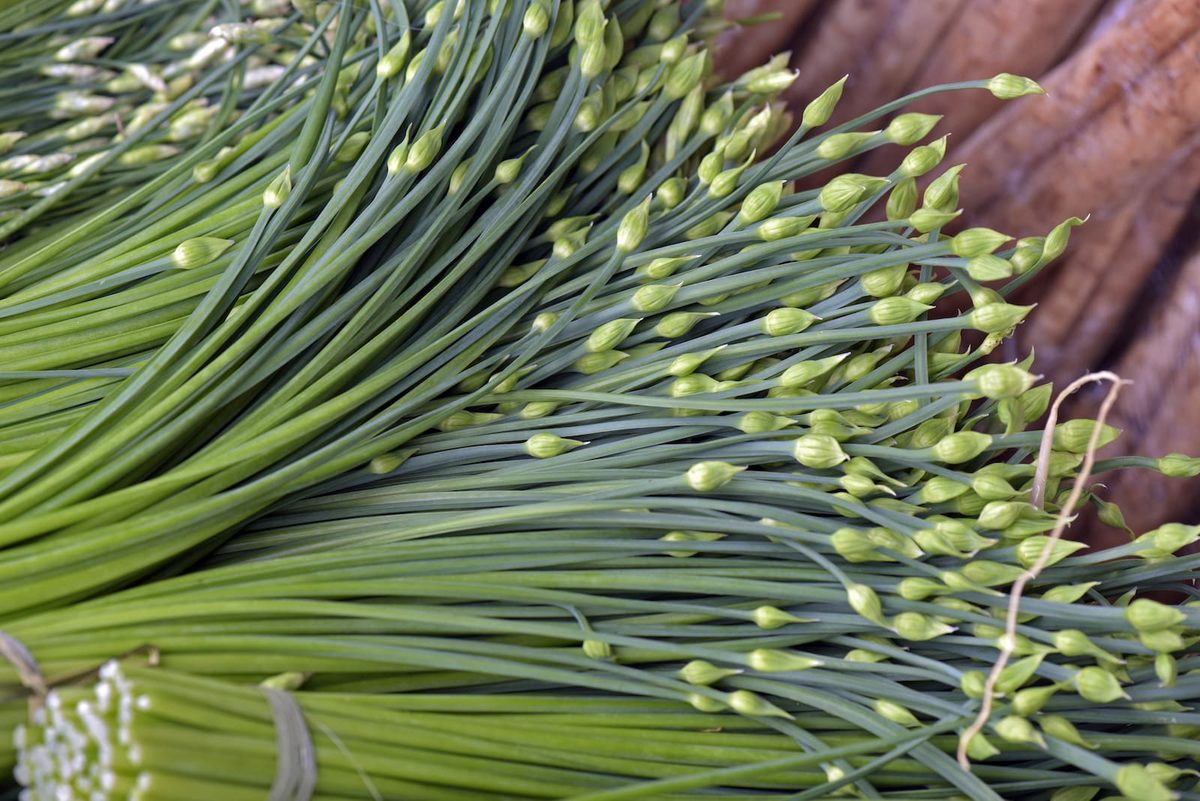
Garlic chives, also called Chinese chives, are Allium tuberosum, a perennial native from the Himalaya to China.12 PROSEA describes them as having a mild garlic taste and smell.2 A 2022 study of their aroma found 59 volatile compounds, with dimethyl trisulfide the most abundant and a garlic-and-onion odor dominating the profile.3 The Woks of Life calls them “more vegetal than herbal” and uses them more as a vegetable than as an herb, in stir-fries and dumpling fillings.4 That last point decides most substitutions: in Chinese cooking garlic chives are often a green vegetable, not a sprinkle.
Quick answer
| What garlic chives are doing | Best substitute | Starting amount | Treatment |
|---|---|---|---|
| A green vegetable in dumplings, stir-fries and savory pancakes | Scallion greens or regular chives, plus fresh garlic | Same volume of greens, plus 1 small clove per cup | Method |
| A raw garnish or finishing herb | Regular chives with a little grated garlic | Same volume of chives, a pinch of garlic | Method |
| A garlicky green note in eggs, noodles or stir-fries | Garlic scapes, thinly sliced | Same volume | Method |
| Spring soups, sauces and pestos | Wild garlic (ramsons) leaves | Same volume, then taste | Method |
No published ratio exists for any of these swaps, so every starting point on this page is a Method starting point. The rest of the page explains each choice.
How the ratios on this page are labeled
Every ratio carries one of four labels.
- Computed: based on a measurable physical relationship, with the source named.
- Attributed: a named source publishes this ratio. We quote it as theirs.
- Disputed: named sources give different answers to the same swap. We show each one and do not average them.
- Method: we found no published ratio. We give a direction and a cautious starting point, and say so.
If garlic chives are a green vegetable
In dumpling fillings, stir-fried with eggs or pork, or folded into savory pancakes, garlic chives supply both bulk and flavor. A substitute has to do both.
1. Scallion greens or regular chives, plus fresh garlic
Regular chives (Allium schoenoprasum) have a mild onion flavor,5 and the Woks of Life notes that garlic chives are flatter and wider than regular chives.4 The Spice House says that to mimic garlic chives you can blend regular chives with a small amount of fresh garlic.6 Scallions are the same idea with more body: The Spice House calls green onions the best substitute for chives.6
Ratio (Method): No source gives an amount. Replace the garlic chives with the same volume of chopped scallion greens or chives, then add one small clove of garlic, minced, per cup of greens. Taste the filling or stir-fry and add more garlic if the dish needs it. In a stir-fry, add the greens at the end so they stay bright, as you would garlic chives; that is kitchen judgment.
2. Other forms of garlic chives
The same plant is sold in more than one form. The Woks of Life describes garlic chive stems with unopened flower buds, which are seasonal and crunchier, and yellow chives, which have “the same basic flavor as green garlic chives, but with a milder delicate flavor.”4 Either can stand in for the green leaves.
Ratio (Method): No published ratio was found. Use the same amount; with yellow chives, expect a milder dish.
If garlic chives are a garnish or finishing herb
Here you need something tender to scatter over a dish at the end.
1. Regular chives with a little garlic
This is The Spice House’s suggestion again: regular chives, with a small amount of fresh garlic blended in.6 Chives are usually sprinkled on food just before serving,5 the same job garlic chives do as a garnish.
Ratio (Method): Use the same volume of chives. For a garnish, a whole clove is usually too much; start with a pinch of finely grated garlic per tablespoon of chopped chives, or a few drops of garlic juice squeezed from a press. That is our starting point, not a measurement.
If you want a firmer, garlicky green
1. Garlic scapes
Scapes are the flower stalks of hardneck garlic.7 UMaine says young chopped scapes give a mild garlic flavor,7 and Nebraska Extension calls them milder than garlic cloves and suggests stir-frying them.8 They are firmer and chewier than garlic chives, so in our judgment slice them thin and give them a minute longer in the pan. They are seasonal: May through July, per Nebraska, and more often at farmers markets than in grocery stores.8
Ratio (Method): No published ratio was found. Start with the same volume, sliced thin, and taste.
If you have wild garlic
Wild garlic, or ramsons, is Allium ursinum, native from western and central Europe to the Caucasus.9 Gernot Katzer describes its taste as similar to garlic, but less strong and with a hint of chives,10 which in our judgment puts it close to garlic chives in effect. A review of the plant lists its leaves eaten raw or cooked, and in soups, sauces and a kind of pesto.11 Katzer advises against boiling or simmering the leaves, since most of the aroma then perfumes the kitchen air rather than the food.10
Ratio (Method): No published ratio was found. Use the same volume of chopped leaves, added at the end of cooking, and taste.
Buy it or know what you are picking. In Germany, ramsons sold in food shops usually comes from controlled cultivation, according to the country’s Federal Institute for Risk Assessment (BfR).12 Foraging is where the danger lies. The BfR reports that poisonings from look-alike plants cluster in April and May and occur every season, some of them fatal; its main concerns are lily of the valley and autumn crocus.12 All parts of autumn crocus are rich in colchicine, a highly toxic alkaloid.10 The BfR’s advice is that, when in doubt, you should not eat ramsons you gathered yourself.12 See wild garlic for the details.
If all you have is garlic
Garlic cloves give the flavor without the green. In our judgment that is fine where garlic chives are a seasoning and a poor fit where they are the vegetable, as in a dumpling filling.
Ratio (Method): No published ratio was found. Start with one small clove, minced, for each cup of garlic chives the recipe calls for, and make up the lost bulk with another green vegetable, such as finely chopped napa cabbage or spinach.
What isn’t known
- No published ratio exists for replacing garlic chives with any other ingredient. All starting points above are ours.
- No study compares the aroma compounds of garlic chives with those of scallions, chives, scapes or ramsons, so we can’t say on chemical grounds which comes closest. The 2022 aroma study we cite was read in abstract only.
- It is sometimes said that shallots taste like garlic chives. No source reviewed here supports that.
Related
- Garlic chives and garlic chives vs. chives
- Chives, chives substitutes, chives vs. green onions
- Garlic scapes, garlic scapes substitutes, wild garlic
- Garlic, fresh garlic substitutes, garlic powder vs. garlic
Footnotes
-
Allium tuberosum Rottler ex Spreng., Plants of the World Online, Royal Botanic Gardens, Kew. powo.science.kew.org · Reference work ↩
-
Allium tuberosum (PROSEA), Plant Resources of South-East Asia. uses.plantnet-project.org · Reference work ↩ ↩2
-
Xie et al., Identification of Major Volatile Aroma-Active Compounds in Chinese Chive, Molecules, 2022 (abstract). doaj.org · Peer-reviewed ↩
-
Fresh Herbs & Aromatics Used in Chinese Cooking, The Woks of Life, 2025. thewoksoflife.com · Publication ↩ ↩2 ↩3
-
Susan Mahr, Chives, Allium schoenoprasum, University of Wisconsin-Madison Division of Extension. hort.extension.wisc.edu · Reference work ↩ ↩2
-
The 5 Best Substitutes for Chives, The Spice House. thespicehouse.com · Merchant ↩ ↩2 ↩3
-
David Fuller and Steven B. Johnson, Growing Hardneck Garlic in Your Maine Garden, University of Maine Cooperative Extension, 2013. projects.sare.org · Reference work ↩ ↩2
-
Garlic Scapes, Nebraska Extension. food.unl.edu · Reference work ↩ ↩2
-
Allium ursinum L., Plants of the World Online, Royal Botanic Gardens, Kew. powo.science.kew.org · Reference work ↩
-
Ramsons (Allium ursinum), Gernot Katzer’s Spice Pages. gernot-katzers-spice-pages.com · Reference work ↩ ↩2 ↩3
-
Sobolewska, Podolak and Makowska-Wąs, Allium ursinum: botanical, phytochemical and pharmacological overview, Phytochemistry Reviews, 2015. link.springer.com · Peer-reviewed ↩
-
Bärlauch: Verwechslungen führen häufig zu Vergiftungen, Bundesinstitut für Risikobewertung, 2023. bfr.bund.de · Regulator ↩ ↩2 ↩3