Blog · Storage
How to Dry Cilantro: Methods, Temperatures and What You Lose
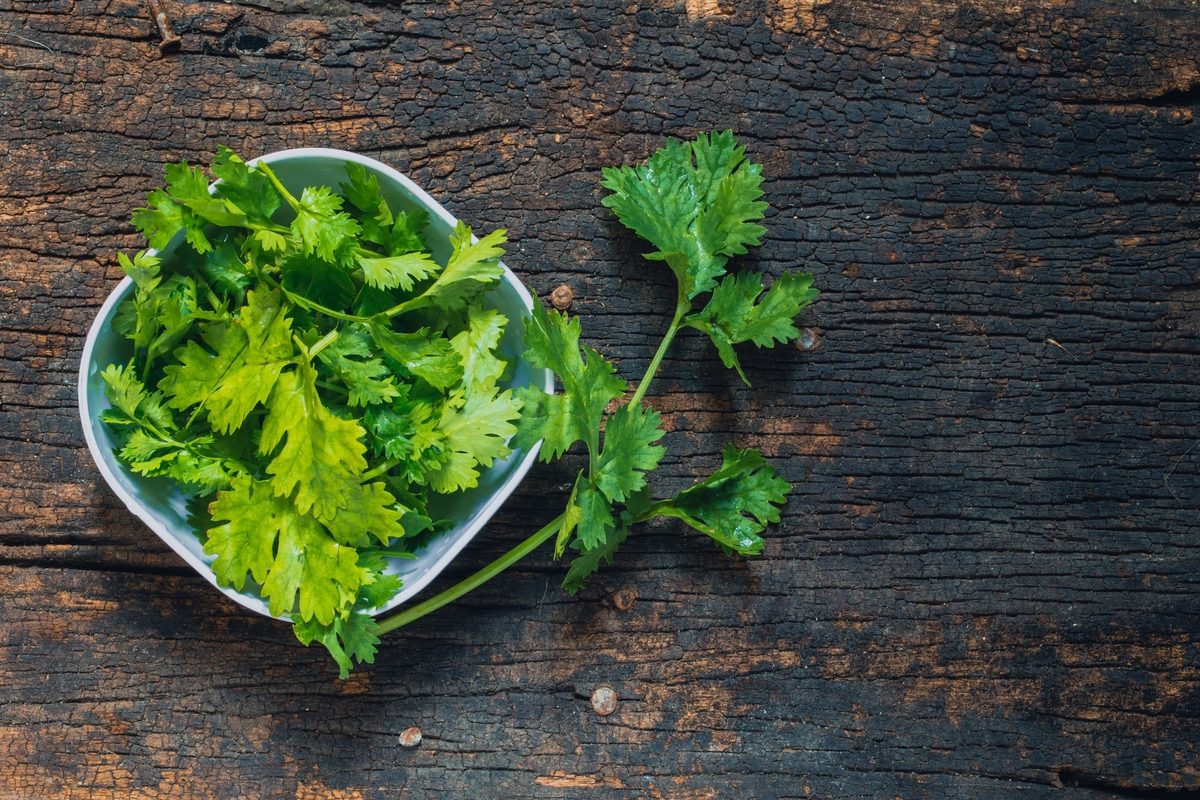
Cilantro is one of the herbs that lose the most when dried. America’s Test Kitchen lists it among the herbs that are much weaker in flavor once dried and better used fresh.1 The authors of the most detailed drying study we found make the same point: fresh, unprocessed leaves are the best source of cilantro’s aroma.2 Drying still has a place if you have more than you can use in the week cut cilantro keeps in the refrigerator,3 and are cooking soups, stews or rice rather than salsa. For a version that stays closer to fresh, see can you freeze cilantro?
At a glance
| Question | Short answer |
|---|---|
| Worth drying? | For cooked dishes only. Dried cilantro is much weaker than fresh.1 |
| Dehydrator | 95 to 115°F (35 to 46°C), up to 125°F in humid areas, 1 to 4 hours (NCHFP).4 Penn State says 95 to 110°F.5 |
| Air drying | Small bunches, low humidity, good airflow, out of the sun; up to a month.456 |
| Oven | Penn State: generally not recommended; if used, no hotter than 180°F (82°C), door open, 3 to 4 hours.5 |
| Microwave | Small amounts; sources disagree on time (table below). |
| Sun | Not recommended.47 |
| Done when | Leaves are crispy and crumble easily.5 |
| Keeps | Up to a year by Penn State’s general figure; up to 3 months for microwave-dried herbs by ATK’s.51 |
What the drying research shows
Łyczko and colleagues dried chopped cilantro leaves with hot air (convective drying) at different temperatures, with vacuum-microwave drying, and with combinations of the two, then tested the aroma chemically and with taste panels.2 The results run against the usual home advice that cilantro needs the lowest possible heat:
- Hot-air drying at 70°C (158°F), alone or followed by vacuum-microwave finishing, was the best of the methods tested for keeping cilantro’s aroma.2
- Vacuum-microwave drying on its own scored lowest.2
- Finishing with hot air at 50°C (122°F) lowered aroma quality.2
- Some hot-air-dried samples were described in terms such as “dry grass,” “hay-like” and “parsley-like.”2
Read these with their scope in mind. This was a laboratory dryer with controlled airflow, and vacuum-microwave drying is a commercial process, not a kitchen microwave. The study did not test a home dehydrator, an oven or air drying in a room, so it can’t tell you which home method is best. What it does show is that, in that dryer, the cooler setting was not the better one for cilantro, and that hot-air-dried cilantro picked up hay and dry-grass notes that fresh cilantro does not have.
Before you start
Rinse the cilantro in cool water, shake off the excess, and discard bruised or damaged leaves and stems.4 The NCHFP and Penn State both advise picking herbs for drying just before they flower;47 cilantro bolts quickly in hot weather, so cut before it does.3
Method 1: A food dehydrator
Spread the leaves in a single layer on the trays.4 Published settings are for leafy herbs in general:
| Source | Temperature | Time |
|---|---|---|
| National Center for Home Food Preservation (NCHFP)4 | 95 to 115°F (35 to 46°C); up to 125°F (52°C) in humid areas | 1 to 4 hours; check periodically |
| Penn State Extension5 | 95 to 110°F (35 to 43°C) | not given |
| Illinois Extension6 | follow the owner’s manual | not given |
Herbs are done when they crumble and stems break when bent.4 A common recommendation of 90 to 110°F for about five hours sits just outside the NCHFP’s range on both counts; we found no named source for it.
Method 2: Air drying
Penn State says air drying works only when humidity is low and air circulation is good, and that herbs should hang away from the sink, stove or dishwasher.5 Keep bunches small: the NCHFP warns that large amounts will mold.4 A paper bag punched with holes around each bunch keeps dust off, which is Penn State’s reason for it,5 and it also catches leaves that fall. Illinois Extension says air drying can take up to a month.6 We found no cilantro-specific time.
Method 3: The oven
Penn State says oven drying is generally not recommended; if you use it, set the lowest temperature, no higher than 180°F (82°C), and dry for 3 to 4 hours with the door open.5 Illinois Extension calls 90 to 110°F ideal, also for 3 to 4 hours, if your oven can hold it.6 A widely repeated figure of about 30 minutes in the oven has no named source behind it; both extension services give hours, not minutes.
Method 4: The microwave
The NCHFP calls the microwave a fast way to dry herbs when only small amounts are involved.4 The sources that give times disagree:
| Source | Method |
|---|---|
| Penn State Extension5 | Single layer between microwave-safe paper towels; high for 2 to 3 minutes per cup; start with 1 minute and mix every 30 seconds |
| Illinois Extension6 | Between two paper towels on high for 1 to 3 minutes; check every 30 seconds and turn the herbs |
| America’s Test Kitchen1 | 30 to 40 seconds |
Start short and check often. Penn State warns that a microwave rated 1,000 watts or more may heat too fast, and that with too little herb in the oven the paper towels can catch fire.5
Why not the sun
The NCHFP and Penn State both advise against sun drying herbs; the NCHFP says they lose flavor and color.47
Storing dried cilantro
Store the leaves whole in airtight containers in a cool, dry, dark place, away from the stove and sink; whole leaves hold their oils and flavor longer than crushed ones.5 Penn State says most dried herbs keep well for up to a year, Illinois says about a year, and ATK suggests up to 3 months for microwave-dried herbs.561 None of these figures was measured on cilantro. By common practice, if the leaves smell of little when crumbled, replace them.
Cooking with it
Dried cilantro belongs in cooked dishes. ATK warns that dried herbs used as a finishing touch can add an unpleasant texture,1 and recommends adding dried herbs at the point you would add fresh.1 For how much to use, see dried cilantro vs. fresh; for fresh alternatives in raw dishes, see cilantro substitutes.
Not yet measured
- How home methods (dehydrator, oven, air, kitchen microwave) compare for cilantro’s aroma.
- Cilantro-specific air-drying times.
- Shelf life of home-dried cilantro, measured on cilantro.
Related
- Cilantro
- Dried cilantro vs. fresh
- How to store cilantro
- Can you freeze cilantro?
- Cooking with cilantro
- Too much cilantro
- How to dry parsley
Footnotes
-
Danielle Lapierre, When You Should Actually Use Dried Herbs, America’s Test Kitchen, 2022. americastestkitchen.com · Publication ↩ ↩2 ↩3 ↩4 ↩5 ↩6 ↩7
-
Łyczko et al., Coriandrum sativum L.: Effect of Multiple Drying Techniques on Volatile and Sensory Profile, Foods, 2021. mdpi.com · Peer-reviewed ↩ ↩2 ↩3 ↩4 ↩5 ↩6
-
Susan Mahr, Cilantro, Wisconsin Master Gardener Program, 2017. mastergardener.extension.wisc.edu · Reference work ↩ ↩2
-
Drying Herbs, National Center for Home Food Preservation. nchfp.uga.edu · Reference work ↩ ↩2 ↩3 ↩4 ↩5 ↩6 ↩7 ↩8 ↩9 ↩10 ↩11
-
Zepp, Hirneisen and LaBorde, Let’s Preserve: Drying Herbs, Penn State Extension, 2023. extension.psu.edu · Reference work ↩ ↩2 ↩3 ↩4 ↩5 ↩6 ↩7 ↩8 ↩9 ↩10 ↩11 ↩12 ↩13
-
Herb Gardening: Preserving, University of Illinois Extension. extension.illinois.edu · Reference work ↩ ↩2 ↩3 ↩4 ↩5 ↩6
-
Stacy Reed, Preserving Herbs by Drying, Penn State Extension, 2024. extension.psu.edu · Reference work ↩ ↩2 ↩3