Blog · Storage
How to Dry Parsley: Microwave, Air, Dehydrator and Oven
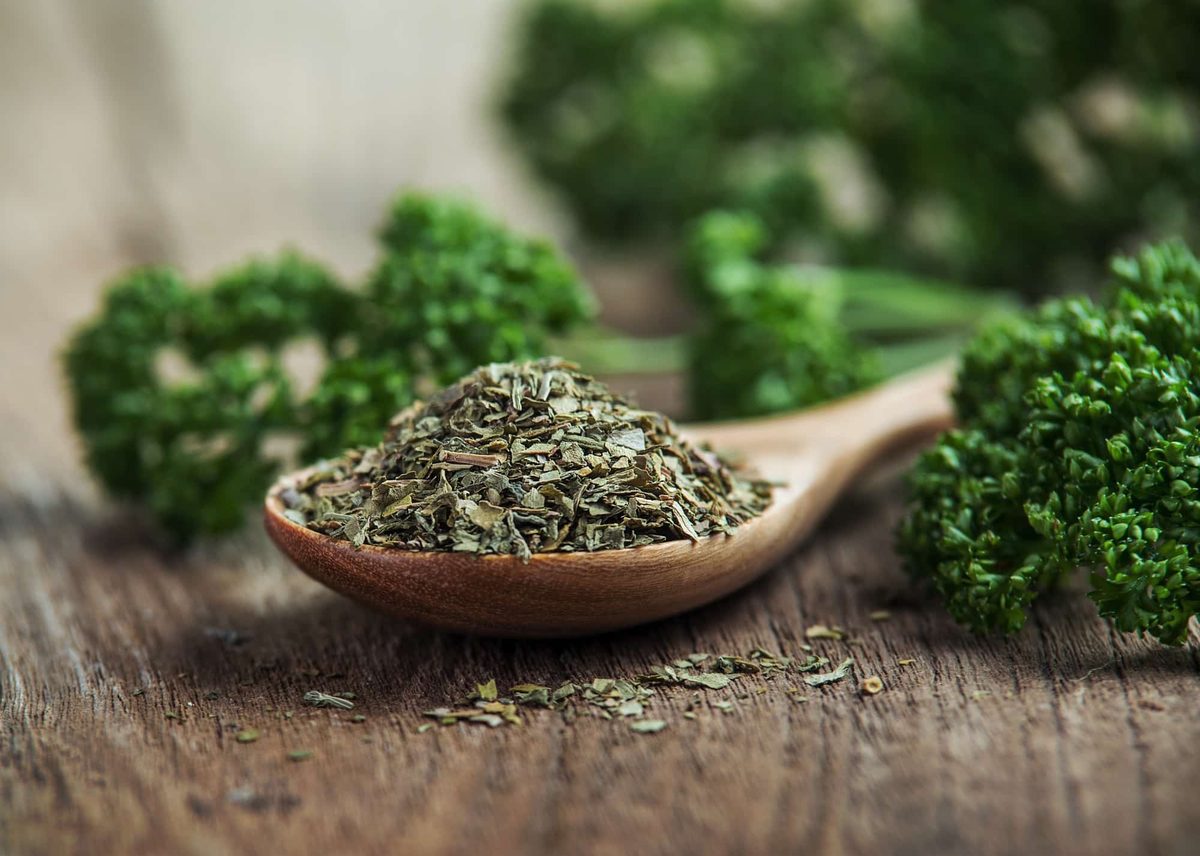
Parsley is one of the easiest herbs to dry. NCHFP, Oregon State and the University of Tennessee all put it among the sturdy herbs that dry easily without a dehydrator,123 and it is one of the few herbs the guides single out as suited to the microwave.23 Expect a milder result than the fresh herb: America’s Test Kitchen puts parsley among the herbs better used fresh, because delicate herbs are much weaker in flavor once dried.4 Home-dried parsley is still useful for color and a green note in soups, sauces and dressings (editorial). The settings below come from university extension guides; where they disagree, the disagreement is shown rather than averaged.
At a glance
| Method | Settings from named sources | Time | Notes |
|---|---|---|---|
| Air-drying | Small bundles hung at 70–80°F in a dry, ventilated spot out of direct sun5 | Generally 2–4 weeks for sturdy herbs5 | Parsley air-dries easily1 |
| Dehydrator | 95–115°F, up to 125°F where humid1; Penn State says 95–110°F6 | 1–4 hours1 | Most control |
| Microwave | On high, from 30 seconds to 3 minutes depending on the source (table below) | Minutes | Works well for parsley in lower-wattage ovens3 |
| Oven | Lowest setting, not above 180°F, door open6 | 3–4 hours6 | Or overnight with only the oven light on1 |
| Sun | Not recommended612 | Costs color and flavor1 |
Before you start
The extension guides agree on timing: the best point to harvest most herbs for drying is just before the flowers first open,12 picked in the early morning once the dew has evaporated.2 Oregon State adds that cut herbs should not lie in the sun or sit unattended after harvest.2
Rinse the stems in cool water and shake off the excess,61 then remove all visible water with towels or paper towels.5 A widely repeated claim says rinsing rids herbs of pathogens; the extension guides present it as cleaning and make no such claim.
Air-drying
Air-drying is the easiest and cheapest method.5 Parsley is not named in the University of Wisconsin’s guide, but its method for sturdy herbs applies: tie washed branches into small bundles of 5–6 stems and hang them upside down in a warm (70–80°F), dry, well-ventilated place out of direct sunlight until the moisture has gone, generally 2–4 weeks.5 Keep the bundles small, because the University of Tennessee warns that herbs in bundles that are too large will mold.3
Penn State says to keep drying herbs away from the sink, stove and dishwasher, where the air is moist.6 Oregon State suggests an attic, a kitchen or any warm place with air circulation,2 and NCHFP says drying indoors usually gives better color and flavor than drying outdoors.1 A paper bag punched with holes keeps the dust off,6 as long as it is big enough that the leaves don’t touch its sides.5
Microwave
Parsley is where the microwave earns its place. Oregon State lists parsley first among the herbs commonly dried this way,2 and the University of Tennessee says parsley dries well in microwaves of lower wattage, under 1,000 watts.3 The guides do not agree on the timing:
| Source | Amount | Time on high | Method |
|---|---|---|---|
| Penn State6 | Per cup | 2–3 minutes | Start with 1 minute, mix every 30 seconds, keep checking |
| University of Tennessee3 | Per cup | 2–3 minutes | Start with 1 minute, mix every 30 seconds |
| Oregon State2 | 1 cup (never more than 1–2 cups) | 1–2 minutes | Stir every 30 seconds after the first minute until almost dry, then finish at room temperature |
| University of Wisconsin5 | 4 or 5 branches between paper towels | 2–3 minutes | Another 30 seconds if not brittle |
| America’s Test Kitchen4 | Not stated, on a paper towel | 30–40 seconds | Crumble and store |
As a starting point (Method), give a cup of leaves one minute, then 30-second rounds, stirring between them, until the leaves crumble. Tennessee’s wattage note is the only one in the guides; none gives times by wattage.
Two safety points apply whatever the timing. Penn State warns that if the load is too small, the paper towels can catch fire,6 and Oregon State says not to use paper towels made from recycled paper, which can contain metal scraps that arc.2 The Wisconsin guidance calls the microwave a last resort that cooks the herbs and gives very poor quality, and notes that the heat drives off some of the oils along with the water, so microwaved herbs may taste less intense than herbs dried other ways.5
Dehydrator
NCHFP’s instructions are to preheat with the thermostat at 95–115°F, going as high as 125°F where humidity is high, and to expect 1–4 hours, checking periodically.1 Penn State’s range tops out lower, at 110°F.6 Spread the sprigs in a single layer and start checking at the one-hour mark (common practice). Because the temperature is set and held, there is less risk of scorching than in an oven or microwave (editorial).
Oven
An oven works only if it can run cool. Penn State’s method is the lowest temperature, not above 180°F, for 3 to 4 hours with the door open,6 and the Wisconsin guide gives the same figures, with the herbs in a single layer and stirred now and then.5 Oregon State warns that drying herbs at too high a temperature can cause flavor loss.2 An hour at 200°F followed by an hour in the cooling oven, a method that circulates widely, appears in none of the extension guides we checked.
If your oven can’t hold 180°F or lower, use the cool-oven method. Lay leaves on a paper towel so they don’t touch, cover with another towel and another layer of leaves, and repeat for up to five layers. Leave them overnight in an oven warmed only by the light of an electric oven or the pilot light of a gas one.13
Why not the sun?
Drying parsley outdoors on a tray in the sun is often suggested. The extension guides that address it advise against it: NCHFP and Oregon State say sun-drying affects the herb’s color and flavor,12 and Penn State adds that in a humid climate like Pennsylvania’s, moisture can’t be removed quickly enough.6
Where the guides disagree
| Question | What named sources say |
|---|---|
| Dehydrator temperature | 95–115°F, up to 125°F where humidity is high (NCHFP, Tennessee, Oregon State)123; 95–110°F (Penn State)6 |
| Air-drying time | Generally 2–4 weeks for sturdy herbs hung in bundles (Wisconsin)5; usually 5–10 days for tender herbs hung in small bunches inside bags (Oregon State)2 |
| Microwave time | From 30–40 seconds (America’s Test Kitchen) to 2–3 minutes per cup (Penn State, Tennessee); see the table above |
| Oven | Lowest setting up to 180°F with the door open for 3–4 hours (Penn State, Wisconsin)65; or no heat but the oven light or pilot light, overnight (NCHFP, Tennessee)13 |
None of these was tested side by side on the same herb, so we have not picked a winner. Where a range is given, starting low and checking often is the cautious reading (Method).
What drying does to parsley
A 2005 study in the Polish Journal of Food and Nutrition Sciences dried parsley leaves from 87–90% water down to 4–6%, in a heat-pump dryer at 45 and 55°C and a cabinet dryer at 55 and 65°C.7 It found 15 volatile compounds in the fresh leaves, led by 1,3,8-p-menthatriene, pinene, myrcene, phellandrene and apiole, and both dryers left fewer volatile compounds as the temperature rose.7 The abstract reports no significant difference in the sensory tests but does not say which samples were compared.7 Those temperatures run from 113°F to 149°F, so the study’s coolest settings overlap the top of the dehydrator range above, and its hottest go beyond it; that is arithmetic, not a finding of the study.
The practical reading is the one the extension guides already give: keep the heat low.2
How to tell it’s done
Herbs are dry when the leaves are crisp and crumble easily between the fingers6 and the stems break when bent.1 Oregon State adds that the leaves should fall from the stems.2 Strip the leaves and discard the stems.5
Check your work after packing. The Wisconsin guidance is to watch the filled containers for a couple of days; if you see any moisture, take the herbs out and dry them longer.5
Air-dried herbs can carry insects. The University of Tennessee says air-dried herbs and seeds need treating to kill insects and their eggs, either by heating at 160°F for 30 minutes or by freezing at 0°F or lower for at least 48 hours, and it recommends freezing for better flavor.3
Storing dried parsley
Keep the leaves whole and crumble them as you cook; Penn State says storing herbs whole is preferred.8 Use airtight containers in a cool, dry, dark place,1 away from the stove and sink.6 Oregon State adds that dried herbs can also go into airtight containers in the freezer.2
How long dried parsley keeps depends on whom you ask, and none of these figures was measured on parsley:
| Source | Scope | Figure |
|---|---|---|
| Penn State6 | Most home-dried herbs | Keep well for up to a year |
| Oregon State2 | Home-dried herbs | Up to one year; for best flavor, use within six months to a year |
| University of Wisconsin5 | Home-dried herbs | Keep for years, but use within a year for best flavor |
| America’s Test Kitchen4 | Herbs dried in the microwave by its method | Up to 3 months, airtight |
| McCormick9 | Leafy dried herbs, a spice company’s own guidance | 1–3 years |
We have not averaged these. McCormick defines shelf life as how long spices stay most aromatic,9 which is the right way to read every figure here: a quality window, not a safety date. The practical test is smell. Crush a pinch, and if the aroma is faint, the parsley has faded.
Herbs in oil are a separate food-safety question. A 2011 review of home-prepared vegetables and herbs stored in oil advises refrigerating them and using them within four days or discarding them, and calls freezing the safest option.10
Not yet measured
- How home drying methods (air, microwave, dehydrator) compare for parsley flavor.
- How long home-dried parsley keeps, measured on parsley rather than herbs in general.
- Microwave times for parsley by oven wattage, beyond Tennessee’s under-1,000-watt note.
Related
- Parsley
- Fresh parsley vs. dried
- How to store parsley
- Can you freeze parsley?
- Parsley substitutes
- Italian parsley vs. curly parsley
- Dried herbs vs. fresh
- How to rehydrate herbs
Footnotes
-
Herbs (drying), National Center for Home Food Preservation. nchfp.uga.edu · Reference work ↩ ↩2 ↩3 ↩4 ↩5 ↩6 ↩7 ↩8 ↩9 ↩10 ↩11 ↩12 ↩13 ↩14 ↩15 ↩16 ↩17
-
Drying herbs (SP 50-921), Oregon State University Extension Service. extension.oregonstate.edu · Reference work ↩ ↩2 ↩3 ↩4 ↩5 ↩6 ↩7 ↩8 ↩9 ↩10 ↩11 ↩12 ↩13 ↩14 ↩15 ↩16 ↩17 ↩18
-
Drying Herbs, University of Tennessee Extension. lawrence.tennessee.edu · Reference work ↩ ↩2 ↩3 ↩4 ↩5 ↩6 ↩7 ↩8 ↩9 ↩10
-
When You Should Actually Use Dried Herbs, America’s Test Kitchen. americastestkitchen.com · Publication ↩ ↩2 ↩3
-
Drying Herbs, Wisconsin Master Gardener Program, University of Wisconsin-Madison. mastergardener.extension.wisc.edu · Reference work ↩ ↩2 ↩3 ↩4 ↩5 ↩6 ↩7 ↩8 ↩9 ↩10 ↩11 ↩12 ↩13 ↩14
-
Let’s Preserve: Drying Herbs, Penn State Extension. extension.psu.edu · Reference work ↩ ↩2 ↩3 ↩4 ↩5 ↩6 ↩7 ↩8 ↩9 ↩10 ↩11 ↩12 ↩13 ↩14 ↩15 ↩16 ↩17
-
Preservation of flavour components in parsley by heat pump and cabinet drying, Polish Journal of Food and Nutrition Sciences, 2005 (abstract). journal.pan.olsztyn.pl · Peer-reviewed ↩ ↩2 ↩3
-
Preserving Herbs by Drying, Penn State Extension. extension.psu.edu · Reference work ↩
-
How Long Do Spices Last?, McCormick. mccormick.com · Merchant ↩ ↩2
-
Nummer et al., Food Protection Trends, 2011. foodprotection.org · Peer-reviewed ↩