Cooking · Cooking with
Cooking With Cilantro: Washing, Stems, Timing and How Much to Use
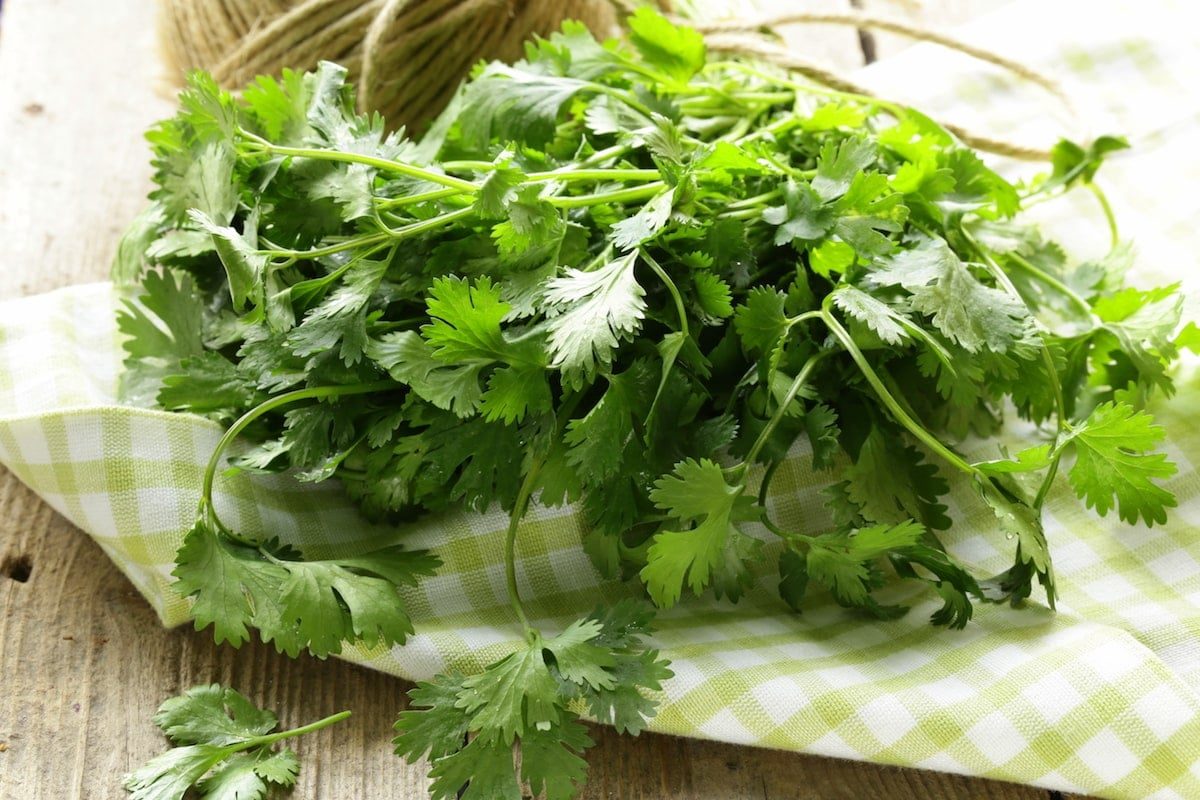
Cilantro is the leaf of Coriandrum sativum, the same plant that gives the spice coriander. Britannica notes the young leaves are widely used in Latin American, Indian and Chinese dishes.1 It is at its best raw or barely heated, and it is one of the few herbs that a sizable share of people actively dislike. This page covers the kitchen side: washing, which parts to use, when to add it, how much, and what it goes in. For the plant and its chemistry, see the cilantro profile.
Quick guide
| Do | Why, per the sources |
|---|---|
| Use it raw or add it at the end | Flavor drops with heat (NDSU); add at the very end (Wisconsin); a minute or two before cooking ends (LSU)234 |
| Use the stems | Similar in flavor to the leaves but more potent (ATK)5 |
| Rinse gently, then dry well | Illinois Extension’s pico de gallo recipe says to rub produce under cool running water; ATK dries delicate herbs in a towel-lined salad spinner67 |
| Use it in quantity | A cup of leaves to six tomatoes in Illinois Extension’s pico de gallo6 |
| Prefer fresh to dried | ATK lists cilantro among herbs that are better fresh8 |
Washing
Bunches of cilantro can carry grit between the stems, so most cooks rinse them; that is common practice. Illinois Extension’s pico de gallo recipe simply says to rub produce gently under cool running water.6 UMass Extension, writing about herbs headed for the freezer, suggests washing gently and only if needed, since water can carry away some of the herb’s oils.9 Dry the leaves before chopping: America’s Test Kitchen spins delicate herbs in a salad spinner lined with paper towels.7 Wet leaves clump on the knife and turn to paste more easily, which is kitchen judgment rather than a tested finding.
Food safety is a separate matter from grit. The FDA has had an import alert on fresh cilantro from Puebla, Mexico, after recurring cyclosporiasis outbreaks between 2012 and 2015, applied to shipments offered from April 1 through August 31 each year.10
Use the stems
The tender upper stems are worth keeping. America’s Test Kitchen notes that the leaves and stems are both widely used in Asian and South American cooking, and its tasting notes describe the stems as similar in flavor to the leaves but more potent.5 Chop them finely with the leaves for salsas, chutneys and green sauces, or use them in a cooked base where the leaves would wilt to nothing. Thick, woody stems at the bottom of the bunch are the ones to trim, as a matter of texture.
PROSEA places cilantro’s aroma compounds in the roots, stems and leaves, and notes that the taproots are eaten as a vegetable in China and Thailand.11 If you can find bunches with roots attached, they are usable too.
When to add it
Heat is the main thing to manage. NDSU Extension says cilantro’s flavor decreases when it is exposed to heat or dried.2 LSU AgCenter puts cilantro among the delicate herbs that should go in a minute or two before cooking ends, or be sprinkled on just before serving.4 Wisconsin Extension advises adding it at the very end to prevent overcooking.3
In practice: stir it into a curry or soup off the heat, scatter it over tacos and rice at the table, and fold it into raw salsas and salads. The stems can go in a little earlier than the leaves in a cooked dish; that is common practice, not a measured result.
How much to use
Cilantro is often used by the handful rather than the pinch. PROSEA describes the leaves, and whole young plants, as popular both as a herb and as a vegetable.11
Amount (Attributed): Illinois Extension’s pico de gallo uses 1 cup of chopped fresh cilantro leaves with 6 Roma tomatoes, 1 medium onion, 1 tablespoon of lime juice and 1/4 teaspoon of salt, with an optional green chile or jalapeño.6 That is a generous share of herb, and a useful benchmark for raw salsas.
For cooked dishes there is no standard amount. A Method starting point: for a pot of curry, dal or soup serving four, finish with a small handful (a few tablespoons, chopped) and add more at the table. Cooks who find cilantro soapy will want less or none (see below).
What to cook with it
- Mexican and Latin American food. Wisconsin Extension notes cilantro is often added to Mexican salsas and meat dishes.3 Pico de gallo, guacamole and taco toppings are the familiar uses; the last two are common practice.
- Indian and Arabic cooking. Wisconsin Extension says Arabic cooking uses both the leaves and the seeds in pickles, curries and chutneys.3 PROSEA lists chutneys and soups among the leaf’s uses.11 In Indian cooking it is a standard finishing herb for curries and dals by common practice.
- Chinese and Southeast Asian food. Britannica includes Chinese dishes,1 and PROSEA notes the roots are eaten as a vegetable in China and Thailand.11
When cilantro tastes like soap
Some people find cilantro soapy, and that is partly genetic. A study of 14,604 people of European ancestry who reported whether cilantro tasted soapy found a variant near a cluster of smell-receptor genes that includes one, OR6A2, that binds several of cilantro’s aldehydes. The share of the trait explained by common genetic variants was low, about 0.087.12 If you are cooking for a group, serving cilantro on the side is the easy answer. For fixes when a dish has too much, see too much cilantro.
Fresh, dried and frozen
America’s Test Kitchen lists cilantro among the herbs that are better fresh, because these delicate herbs are much weaker in flavor once dried.8 NDSU says the same about drying.2 Freezing does better: UMass Extension names cilantro among the herbs for which freezing keeps the best flavor.9 See dried vs. fresh cilantro, can you freeze cilantro and how to dry cilantro.
Keeping it fresh until you cook
Wisconsin Extension says cut leaves keep in the refrigerator for about a week,3 and NDSU suggests wrapping the fresh leaves loosely in a slightly damp paper towel.2 For the full comparison of jars, bags and towels, see how to store cilantro.
Related pages
- Cilantro substitutes
- Coriander vs. cilantro, cilantro vs. parsley, basil vs. cilantro, culantro vs. cilantro
- Cooking with coriander for the seeds
Footnotes
-
“Coriander”, Encyclopaedia Britannica. britannica.com · Reference work ↩ ↩2
-
“Field to Fork: Cilantro” (FN1933), NDSU Extension. ag.ndsu.edu · Reference work ↩ ↩2 ↩3 ↩4
-
Susan Mahr, “Cilantro”, Wisconsin Master Gardener Program, University of Wisconsin-Madison Extension, 2017. mastergardener.extension.wisc.edu · Reference work ↩ ↩2 ↩3 ↩4 ↩5
-
“Flavorful Herbs”, LSU AgCenter. lsuagcenter.com · Reference work ↩ ↩2
-
“Can You Eat Cilantro Stems?”, America’s Test Kitchen. americastestkitchen.com · Publication ↩ ↩2
-
“Pico de Gallo”, University of Illinois Extension, Eat. Move. Save. eat-move-save.extension.illinois.edu · Reference work ↩ ↩2 ↩3 ↩4
-
Liz Bomze, “Our Guide to Fresh Herbs”, America’s Test Kitchen, 2019. americastestkitchen.com · Publication ↩ ↩2
-
Danielle Lapierre, “When You Should Actually Use Dried Herbs (and Which Ones to Avoid)”, America’s Test Kitchen, 2022. americastestkitchen.com · Publication ↩ ↩2
-
Jodie Gilson, “Herb Preservation”, UMass Amherst Extension. umass.edu · Reference work ↩ ↩2
-
Import Alert 24-23, U.S. Food and Drug Administration. accessdata.fda.gov · Regulator ↩
-
Coriandrum sativum, Plant Resources of South-East Asia (PROSEA). uses.plantnet-project.org · Reference work ↩ ↩2 ↩3 ↩4
-
Eriksson et al., “A genetic variant near olfactory receptor genes influences cilantro preference”, Flavour, 2012. link.springer.com · Peer-reviewed ↩