Blog · Storage
How to Store Coriander Seed: Whole vs Ground, Containers and Shelf Life
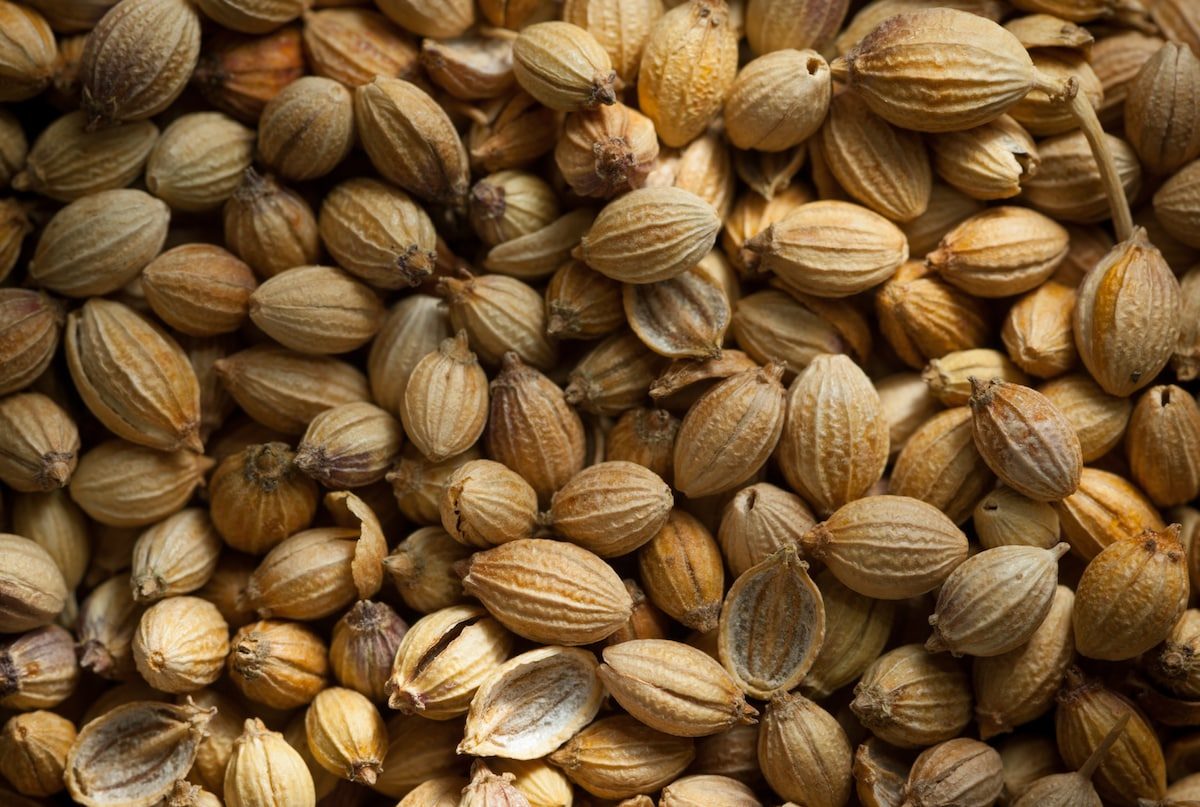
Coriander, the spice, is the dried fruit of Coriandrum sativum, sold whole as round seeds or ground to a powder.1 The fresh leaves of the same plant are cilantro, and they store completely differently: see how to store cilantro. For the seed, storage is about keeping its aromatic oil in and keeping moisture out. Whole seed does both far better than ground.
At a glance
| Question | Short answer |
|---|---|
| Whole or ground? | Whole. PROSEA says dried fruits stored dry keep their oil for several years, but crushed seed loses it quickly.1 |
| Container | Tightly closed and airtight.23 For ground coriander, the barrier the container gives matters (see the packaging study below).4 |
| Where | Cool, dry and dark, not above the stove, dishwasher, microwave or refrigerator.23 |
| Fridge or freezer? | Not needed. If you do, use airtight jars and let them warm before opening so condensation does not form.3 |
| How long | Named sources disagree: see the table below. None of their figures were measured on coriander. |
| Faded? | Crush a few seeds and smell them. Strong aroma means it is still potent.2 |
Why whole seed keeps longer
Coriander seed oil is dominated by linalool.1 PROSEA, the Southeast Asian plant-resources handbook, says thoroughly dried fruits stored dry “will maintain the essential oil for several years without loss,” and that the oil disappears quickly once the fruits are crushed.1 Oregon State University Extension makes the general point for herbs and seeds: crushing or grinding them for storage increases the loss of aroma and flavor.5 Penn State Extension gives the same reason for storing herbs whole: whole, they hold their oil longer.3
The practical upshot is common kitchen practice: buy whole coriander and grind only what a recipe needs.
How long coriander lasts: what named sources say
Figures such as “whole coriander keeps a year, ground keeps two to six months” circulate without a traceable source. Here is what named sources say, with the scope of each.
| Source | What it covers | Whole | Ground |
|---|---|---|---|
| UC Cooperative Extension, 20022 | Spices in general, home storage | 2 years | 1 year |
| America’s Test Kitchen6 | Spices in general, home storage | 2 years | 1 year |
| McCormick7 | Spices in general; a spice company’s own guidance | 3–4 years | 2–4 years |
| PROSEA1 | Coriander fruits, thoroughly dried and stored dry | several years without oil loss | loses oil quickly |
| Rahman et al., 20074 | Ground coriander in three packaging films, room temperature, Bangladesh | not tested | strong flavor to 12 months in laminated aluminum foil; flavor unchanged to 2 months in polypropylene, 6 in HDPE |
These do not agree, and we have not averaged them. McCormick defines shelf life as how long spices stay “most aromatic and delicious for cooking,” so read every figure here as a quality window, not a safety date.7
Two coriander storage studies
Ground coriander and packaging. Rahman and colleagues sealed ground coriander in three films (laminated aluminum foil, high-density polyethylene and polypropylene), kept the bags at room temperature for a year and tested them every two months. Flavor held up to two months in polypropylene and six in HDPE, while the foil-laminate bags kept a strong flavor through 12 months.4 The authors tied the decline to the powder absorbing moisture during storage, and found that rising water activity made the sensory qualities worse.4 That is one lot of powder in one climate, and the study did not measure volatile oil, but it shows the point clearly: ground coriander needs a container that keeps water vapor out. At home, a jar with a tight lid does that job better than a thin plastic bag (editorial).
Whole seed over a year. An Egyptian study stored dry coriander seeds in carton bags in a dry place at room temperature for a year.8 The oil content of the seed did not fall (0.31% at harvest, 0.35% after a year), but the oil’s makeup changed: linalool dropped from 59.6% of the oil at harvest to 47.69% after a year of room-temperature storage.8 Oil distilled at harvest and kept in the refrigerator held its linalool at 59.28%.8 Note the scope: the refrigerated sample was extracted oil, not seed, so this is not a test of refrigerating coriander seed. It does show that a year in a bag at room temperature changes the aroma even when the oil content holds.
What degrades coriander
UC Cooperative Extension lists air, light, moisture and heat as the four things that speed flavor and color loss in herbs and spices.2 McCormick singles out repeated heat as “an enemy of spice longevity, whole and ground.”7
- Heat. Keep coriander away from the stove, dishwasher, microwave and the top of the refrigerator.2 A widely repeated rule says to keep spices below 70°F. We could not trace that figure to a source, so we leave it as a rule of thumb, not a threshold.
- Moisture. The packaging study above links flavor loss in ground coriander to moisture uptake.4 UC Extension also advises against sprinkling a spice straight from its container over a steaming pot; use a dry spoon instead.2
- Light. Store spices in a dark place away from sunlight.2 We found no study measuring light damage to coriander specifically, so the claim that light “photodegrades” coriander is not repeated here.
Should you refrigerate or freeze coriander?
You don’t need to. Penn State Extension says dried herbs can be kept in the refrigerator or freezer in freezer jars or heavy-duty foil, and warns that moving them from the cold to a warm room can cause condensation that the herbs absorb.3 Oregon State also allows airtight containers in the freezer for dried herbs.5 UC Extension recommends refrigeration only for paprika, chili powder and red pepper, for color.2
If you buy coriander in bulk, one approach that follows from the condensation warning is to keep the main supply sealed in the freezer and refill a small jar for everyday use, letting the cold container come to room temperature before you open it. That is a practical suggestion, not a tested method.
How to tell coriander has faded
Crush a few seeds, or rub a pinch of the powder, and smell it. UC Extension’s rule is that if it smells strong and flavorful, it is probably still potent.2 America’s Test Kitchen says to restock when aroma and color have faded.6 Faded coriander is not unsafe; it just gives the dish less. If you compensate by adding more, see too much coriander before you overshoot.
Not yet measured
- Home shelf life of whole or ground coriander, measured on coriander rather than spices in general.
- Whether refrigerating or freezing coriander seed slows aroma loss.
- How light affects stored coriander.
Related
- Coriander
- Cooking with coriander
- Coriander vs. cilantro
- Dried coriander vs. fresh
- Coriander substitutes
- Do spices go bad?
- Containers for spices
Footnotes
-
Coriandrum sativum, Plant Resources of South-East Asia (PROSEA). uses.plantnet-project.org · Reference work ↩ ↩2 ↩3 ↩4 ↩5
-
Add a Little Spice to Your Life! Part II, University of California Cooperative Extension. ucanr.edu · Reference work ↩ ↩2 ↩3 ↩4 ↩5 ↩6 ↩7 ↩8 ↩9 ↩10
-
Preserving Herbs by Drying, Penn State Extension. extension.psu.edu · Reference work ↩ ↩2 ↩3 ↩4 ↩5
-
Rahman et al., Bangladesh Journal of Scientific and Industrial Research, 2007. banglajol.info · Peer-reviewed ↩ ↩2 ↩3 ↩4 ↩5
-
Drying Herbs, Oregon State University Extension Service. extension.oregonstate.edu · Reference work ↩ ↩2
-
Keeping Spices and Dried Herbs Fresher Longer, America’s Test Kitchen. americastestkitchen.com · Publication ↩ ↩2
-
How Long Do Spices Last?, McCormick. mccormick.com · Merchant ↩ ↩2 ↩3
-
Wahba, Abd Rabbu and Ibrahim, Bulletin of the National Research Centre, 2020. link.springer.com · Peer-reviewed ↩ ↩2 ↩3