Cooking · Storage
How to Store Saffron: Dark, Dry and Cool, and What the Research Shows
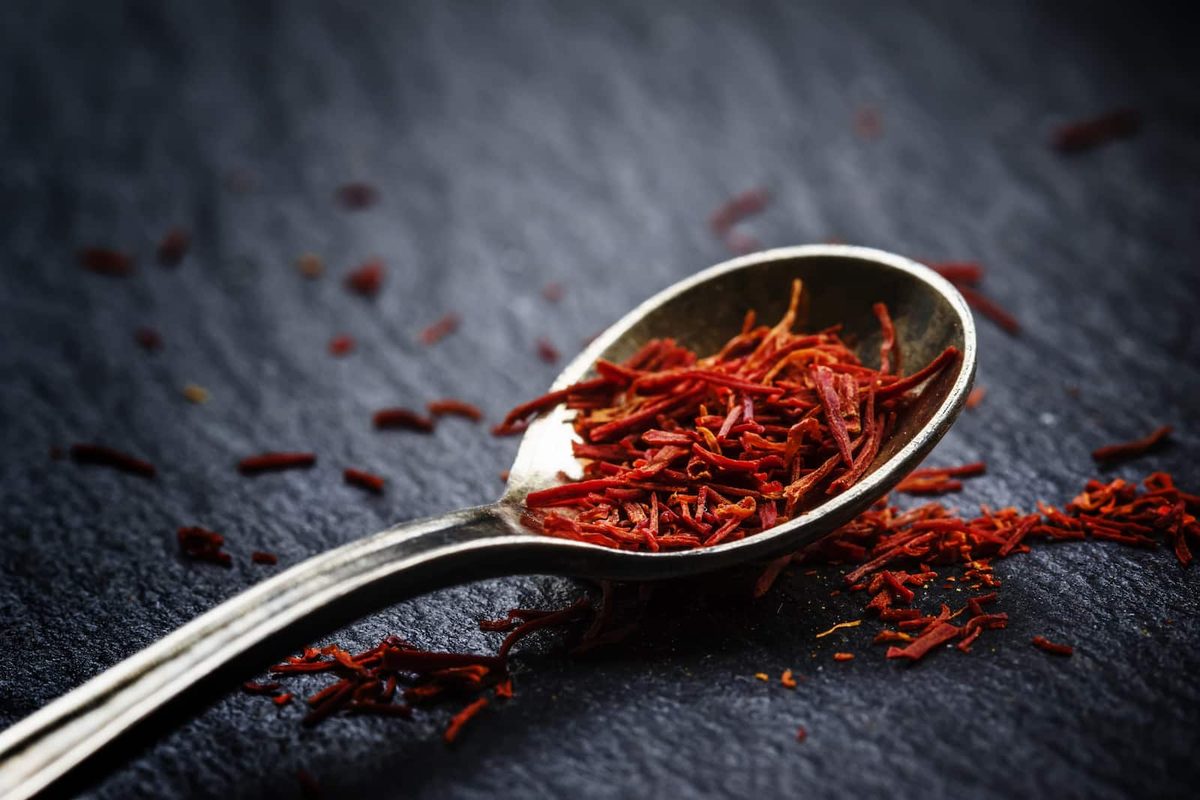
Saffron is the dried stigma of a crocus flower, and Encyclopaedia Britannica still calls it the most expensive spice in the world.1 What you are protecting is its color (the pigment crocin), its bitterness and its aroma.1 The one storage study we could find that measured all three points to the same rules: keep saffron dry, dark and cool, in a closed container.2 Beyond that, most of the storage advice that circulates, including shelf-life figures, cannot be traced to a source.
At a glance
| Question | Short answer |
|---|---|
| Container | An aluminum tin or a glass container with a tight-fitting lid.3 |
| Where | In the dark, at room temperature, per University of Vermont saffron researchers.3 |
| Humidity | Keep it closed. Saffron left out on a humid day absorbs moisture from the air.3 Damp storage destroyed color fastest in a lab study.2 |
| Temperature | Cooler is better within the range tested (20 to 40°C, or 68 to 104°F).2 |
| Light | Keep it dark. Light sped the loss of crocin in the same study.2 |
| Refrigerator | No source we found tested it. See below. |
| How long | No traceable home shelf-life figure. The study’s own estimates are in the table below. |
What degrades saffron
The clearest evidence comes from a 2008 study from Iran that stored dried saffron for 12 weeks at 20, 30 and 40°C, at three humidity levels, in light and in the dark, in glass containers with airtight lids.2 The authors open with the point that the quality of dried saffron depends heavily on processing and storage conditions.2
- Heat and moisture. Coloring strength fell considerably as temperature and water activity (a measure of how much free moisture the saffron holds) went up.2 In the dark, samples kept at 40°C lost more than half their coloring strength in 12 weeks.2
- Light. Samples stored in light lost more pigment than those kept in the dark, and the authors describe light as a catalyst for crocin breakdown.2
- Bitterness and aroma. Bitterness fell during storage while the aroma reading rose, and the authors tie higher temperatures to more safranal.2 So warm storage does not weaken saffron evenly: color drops while the aroma reading climbs.
The authors’ conclusion is the practical one: dry fresh stigmas as soon as possible, then store them in a dark, cool, dry place.2
How long saffron keeps
Online claims that saffron lasts “two years or more” are common. We could not trace them to any measurement. The only figures we found come from the 2008 study, and they do not agree with each other.
| Figure | Conditions | Source |
|---|---|---|
| 40.9 weeks (dark) / 35.2 weeks (light) | Lowest humidity tested (water activity 0.32) | The study’s shelf-life table2 |
| 4.2 weeks (dark) / 4.6 weeks (light) | Highest humidity tested (water activity 0.75) | Same table2 |
| 31.1 / 16.4 / 7.4 weeks (dark) | 20°C / 30°C / 40°C | Same table2 |
| 23.5 / 11.3 / 6.3 weeks (light) | 20°C / 30°C / 40°C | Same table2 |
| “More than 3 years” | Water activity 0.32, in the dark | The study’s discussion text2 |
The discussion’s three-year figure and the table’s 40.9 weeks describe the same conditions, and the paper does not reconcile them. We have not picked one. The study ran under controlled laboratory conditions with the warmest storage at 40°C, so its weeks are not a forecast for a kitchen drawer. What it does show, consistently, is the direction: drier, cooler and darker storage kept color longer.
Container and place
The University of Vermont’s saffron researchers advise putting dried saffron in an aluminum tin or a glass container with a tight-fitting lid, held in the dark at room temperature.3 They warn that saffron left out in the air on a humid day will absorb moisture.3 That fits the study above, where the dampest storage cut estimated shelf life to about a month.2
Some practical habits follow from that, though no source has tested them: buy amounts you will use, keep the container closed except while you measure, and avoid opening it over a steaming pot. A tinted or opaque container, or a clear one kept in a closed drawer or cupboard, deals with light.
Should you refrigerate or freeze saffron?
We found no study or extension source that tested home refrigeration or freezing of saffron. The study’s coolest condition was 20°C (68°F), which beat 30 and 40°C,2 but that says nothing direct about a refrigerator, where the risk is moisture rather than heat. A common claim is that refrigerated saffron picks up condensation when it comes out. No source we found tests that for saffron, though the University of Vermont researchers do tell growers to let freshly dried stigmas cool completely before packing, to prevent condensation.3
Our suggestion, which is judgment rather than a tested rule: a sealed container in a dark cupboard away from the stove is enough. If you do keep saffron cold, let the closed container come to room temperature before you open it.
Drying fresh saffron
If you grow saffron, the stigmas must be dried before storage. The Vermont researchers say they need to lose more than 80% of their water to give high-quality saffron.3 In their trials, saffron dried at room temperature was of significantly lower quality, and they tested three oven regimes instead: about 100°C (210°F) for 7 to 10 minutes, about 77°C (170°F) for 25 minutes, and about 55°C (130°F) for 60 minutes.3 They note that many kitchen ovens cannot be set low enough, suggest propping the door open, and recommend an oven thermometer.3 Saffron that is not dried enough may mold in its container.3
A common home method dries the threads between paper towels in a warm room for about a week. We found no source for it, and the Vermont results on room-temperature drying argue against it.
Harvest timing. It is often said that saffron’s sensitivity to light dictates when the flowers are picked. The Vermont harvesting guide does recommend picking in the morning, but gives two reasons: harvesters prefer to finish before it gets hot, and sun exposure may degrade the flower and its stigmas.4 It advises separating the stigmas as soon after picking as possible, and if processing must wait, spreading the flowers on a paper towel on a tray in the refrigerator.4
Resting. The same researchers mention a report that saffron is best used a month after drying, and say plainly that this has not been confirmed scientifically.3
How to tell saffron has faded
Color is the quality the study saw fall most clearly in storage,2 so look at it: threads that have turned from deep red toward brick or brown are past their best. Steeping a few threads in warm water and comparing the color with a fresh batch is a simple check. Both tests are kitchen judgment, not published methods. Faded saffron simply does less; you will need more of it for the same color. If you overdo it, see too much saffron.
Not yet measured
- A home shelf-life figure for saffron in a closed jar at room temperature.
- Whether refrigeration or freezing helps or harms saffron at home.
- The storage recommendations in the international saffron standard (ISO 3632-1), which we could not read for this review.
- Whether powdered saffron fades faster than threads. We found no study comparing them.
Related
- Saffron and why saffron is so expensive
- Cooking with saffron and saffron uses
- Saffron substitutes, saffron vs. turmeric and safflower vs. saffron
- Do spices go bad? and containers for spices
- How to store nutmeg
Footnotes
-
“Saffron”, Encyclopaedia Britannica. britannica.com · Reference work ↩ ↩2
-
Bolandi et al., “Shelf-life determination of saffron stigma: water activity and temperature studies”, World Applied Sciences Journal, 2008. idosi.org · Peer-reviewed ↩ ↩2 ↩3 ↩4 ↩5 ↩6 ↩7 ↩8 ↩9 ↩10 ↩11 ↩12 ↩13 ↩14 ↩15 ↩16 ↩17 ↩18 ↩19
-
Ghalehgolabbehbahani et al., “Saffron Drying Methods”, University of Vermont, 2021. uvm.edu · Reference work ↩ ↩2 ↩3 ↩4 ↩5 ↩6 ↩7 ↩8 ↩9 ↩10 ↩11
-
Skinner, Ghalehgolabbehbahani and Parker, “Harvesting Saffron Flowers”, University of Vermont, 2021. uvm.edu · Reference work ↩ ↩2