Spice Comparisons · Comparison
Hulled vs. Unhulled Sesame Seeds: Calcium, Bitterness and When the Hull Matters
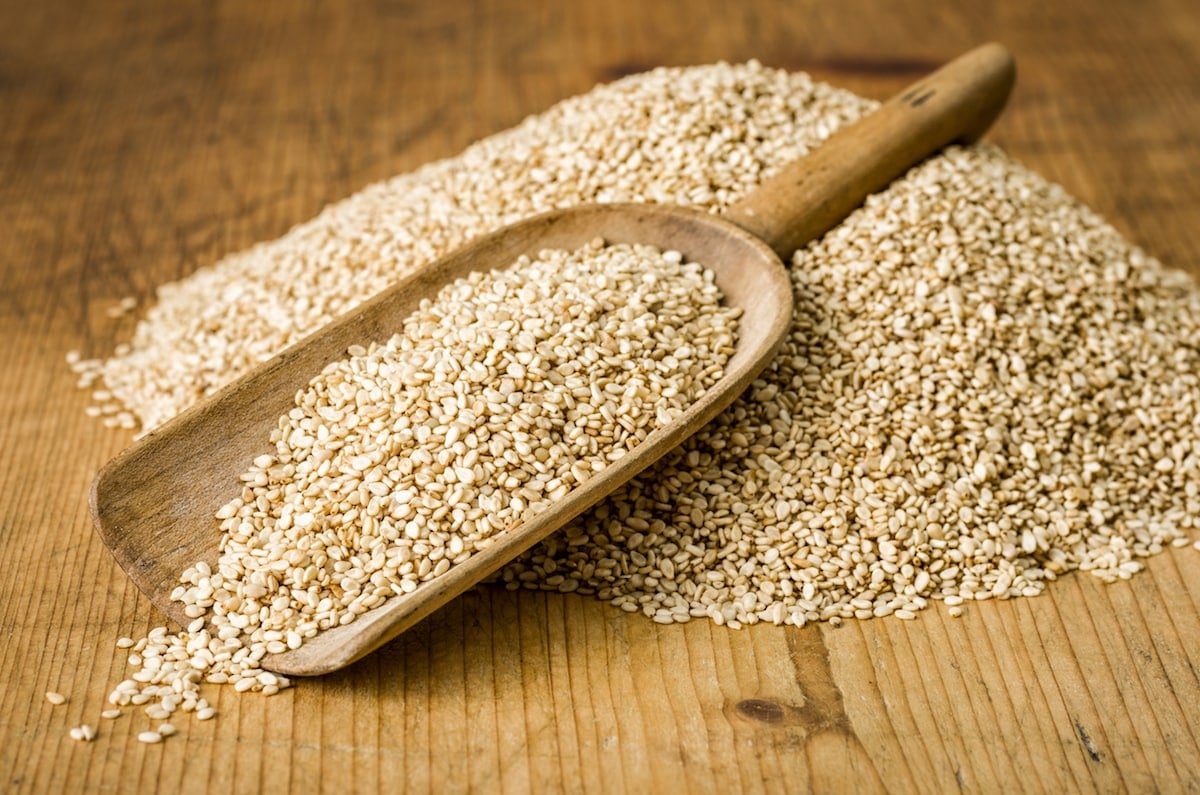
Hulled and unhulled sesame are the same seed of Sesamum indicum, with and without its outer coat.12 Taking the coat off removes most of the calcium (USDA lists 989 mg per 100 g for whole toasted seed against 131 mg for hulled toasted kernels) and, according to food-processing researchers, the oxalates and bitterness that sit in the hull.345 In the kitchen, hulled seed is paler and milder, and unhulled seed is a little more bitter and crunchy, and keeps the coat’s color.
Side by side
| Unhulled (whole) sesame | Hulled sesame (kernels) | |
|---|---|---|
| Species | Sesamum indicum, family Pedaliaceae1 | Same seed, coat removed1 |
| What is removed | Nothing; the seed coat stays on | The hull (seed coat), by soaking and rubbing or by industrial methods56 |
| Color | Set by the cultivar’s seed coat: white, gray, yellow-white, brown or black2 | Pale kernel |
| Calcium, toasted, per 100 g (USDA) | 989 mg3 | 131 mg4 |
| Total dietary fiber, toasted, per 100 g (USDA) | 14.0 g3 | 16.9 g4 |
| Iron, toasted, per 100 g (USDA) | 14.8 mg3 | 7.78 mg4 |
| Oxalate | Found mainly in the hull56 | Dehulling removes the hull’s oxalates5 |
| Taste (editorial, consistent with the sources below) | Nutty with a slightly bitter edge | Milder and sweeter; dehulled sesame flour is described as free of bitterness5 |
| Typical uses (editorial) | Where color, crunch or a stronger taste is wanted | Breads, buns, sweets and pale pastes |
| Price | No dated, sourced comparison found | No dated, sourced comparison found |
The USDA figures are SR Legacy entries for whole roasted and toasted seed and for toasted, hulled (“decorticated”) kernels.34 Neither entry states seed color or origin, so they describe the categories, not any particular bag.
Color is the cultivar, not the hull
A common rule of thumb says unhulled seeds are brown and hulled seeds are white. That only works for some seed. PROSEA lists seed color (white, gray, yellow-white, brown or black) as a trait that distinguishes sesame cultivars,2 and a 2022 study found that black seeds get their color from a melanin-like pigment in the seed coat.7 So an unhulled seed can be white, brown or black, depending on the plant. Hulling removes whatever color the coat had. For the black-and-white question, see black vs. white sesame seeds.
What hulling changes
Calcium and minerals
Calcium is the big difference. In USDA’s toasted entries, whole seed has 989 mg per 100 g and hulled kernels 131 mg, about seven and a half times as much in the whole seed (our arithmetic).34 Per ounce (28.35 g, USDA’s portion), that works out to roughly 280 mg against 37 mg (our arithmetic).34 Iron and copper are also higher in the whole toasted seed (14.8 mg and 2.47 mg per 100 g) than in the kernels (7.78 mg and 1.46 mg).34
How much of that calcium the body absorbs is a separate question. PROSEA notes that the seed is rich in phytic and oxalic acid, which bind calcium.2 We found no study that measures calcium absorption from hulled versus whole sesame.
Fiber: the sources point in different directions
| Scope | Unhulled | Hulled | Source |
|---|---|---|---|
| Total dietary fiber, toasted seed, per 100 g | 14.0 g | 16.9 g | USDA34 |
| Crude fiber in the cake left after oil extraction | 5 to 6% | about 3% | PROSEA2 |
| Dehulled sesame flour | described as low in fiber | Moharram et al.5 |
These measure different things: total dietary fiber in eating seed, crude fiber in pressed oilseed cake, and a general description of flour. They should not be read as one answer. On USDA’s figures, a cook eating toasted seed does not lose fiber by choosing hulled kernels.
B vitamins and vitamin E
USDA’s toasted kernels list more thiamin (1.20 mg vs. 0.803 mg per 100 g), riboflavin (0.466 vs. 0.251 mg) and niacin (5.44 vs. 4.58 mg) than the whole toasted seed.34 The kernel entry gives 0.25 mg of vitamin E (alpha-tocopherol) per 100 g; the whole toasted entry gives no vitamin E figure, so the two cannot be compared on it.34
Oxalates and bitterness
Researchers who studied industrial dehulling describe it as important because it “eliminates oxalates in the hull,” and describe dehulled sesame flour as white and free of bitterness.5 A 2014 Nigerian study likewise says phytate and oxalate are usually found in the seed hulls.6 PROSEA links sesame’s slight bitterness to its phytic and oxalic acids binding calcium.2 Together, those sources support the kitchen observation that unhulled seed tastes a little more bitter. None of them measures oxalate in retail hulled and unhulled seed side by side, so we have no figure for how much hulling removes.
If you have been told to limit oxalate, hulled sesame is the lower-oxalate choice by these sources’ description, but ask your clinician or dietitian how much sesame of either kind fits your plan; we found no figure to give you.
Oil and processing
PROSEA says most sesame is processed with the seed coats on, although hulled seed produces higher-quality oil and meal.2 Dehulling is fiddly: Moharram and colleagues describe the traditional method of soaking seeds and separating hulls in brine, which needs a lot of water and loses about 19 percent of the seed.5
Health claims
Sesame is often said to protect the heart. A 2016 systematic review and meta-analysis of controlled trials found that sesame lowered blood triglycerides, an effect that came from sesame oil rather than seeds, and that it did not significantly change total cholesterol.8 Nothing in the evidence we found shows that one form of seed is healthier than the other. Sesame in any form is one of the nine major food allergens in the United States, which must be declared on packaged foods.9
Can one stand in for the other?
Yes. They are the same seed, so this is not a flavor substitution in the usual sense, and no source publishes a ratio.
- Ratio (Method): 1 to 1 by volume, either way. No published ratio exists. What changes is how the dish looks and, slightly, how it tastes.
- Hulled for unhulled. Expect a milder, paler result. Toasting the kernels first helps; Katzer notes that much of toasted sesame’s flavor comes from compounds that form only during toasting.10 Using a little more, or toasting a little darker, is our suggestion to make up the difference, not a tested rule.
- Unhulled for hulled. Expect a slightly bitter edge, more crunch and the color of the coat. In a pale paste or a delicate dessert this shows; on a bread crust or in a savory dish it usually does not (editorial).
For other options when you have no sesame at all, see sesame seed substitutes.
When to use which
These are kitchen judgments, not sourced rules:
- Hulled: hamburger buns, rolls and bagels, cookies and brittle, and pale homemade pastes, where a clean look and mild taste help.
- Unhulled: savory toppings, seed mixes and coatings where the coat’s color, crunch and slightly stronger taste are welcome, and whenever the calcium matters to you.34
What isn’t known
- No measurement of oxalate in retail hulled versus unhulled sesame was found; the sources say oxalates are concentrated in the hull but do not give a figure for how much hulling removes.56
- No study of calcium absorption from hulled versus whole sesame was found.
- No sensory study comparing hulled and unhulled seed was found.
- USDA’s whole toasted entry gives no vitamin E figure.3
- No dated price comparison was found.
Related
- Sesame seeds and black sesame seeds
- Black vs. white sesame seeds
- Sesame seed substitutes and poppy seeds
- Gomasio, furikake and everything bagel seasoning
Footnotes
-
Sesamum indicum L., Plants of the World Online, Royal Botanic Gardens, Kew. powo.science.kew.org · Reference work ↩ ↩2 ↩3
-
Weiss and de la Cruz, Sesamum orientale, Plant Resources of South-East Asia (PROSEA), via Pl@ntUse. uses.plantnet-project.org · Reference work ↩ ↩2 ↩3 ↩4 ↩5 ↩6 ↩7
-
Seeds, sesame seeds, whole, roasted and toasted (FDC ID 170151), USDA FoodData Central. fdc.nal.usda.gov · Regulator ↩ ↩2 ↩3 ↩4 ↩5 ↩6 ↩7 ↩8 ↩9 ↩10 ↩11 ↩12 ↩13
-
Seeds, sesame seed kernels, toasted, without salt added (decorticated) (FDC ID 170152), USDA FoodData Central. fdc.nal.usda.gov · Regulator ↩ ↩2 ↩3 ↩4 ↩5 ↩6 ↩7 ↩8 ↩9 ↩10 ↩11 ↩12
-
Moharram, Osman and Abou-El-Khier, article on chemical dehulling of sesame seeds, United Nations University archive. archive.unu.edu · Publication ↩ ↩2 ↩3 ↩4 ↩5 ↩6 ↩7 ↩8 ↩9
-
Makinde and Akinoso, “Comparison between the nutritional quality of flour obtained from raw, roasted and fermented sesame”, Acta Scientiarum Polonorum Technologia Alimentaria, 2014. food.actapol.net · Peer-reviewed ↩ ↩2 ↩3 ↩4
-
Dossou et al., “The Dark Pigment in the Sesame (Sesamum indicum L.) Seed Coat”, Frontiers in Nutrition, 2022. frontiersin.org · Peer-reviewed ↩
-
Khalesi et al., “Sesame fractions and lipid profiles: a systematic review and meta-analysis of controlled trials”, 2016. cambridge.org · Peer-reviewed ↩
-
“Food Allergies”, U.S. Food and Drug Administration. fda.gov · Regulator ↩
-
“Sesame (Sesamum indicum)”, Gernot Katzer’s Spice Pages. gernot-katzers-spice-pages.com · Reference work ↩